

SEO Video Marketing: 5 Essential Strategies for Success
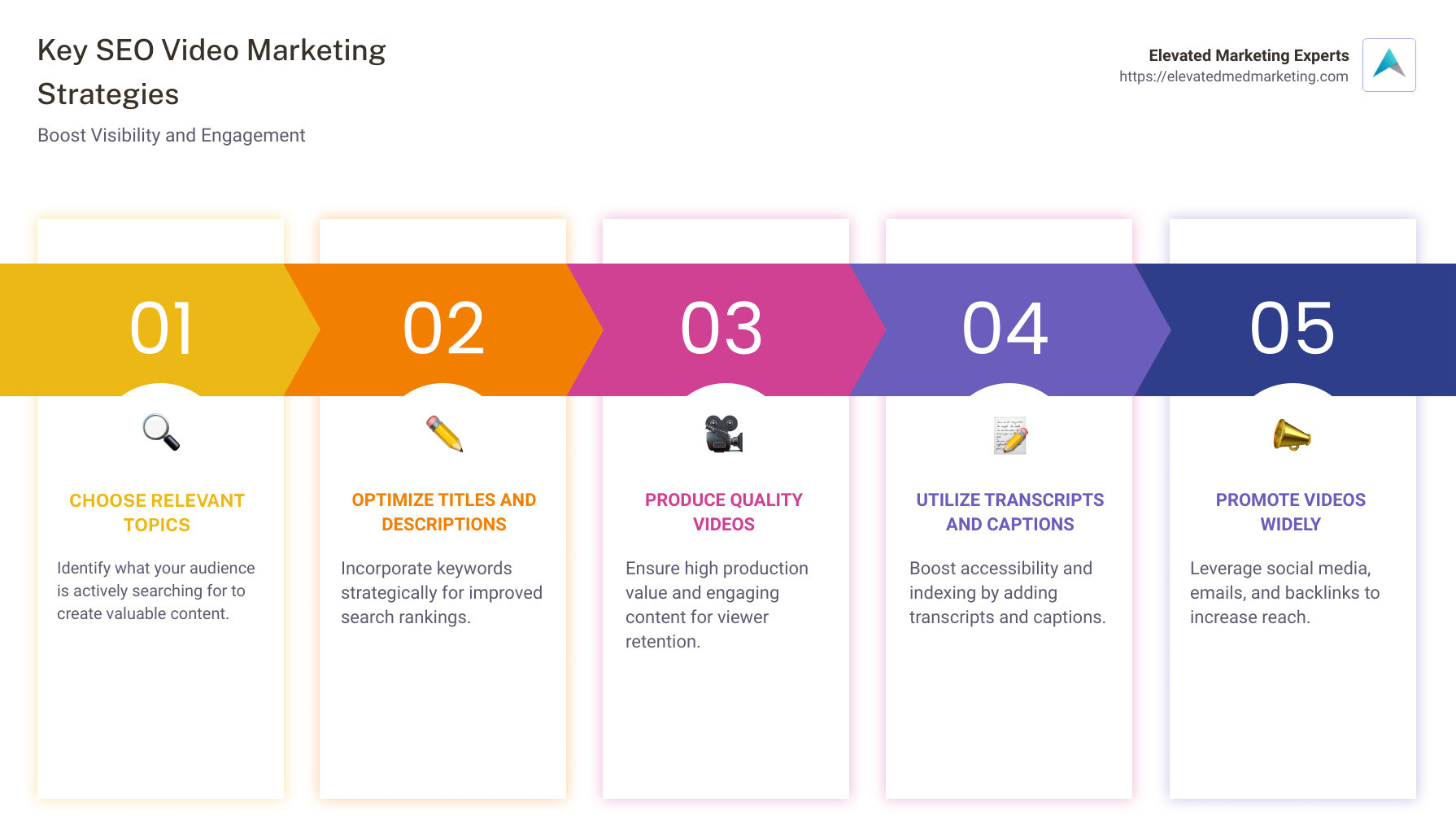
SEO video marketing is a game-changer for any business looking to establish a solid online presence and reach more potential clients. By optimizing your video content for search engines, you increase the visibility of your videos on platforms like Google and YouTube, engaging a wider audience and driving more traffic to your website. Here’s a quick guide to get you started with SEO video marketing:
- Choose relevant topics: Focus on what your audience is searching for.
- Optimize Titles and Descriptions: Use keywords wisely for better rankings.
- Make Quality Videos: Engaging and valuable content is key for retention.
- Use Transcripts and Captions: Improve accessibility and searchability.
- Promote Everywhere: Use social media, emails, and backlinks to spread the word.
Integrating video SEO into your broader marketing strategy is crucial. It not only boosts brand awareness but also improves engagement and conversions, making your practice stand out in the competitive world of aesthetic services.
I’m Joe Amaral. After founding a successful digital marketing company, my passion for SEO video marketing has grown tremendously. I am now on my third startup, helping businesses like yours amplify their reach and optimize their digital presence effectively.
Understanding Video SEO
Video SEO is all about making your video content more visible on search engines like Google and YouTube. The goal is simple: get your videos to show up when people search for topics you’re covering.
Video Content and Search Engines
When it comes to video content, search engines can’t “watch” videos like humans do. Instead, they rely on text-based information to understand and rank videos. This means that elements like titles, descriptions, and transcripts are crucial. They help search engines figure out what your video is about and match it with relevant search queries.
For instance, if you create a video reviewing the latest smartphone, you want search engines to know this. By using keywords like “smartphone review” in your title and description, you signal to search engines what the video covers.
Key Ranking Factors
Several factors influence how well your videos rank in search results:
Relevance: Your video’s content should match the searcher’s intent. This is why keyword research is vital. Tools like Semrush’s Keyword Magic Tool can help you find what people are searching for.
Engagement: Videos that keep viewers watching tend to rank better. This is because search engines see high engagement as a sign of quality content.
Metadata: Optimizing your video’s title, description, and tags with relevant keywords can significantly impact your rankings.
Backlinks: Getting links from other websites pointing to your video can boost its visibility. Google sees these links as endorsements of your content’s quality and relevance.
The Role of Search Engines
Search engines are constantly evolving. Google’s algorithms, for instance, prioritize user experience and relevant content. This means that simply stuffing keywords won’t cut it. Instead, focus on creating valuable and engaging content that meets your audience’s needs.
YouTube, being the second largest search engine, also has its own ranking factors. Videos with high watch time, likes, and shares often rank higher. So, encourage your viewers to engage with your content!
In conclusion, understanding how video SEO works is crucial for anyone looking to increase their online presence. By focusing on relevant content, optimizing for search engines, and engaging your audience, you can improve your video’s visibility and reach a wider audience.
Next, we’ll dive into essential strategies to optimize your video titles and descriptions for maximum impact.
5 Essential Video SEO Strategies
Let’s explore the core strategies that can lift your SEO video marketing game. These tactics will help your videos climb the search engine ranks and reach more eyes.
1. Optimize Video Titles and Descriptions
Your video title and description are like a billboard for your content. They need to be clear, engaging, and keyword-rich.
Keywords Matter: Use tools like Semrush’s Keyword Magic Tool to find the right keywords. These are the terms your audience is searching for. Incorporate them naturally into your title and description.
Craft Click-Worthy Titles: Instead of a bland title like “Smartphone Review,” try something more enticing like “Top 5 Features of the New Smartphone You Need to Know!” This not only includes keywords but also sparks curiosity.
Detailed Descriptions: Your description should provide a summary of the video content and include keywords. This helps search engines understand your video’s topic. Plus, it gives viewers a reason to click and watch.
2. Create High-Quality and Engaging Videos
Quality content is king. If your video is engaging, people will watch it longer, signaling to search engines that it’s valuable.
Production Quality: Invest in good lighting, clear audio, and professional editing. A polished video is more likely to be shared and liked.
Engage Your Audience: Create content that resonates with your viewers. Ask questions, include calls to action, and keep the content relevant to their interests.
3. Use Video Transcripts and Captions
Transcripts and captions are not just for accessibility; they’re also SEO gold.
Accessibility: Captions make your videos accessible to a wider audience, including those with hearing impairments.
Indexing: Search engines can’t “watch” your video, but they can read transcripts. This helps them understand the content and rank it appropriately.
4. Leverage Video Thumbnails
A compelling thumbnail can make all the difference in whether someone clicks on your video.
Visual Appeal: Use bright, high-resolution images that are relevant to your content. Thumbnails should stand out in search results and entice users to click.
Consistency: Keep your thumbnails consistent with your brand’s aesthetic. This helps in building brand recognition.
5. Promote and Distribute Your Videos
Creating a great video is just the start. You need to get it in front of people.
Social Media: Share your videos across platforms like Facebook, Twitter, and Instagram. This increases visibility and can drive traffic back to your site.
Backlinks: Reach out to industry blogs or websites and ask them to link to your video. Backlinks are like votes of confidence in the eyes of search engines.
Email Campaigns: Include videos in your newsletters. This not only engages your audience but also encourages sharing.
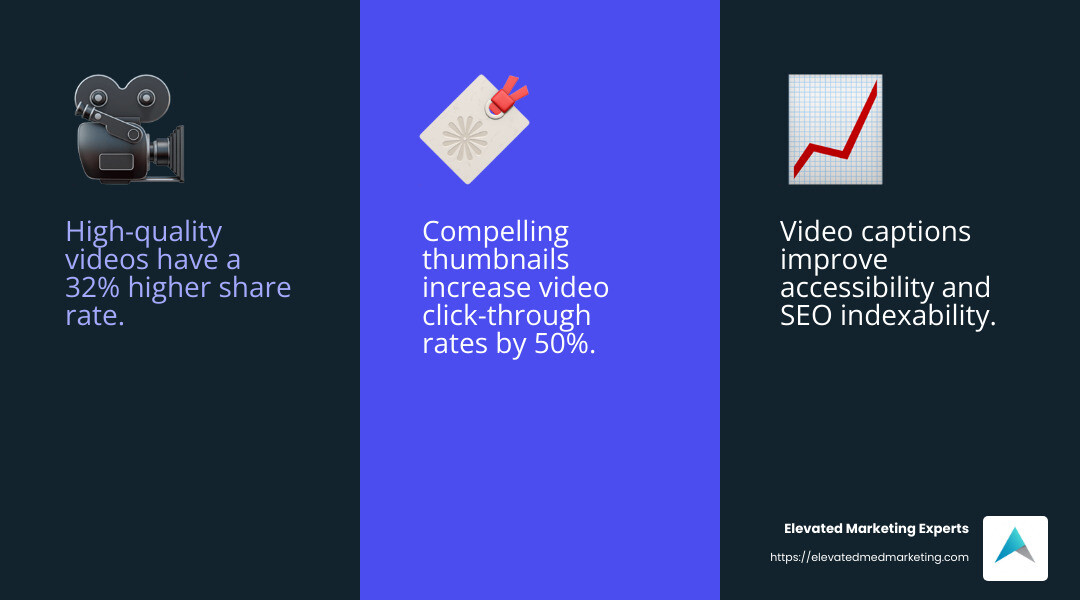
By implementing these strategies, you’re setting your videos up for success. Each tactic plays a crucial role in how search engines perceive and rank your content. Next, we’ll explore some advanced techniques to further improve your video SEO efforts.
1. Optimize Video Titles and Descriptions
Your video title and description are like a billboard for your content. They need to be clear, engaging, and keyword-rich.
Keywords Matter: Use tools like Semrush’s Keyword Magic Tool to find the right keywords. These are the terms your audience is searching for. Incorporate them naturally into your title and description.
Craft Click-Worthy Titles: Instead of a bland title like “Smartphone Review,” try something more enticing like “Top 5 Features of the New Smartphone You Need to Know!” This not only includes keywords but also sparks curiosity.
Detailed Descriptions: Your description should provide a summary of the video content and include keywords. This helps search engines understand your video’s topic. Plus, it gives viewers a reason to click and watch.
Keywords Matter
Choosing the right keywords is essential for your video to be finded. Keywords are the terms your audience is searching for. Use tools like Semrush’s Keyword Magic Tool to identify these terms. Incorporate them naturally into your title and description to help search engines understand your video’s topic.
Craft Click-Worthy Titles
Your title is the first thing potential viewers see. Make it enticing! Instead of a bland title like “Smartphone Review,” try something more engaging like “Top 5 Features of the New Smartphone You Need to Know!” This approach not only includes keywords but also sparks curiosity, increasing your click-through rate (CTR).
Detailed Descriptions
Your description should not only summarize the video content but also include relevant keywords. This helps search engines understand what your video is about. A well-crafted description can also give viewers additional reasons to click and watch. Include a hook in the first sentence to grab attention, and don’t forget to add links to your website or social media for further engagement.
By optimizing your video titles and descriptions, you’re setting a solid foundation for your SEO video marketing strategy. These elements play a crucial role in how search engines perceive and rank your content. Next, we’ll explore how to create high-quality and engaging videos that keep viewers coming back for more.
2. Create High-Quality and Engaging Videos
Creating high-quality videos is crucial for successful SEO video marketing. Here’s how to ensure your videos not only look great but also keep viewers engaged and coming back for more.
Production Quality
Think of production quality as the first impression your video makes. It’s not just about having the latest camera or software; it’s about how you use them. Good lighting, clear audio, and smooth editing are essential. They make your video look professional and help retain viewers.
Consider this: Would you sit through a video with poor sound or shaky visuals? Probably not. Neither will your audience.
User Experience
User experience (UX) in videos is about making sure viewers enjoy watching your content. This means having a clear structure, engaging visuals, and a captivating story.
Start Strong: Hook viewers in the first 15-20 seconds. Tell them what to expect and why they should keep watching.
Add Value: Educate, entertain, or inspire your audience. Give them a reason to stay until the end.
Keep It Simple: Avoid jargon and keep your language easy to understand. You’re speaking to a broad audience.
Viewer Retention
Viewer retention is key to your video’s success. The longer people watch, the better your video performs in search rankings.
Engage Throughout: Use engaging visuals and dynamic cuts to keep viewers interested.
Include Interactive Elements: Add questions, polls, or prompts to encourage viewer interaction.
Call to Action: Encourage viewers to like, comment, or subscribe at the end of your video.

By focusing on production quality, user experience, and viewer retention, you can create videos that not only attract viewers but keep them engaged. This is a vital part of your SEO video marketing strategy. Next, we’ll discuss how using video transcripts and captions can improve your video’s accessibility and searchability.
3. Use Video Transcripts and Captions
Incorporating video transcripts and captions is a game-changer for SEO video marketing. Not only do they make your content more accessible, but they also help search engines understand and index your videos better.
Accessibility
Transcripts and captions make your videos accessible to a wider audience, including those who are Deaf or hard of hearing. This is crucial because accessibility isn’t just about compliance; it’s about inclusivity and user experience.
Consider this stat: 70% of Gen Z regularly use subtitles because they often watch videos in noisy environments or without sound. By adding captions, you’re catering to this large audience segment and potentially increasing your viewer base.
Indexing
Search engines can’t watch videos like humans do. They rely on text data to understand and index content. Transcripts serve as this text data, providing a detailed account of your video’s audio content. By including transcripts, you give search engines the context they need to rank your videos accurately.
Think of transcripts as the bridge between your video and search engine bots. They expose keywords naturally embedded in your video’s dialogue, making it easier for search engines to find and categorize your content.
Search Bots
When you use transcripts and captions, you’re essentially giving search bots a script to follow. This helps in improving your video’s searchability. Captions, in particular, can improve user experience, leading to better engagement metrics, which search engines love.
A Facebook study revealed that captioned videos get 12% more views than those without captions. This boost in views can positively impact your video’s search rankings, making it more visible to a broader audience.
By leveraging transcripts and captions, you not only improve accessibility but also improve your video’s chances of being finded by search engines. This is a critical step in optimizing your videos for SEO success. Next, we’ll explore the power of leveraging video thumbnails to improve engagement and clickability.
4. Leverage Video Thumbnails
When it comes to SEO video marketing, video thumbnails are more than just a pretty picture. They are a vital component in attracting viewers and boosting engagement.
Clickability
Think of thumbnails as the cover of a book. It’s the first thing viewers see, and it can make or break their decision to click. A compelling thumbnail can significantly increase your video’s click-through rate (CTR).
Consider this: According to Wistia, videos with custom human thumbnails receive a 30% higher play rate than those without. This means the right thumbnail can make your content stand out and draw in more viewers.
Visual Appeal
Creating visually appealing thumbnails is an art. They should be high-quality, relevant, and engaging. Use vibrant colors, clear images, and bold text to catch the eye. It’s also a good idea to include a human element, as people tend to connect more with faces.
For instance, if you’re a travel vlogger, a thumbnail showing you in a stunning location can be more enticing than generic scenery. Similarly, tech reviewers like Marques Brownlee often use close-up shots of gadgets to intrigue potential viewers.
Engagement
Engagement is crucial for video success, and thumbnails play a significant role in this. An engaging thumbnail encourages viewers to watch, leading to better viewer retention and interaction.
Here’s a fact: Videos with engaging thumbnails are more likely to be shared, liked, and commented on, which boosts engagement metrics. These metrics are crucial for search engines, as they often prioritize content that keeps viewers engaged.
By focusing on creating eye-catching thumbnails, you not only improve your video’s clickability but also improve overall engagement. This, in turn, can lead to higher search rankings and more visibility for your content.
Next, we’ll dig into how promoting and distributing your videos can further amplify their reach and impact.
5. Promote and Distribute Your Videos
Once you’ve optimized your video content and thumbnails, it’s time to promote and distribute your videos effectively. This step is crucial for maximizing reach and engagement.
Social Media
Social media platforms are a powerhouse for video distribution. Platforms like Facebook, Instagram, and TikTok are goldmines for reaching a vast audience. According to HubSpot, short-form videos are the most engaging type of in-feed content.
To get the most out of social media, tailor your video content to suit each platform. For instance, Instagram Reels are perfect for quick, eye-catching clips, while YouTube is ideal for longer, in-depth content. Each platform has its own audience and style, so adapt accordingly.
Backlinks
Backlinks are like digital votes of confidence. They signal to search engines that your content is credible and worth sharing. Building backlinks is a strategic way to boost your video’s SEO performance.
Start by reaching out to industry-related websites, blogs, or influencers who might find your video valuable. Offer them a compelling reason to link to your content. Perhaps your video provides a unique insight or a fresh perspective on a topic they care about.
Tools like Semrush’s Link Building Tool can help you identify potential sites for outreach. A solid backlink strategy can significantly improve your video’s authority and search rankings.
Email Campaigns
Email campaigns are a direct and personalized way to promote your videos. By including videos in your emails, you can increase engagement and click-through rates.
According to a study by Forrester, including video in an email can boost click-through rates by up to 300%. That’s a massive opportunity to drive traffic to your video content.
Craft engaging emails that highlight the value of your video. Use compelling subject lines and include a clear call to action. Encourage recipients to watch, share, and engage with your content.
By leveraging social media, building backlinks, and utilizing email campaigns, you can effectively distribute your videos and amplify their impact. These strategies not only increase visibility but also improve your overall SEO video marketing efforts.
Next, we’ll explore advanced techniques for video SEO to further optimize your content for search engines.
Advanced Techniques for Video SEO
Once you’ve nailed the basics of SEO video marketing, it’s time to dive into advanced techniques that can give your videos an extra edge in search results. These methods involve some technical aspects, but don’t worry—I’ll break them down into simple steps.
Schema Markup
Schema markup is like giving search engines a roadmap to your content. It’s a type of code that helps search engines understand the context of your videos. By using schema markup, you can improve how your videos appear in search results, potentially leading to rich snippets that include thumbnails, titles, and more.
For videos, you’ll want to use the VideoObject schema. Here’s a basic example:
“`html
“`
This code provides search engines with essential details about your video, enhancing its visibility in search results.
Video Sitemaps
A video sitemap is a file you create to tell search engines about the videos on your website. It acts like a guide, helping search engines find and index your video content more efficiently.
Creating a video sitemap involves listing each video’s URL, title, description, and other relevant metadata. This is especially useful if you host your videos on your own site rather than platforms like YouTube.
Here’s a simple structure for a video sitemap:
xml
 <urlset xmlns="http://www.sitemaps.org/schemas/sitemap/0.9"
 xmlns:video="http://www.google.com/schemas/sitemap-video/1.1">
 <url>
 <loc>https://yourwebsite.com/videos/video1.html</loc>
 <video:video>
 <video:title>Video Title</video:title>
 <video:description>Video Description</video:description>
 <video:thumbnail_loc>https://yourwebsite.com/thumbnail.jpg</video:thumbnail_loc>
 <video:content_loc>https://yourwebsite.com/videos/video1.mp4</video:content_loc>
 <video:publication_date>2024-01-13T00:00:00Z</video:publication_date>
 </video:video>
 </url>
 </urlset>
Once you’ve created your video sitemap, submit it through Google Search Console to ensure your videos are indexed.
JSON-LD
JSON-LD (JavaScript Object Notation for Linked Data) is a lightweight method for structuring data. It’s particularly effective for embedding schema markup directly into your HTML.
Using JSON-LD can make it easier for search engines to process your video data. It’s considered more efficient than other formats because it doesn’t require altering the HTML structure of your page.
Phil Nottingham, a video SEO expert, suggests that platforms like Wistia automatically insert SEO metadata using JSON-LD, which can boost your chances of being indexed. This is a valuable feature if you’re focused on driving traffic to your own site rather than just gaining views on platforms like YouTube.
By implementing these advanced techniques—schema markup, video sitemaps, and JSON-LD—you can significantly improve your video’s searchability and visibility. These strategies ensure that search engines understand your content, leading to better rankings and more traffic.
Next, we’ll tackle frequently asked questions about SEO video marketing to address common concerns and provide you with practical solutions.
Frequently Asked Questions about SEO Video Marketing
What is SEO in video marketing?
SEO in video marketing is all about making your videos more findable and attractive to search engines like Google and YouTube. Think of it as giving your video the best chance to be found when someone searches for a topic it covers. This involves optimizing various elements of your video content to improve its searchability and visibility.
When you optimize your video, you’re adjusting aspects like the title, description, and tags to include relevant keywords. This helps search engines understand what your video is about and match it with user queries. For example, if your video is about “dog training tips,” using these keywords strategically can help it rank higher when someone searches for that topic.

How do I add SEO to my video?
To add SEO to your video, start by focusing on these key areas:
Keywords: Research and use keywords that your target audience is searching for. Tools like the Semrush Keyword Magic Tool can help you find popular search terms related to your video content. Place these keywords naturally in your video title, description, and tags.
Video Placement: Host your videos on platforms like YouTube, which is the second-largest search engine. This increases your chances of being found. Also, consider embedding your videos on relevant webpages to drive traffic to your site.
Mobile Optimization: Ensure your videos are mobile-friendly, as a significant portion of video content is consumed on mobile devices. This includes having responsive video players and ensuring fast load times.
Transcripts and Captions: Adding transcripts and captions not only improves accessibility but also aids in indexing by search bots. This can improve your video’s search rankings.
Are videos good for SEO?
Absolutely, videos are good for SEO. They can significantly boost user engagement, which is a key factor in search rankings. Videos can keep visitors on your site longer, reducing bounce rates and signaling to search engines that your content is valuable.
Moreover, videos are highly shareable, increasing the potential for backlinks. More backlinks can improve your site’s authority, further boosting your search rankings. According to a 2023 survey by Wyzowl, 90% of marketers acknowledged video’s role in generating leads, and 87% said it was effective at boosting sales.
In summary, incorporating video into your SEO strategy can lead to higher search rankings, more traffic, and increased visibility for your brand. Next, we’ll explore how to effectively implement these strategies to maximize your video’s impact.
Conclusion
In the changing digital landscape, video content has emerged as a powerful tool for enhancing SEO and boosting online visibility. At Liftd Marketing Experts, we understand the unique needs of aesthetic practices and strive to help them harness the full potential of SEO video marketing.
As a full-service digital marketing agency, we specialize in providing custom marketing solutions that cater to the specific demands of plastic surgeons and medical spas. Our expertise in the aesthetic and wellness industry sets us apart, ensuring that our strategies are not only effective but also aligned with the goals of our clients.
By implementing video content as part of your digital marketing strategy, you can significantly improve your website’s ranking on search engines. Videos offer a dynamic way to engage with your audience, providing them with valuable information that keeps them on your site longer. This increased engagement signals to search engines that your content is relevant and valuable, which can lead to higher rankings.
Moreover, videos are highly shareable, creating opportunities for backlinks and further enhancing your site’s authority. By leveraging platforms like YouTube and embedding videos on your site, you can drive more traffic and improve your search visibility.
At Liftd Marketing Experts, we offer comprehensive SEO content marketing services to help you achieve top rankings and grow your online presence. Our team of experts is dedicated to crafting high-quality content that resonates with your target audience and meets the standards set by search engines.
Incorporating video into your SEO strategy is not just about staying current—it’s about staying ahead. By optimizing your video content for search engines, you can create a lasting impact on your audience and lift your digital presence. Let us help you release the power of video SEO and take your aesthetic practice to new heights.


