

SEO for wellness retreats: 7 Proven Ways to Boost Bookings 2025
Capturing the Growing Wellness Retreat Market with SEO
SEO for wellness retreats is essential for attracting more guests to your transformative experiences in today’s digital-first world. Here’s what you need to know:
- 46% of all Google searches have local intent, making local SEO crucial
- 60%+ of wellness searches happen on mobile devices
- The global wellness industry is projected to reach $7 trillion by 2025
- SEO results typically materialize after six months of consistent effort
- Effective SEO combines on-page optimization, local visibility, and content marketing
In recent years, we’ve witnessed a profound shift in how people approach wellness. The pandemic accelerated interest in mental health retreats, digital detoxes, and transformative experiences. Yet many retreat centers with life-changing programs remain hidden on page four of search results, missing out on the growing demand.
Think of SEO as the digital pathway guiding potential guests to your retreat sanctuary. Without it, you’re essentially hosting a transformative experience in the middle of nowhere with no signposts leading the way.
As Joe Amaral, I’ve helped numerous wellness retreat operators increase their bookings through targeted SEO for wellness retreats strategies, combining my digital marketing expertise with data-driven approaches to connect mindfulness seekers with transformative experiences.
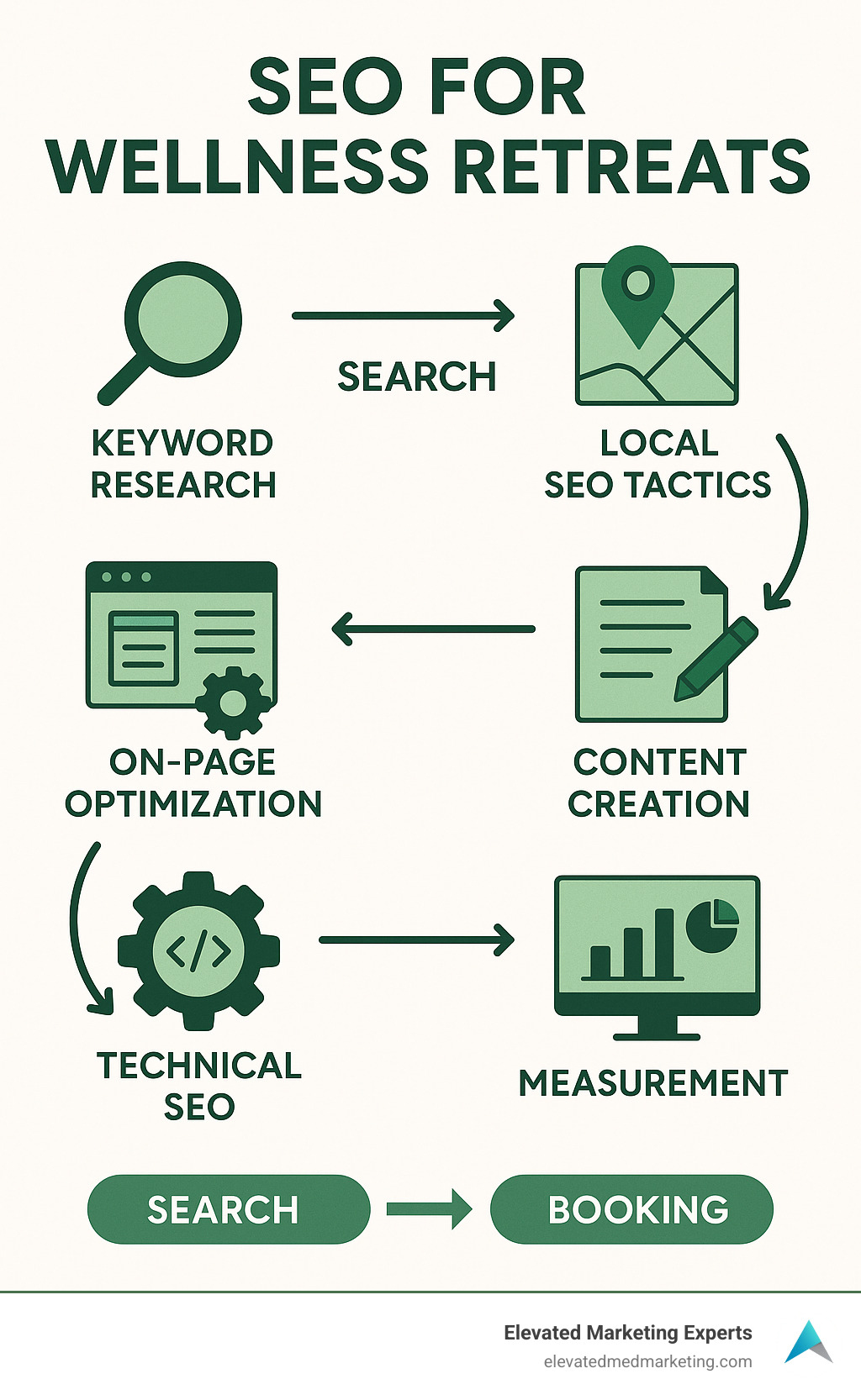
Why SEO Matters for Wellness Retreats
Imagine hosting a life-changing retreat in a breathtaking location… that no one can find. SEO for wellness retreats isn’t just another marketing buzzword—it’s the bridge connecting your transformative experiences with the people who need them most.
Building Trust and Credibility
When someone searches for a wellness retreat, they’re not just looking for a place to stay—they’re seeking an experience that might change their life. Google understands this through its E-E-A-T framework (Experience, Expertise, Authoritativeness, and Trustworthiness), which heavily influences rankings in the wellness space.
Strong SEO for wellness retreats signals to both search engines and potential guests that your retreat center is credible and trustworthy—essential qualities when people are entrusting you with their physical and mental wellbeing.
Sustainable, Long-Term Traffic
Think of paid ads as a sprint and SEO as a marathon. While ads can bring immediate visibility, they disappear the moment you stop paying. Good SEO, on the other hand, builds a foundation that continues bringing interested guests to your website months and even years after implementation.
The six-month ramp-up period for SEO might seem long, but the sustainable traffic it creates becomes a predictable pipeline of potential guests that grows stronger over time.
Cost-Effective Guest Acquisition
With the wellness retreat industry projected to reach $427 billion by 2027, competition for guests is fierce. SEO for wellness retreats allows you to tap into this expanding market without the recurring costs of paid advertising. While the upfront investment in SEO might be similar to advertising, the long-term return makes your guest acquisition costs dramatically lower over time.

Aligning with the Wellness Seeker’s Journey
The beauty of SEO for wellness retreats is how it connects with potential guests at every stage of their decision-making journey:
At the awareness stage, they might search for “benefits of meditation retreats” or “why try a yoga retreat.” During consideration, they look for “best yoga retreats in California” or “affordable wellness retreats.” And when they’re ready to book (decision stage), they search for specific terms like “luxury wellness retreat October booking.”
By creating content that addresses each stage, you naturally guide people toward choosing your retreat when they’re ready.
Wellness Consumer Search Behavior
Understanding how wellness seekers search is fascinating—and crucial for effective retreat marketing. Our research reveals that mental health retreats receive around 4,400 monthly searches globally, while silent retreats attract approximately 5,400 monthly searches.
We’ve also noticed that wellness searches have distinct seasonal patterns. January sees a huge spike (thanks to New Year’s resolutions), and pre-summer months show increased interest as people prepare for vacation season.
Today’s wellness seekers are increasingly specific, too. Rather than generic “wellness vacation” searches, they’re looking for transformative experiences like “vipassana meditation retreat” (1,400 monthly searches) or “ayurvedic detox retreat.”
Perhaps most importantly, scientific research on local intent shows that 46% of all Google searches have local intent. For retreat centers, this means optimizing for “near me” searches and location-specific keywords is essential. And with over 60% of wellness-related searches happening on mobile devices, having a mobile-first user experience isn’t just nice to have—it’s absolutely necessary.
Keyword & Content Strategy for SEO for Wellness Retreats
Finding your perfect wellness guests starts with speaking their language. A thoughtful SEO for wellness retreats strategy isn’t about stuffing keywords—it’s about creating a digital path that leads seekers right to your doorstep. Let me show you how to build that path with intention and care.
Finding High-Impact Wellness Keywords
Think of keywords as the stepping stones that guide your ideal guests to you. The perfect keywords balance popularity with achievability—like finding terms that at least 500 people search monthly, but aren’t so competitive that you’ll never rank for them.
I’ve seen many retreat owners transform their bookings by using tools like Ahrefs, Google Keyword Planner, and SEMrush to uncover these hidden gems. Start by exploring your core offerings: “wellness retreat,” “yoga retreat,” or “meditation retreat.” Then get specific with your location: “wellness retreat in Colorado” or “Sedona spiritual retreat.”
Don’t forget to consider what makes your retreat special—are you offering a “women’s wellness weekend” or a “luxury digital detox experience”? These niche modifiers often have less competition but attract more committed guests.
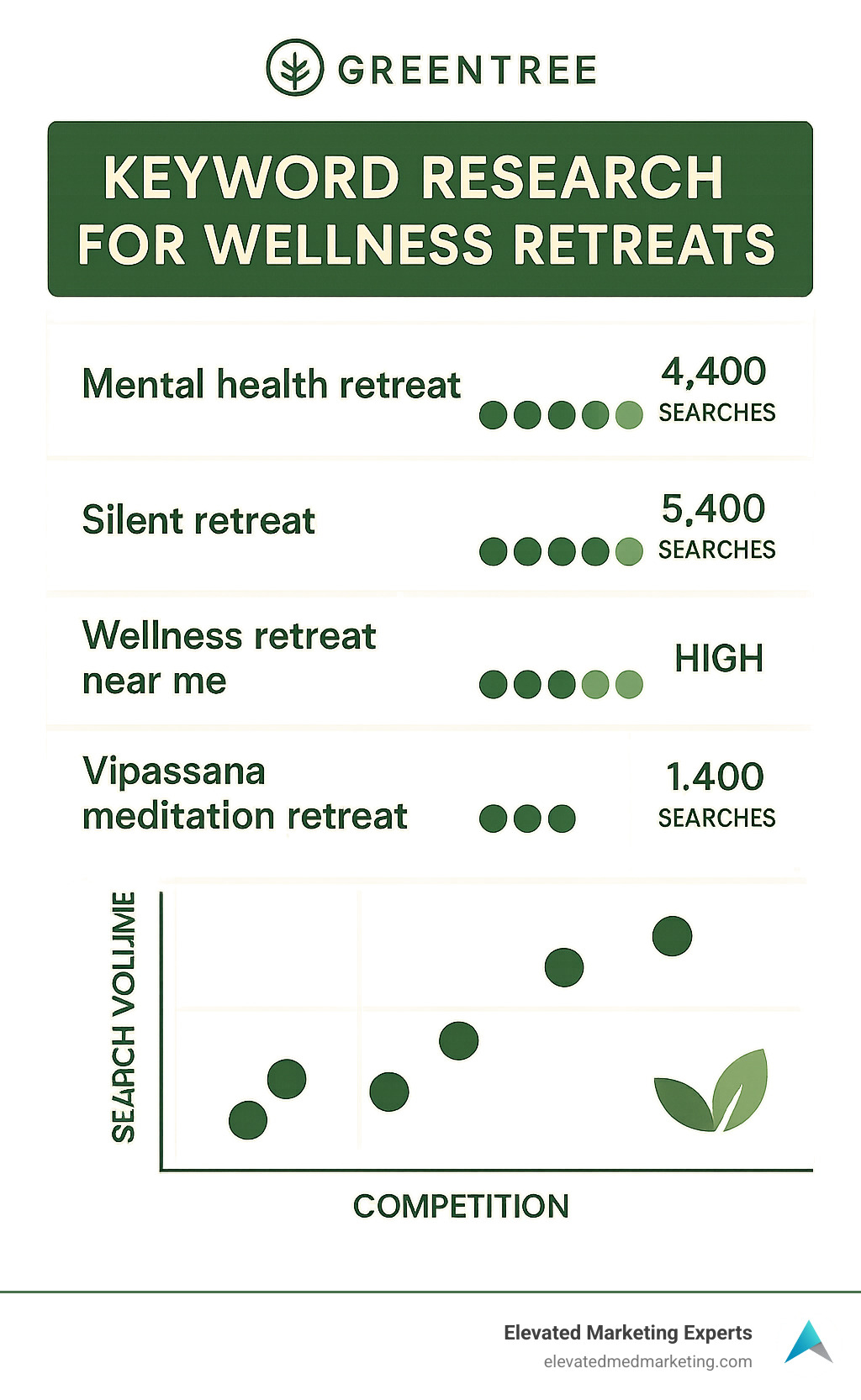
The real magic happens when you understand search intent. Is someone researching general information about retreats, comparing options, or ready to book? Seasonal trends matter too—wellness searches spike in January (hello, resolutions!) and pre-summer months. These insights help you time your content perfectly.
For more in-depth guidance, our Content Marketing and SEO resources can help you build a comprehensive strategy.
Crafting Retreat Descriptions with SEO for Wellness Retreats
Your retreat descriptions should do double duty—they need to please both search engines and human souls. The best descriptions transport readers to your retreat before they’ve even booked.
Start with a clear, keyword-rich title formula: “7-Day Changeal Yoga Retreat in Bali” tells search engines and humans exactly what you offer. Keep your URLs clean and simple (yoursite.com/yoga-retreat-bali), and craft meta descriptions under 160 characters that include your keyword early and a compelling reason to click.
Where many retreat descriptions fall flat is in their sensory language. Instead of saying “4 nights accommodation included,” try “Sink into four nights of restful sleep in our eco-bamboo bungalows, where the only alarm clock is the gentle morning birdsong.” Feel the difference?
Structure matters too. Use headers to break up content, keep paragraphs short, and include all the practical details (dates, pricing, what’s included) that help someone make a decision. And always, always include authentic testimonials—they’re pure gold for both SEO and building trust.
For more guidance on creating websites that convert, check out our Wellness Practice Website Design services.
Leveraging User-Generated Content for SEO for Wellness Retreats
There’s nothing more powerful than letting your guests tell your story. User-generated content creates an authentic, ever-refreshing stream of content that both search engines and potential guests love.
Start by actively collecting and showcasing reviews. Create a simple follow-up system that encourages participants to share their experiences after they return home. These testimonials become powerful content for your site—especially when you implement FAQ schema markup that might land you a coveted featured snippet in search results.
Create a branded hashtag for your retreat and encourage participants to share their changeal moments on social media. Something like #SereneSoulRetreat or #MindfulMountainEscape gives you a collection of authentic content you can (with permission) repurpose on your site.
Some of our most successful clients invite past participants to share their change stories as guest blog posts. These personal narratives not only create fresh content for search engines but also provide the kind of authentic social proof that turns curious browsers into committed bookers.

The most effective SEO for wellness retreats doesn’t feel like SEO at all—it feels like genuine connection. By understanding what your ideal guests are searching for and creating content that speaks to their deepest needs, you create not just visibility but resonance.
Want to learn more about our approach to organic visibility? Explore our Wellness Practice Organic SEO resources for deeper insights.
On-Page and Technical Optimization Essentials
Think of technical SEO as the foundation of your wellness retreat’s digital home. Without a solid foundation, even the most beautiful content won’t attract the visitors you deserve. Here’s how to build that foundation for effective SEO for wellness retreats:
Mobile Optimization
Picture this: a stressed executive scrolls through her phone during a lunch break, searching for “weekend meditation retreat” to escape her burnout. Will your site welcome her or frustrate her?
With over 60% of wellness searches happening on mobile devices, your website must feel like a calming oasis on every screen size. This means embracing responsive design that adapts beautifully to all devices, creating touch-friendly buttons that respond to fingers not mouse clicks, and ensuring your text remains readable without that annoying pinch-to-zoom dance. Most importantly, your booking forms should be as easy to complete on a phone as they are on a desktop.
Site Speed Improvements
We humans are an impatient bunch—especially when seeking wellness! If your site takes more than three seconds to load, potential guests will bounce faster than you can say “namaste.”
To keep your site swift and serene, compress those beautiful retreat images without losing their tranquil quality. Implement browser caching so returning visitors experience even faster load times. Consider it digital hospitality—nobody likes waiting at the door, especially when seeking relaxation.
Technical SEO Foundations
Behind every peaceful retreat experience lies careful planning, and your website is no different. These technical elements aren’t glamorous, but they’re essential:
Secure your site with HTTPS encryption—it’s not just about security, it’s a ranking factor Google loves. Create an XML sitemap that guides search engines through your content like a well-marked trail map. Use your robots.txt file to tell search engines which paths to follow and which to avoid. Add canonical tags to prevent duplicate content issues (like having multiple trails leading to the same viewpoint). And don’t neglect Core Web Vitals—these user experience metrics have become Google’s way of ensuring visitors enjoy their journey through your site.
Schema Markup Implementation
Schema markup is like speaking Google’s native language. It helps search engines truly understand what your content means, not just what it says. For SEO for wellness retreats, implement event schema for your retreat dates (helping them appear in Google’s event carousel), review schema for those glowing testimonials, FAQ schema for common questions, LocalBusiness schema for your retreat center, and organization schema for your brand identity.

Content Hierarchy and Structure
Just as your retreat has a thoughtful flow from morning meditation to evening reflection, your content needs a clear structure that guides both visitors and search engines.
Organize each retreat page with one compelling H1 tag containing your primary keyword. Use H2 tags to separate major sections like “About This Experience,” “Daily Schedule,” and “Accommodations.” Add H3 tags for subsections that provide deeper detail. Don’t forget descriptive alt text for all those inspiring retreat images—they help both accessibility and SEO. Finally, create internal links between related retreats or content, guiding visitors naturally through your offerings just as you would guide them through a transformative retreat experience.
By addressing these technical elements with the same care you put into your retreat programming, you create a digital space that welcomes both search engines and seekers of wellness with open arms.
Local and Off-Page Strategies to Boost Retreat Bookings
Getting found online isn’t just about having a beautiful website—it’s about establishing your retreat’s presence across the entire digital landscape. Let’s explore how local and off-page strategies can dramatically increase your bookings and visibility.
Google Business Profile Optimization
For retreat centers with physical locations, your Google Business Profile is like your digital front door—and many potential guests will peek through it before deciding to visit.
Start by claiming and verifying your listing on Google Business Profile. This simple step immediately boosts your credibility. Then, take time to complete every section thoroughly. This means adding your exact business name, address, and phone number (what we call your “NAP”), selecting the most appropriate category (like “Wellness Retreat Center”), and writing a compelling business description that naturally incorporates your keywords.
Don’t underestimate the power of visual storytelling! Upload high-quality photos showing the tranquil spaces, smiling faces, and transformative experiences that await your guests. These images help searchers envision themselves at your retreat.
Reviews can make or break your local SEO for wellness retreats efforts. Respond thoughtfully to every review—yes, even the less-than-glowing ones. A gracious response to criticism often impresses potential guests more than a perfect rating. Create a simple follow-up system that encourages past participants to share their experiences online.
Remember to keep your information fresh by updating hours, special events, and safety protocols regularly. Google rewards active profiles with better visibility.
NAP Consistency Across the Web
Think of your retreat’s name, address, and phone number as your digital fingerprint—it needs to be identical everywhere it appears online. Even tiny differences like abbreviating “Street” to “St.” can confuse search engines and weaken your rankings.
Audit your listings across Google Business Profile, Yelp, TripAdvisor, Facebook, wellness directories, and your local Chamber of Commerce. Ensuring this consistency sends strong signals to search engines that you’re a legitimate, established business—exactly what they want to recommend to searchers.
Building High-Quality Backlinks
Backlinks are essentially digital votes of confidence from other websites, and they remain one of the most powerful ranking factors for SEO for wellness retreats. Think of them as “digital handshakes” introducing your retreat to new audiences.
Focus on quality over quantity by seeking connections with reputable wellness blogs, travel websites, and lifestyle publications. Guest posting allows you to share your expertise while earning valuable backlinks. When you write about topics like “How Meditation Retreats Reduce Cortisol Levels” or “The Science Behind Forest Bathing,” you’re not just building links—you’re establishing authority in your niche.
Partnerships with wellness influencers can amplify your reach exponentially. When they authentically share their experiences at your retreat, their engaged followers take notice. Similarly, getting listed in respected retreat directories like BookRetreats or Retreat Guru puts your offerings in front of highly motivated potential guests.
Don’t overlook the power of media coverage. A unique program or inspiring founder story can catch the attention of journalists covering wellness trends. Podcast appearances also provide dual benefits—the backlink from the show notes and exposure to an audience already interested in personal growth.
Amplifying Reach with Paid Ads and Social Media
While organic SEO for wellness retreats builds a sustainable foundation, strategic paid advertising can fill your upcoming retreats faster. Google Ads allow you to capture high-intent searches like “book yoga retreat California” or “weekend meditation retreat near me.” Use geo-targeting to focus your budget on locations where your ideal guests live.
Remarketing is particularly powerful for retreats, as the decision to book often involves consideration. Gentle reminders through display ads can bring back visitors who were interested but not quite ready to commit.
On social media, showcase the transformative aspects of your retreats through authentic content. Instagram Reels and Stories are perfect for capturing the energy of a yoga session or the serenity of your meditation spaces. Strategic hashtags like #wellnessjourney or #yogaretreat help your content reach people actively seeking experiences like yours.
Paid and organic strategies work best in harmony—like the balanced approach to wellness you offer your guests. Together, they create a comprehensive SEO for wellness retreats strategy that attracts more of the right people to your transformative experiences.
For more insights on effective digital marketing for wellness practices, explore our Wellness Practice Marketing Solutions or learn about our comprehensive SEO Services List.
Tracking Success & Future-Proofing Your Strategy
Let’s be honest – implementing great SEO for wellness retreats is only half the battle. The other half? Knowing if your efforts are actually working and staying ahead of the curve as search trends evolve. Think of this as tending to your digital garden – you need to regularly check what’s growing, pull some weeds, and adapt to changing seasons.
Setting Up Proper Analytics
Gone are the days of launching your website and hoping for the best. To truly understand your retreat’s digital performance, you need a solid measurement foundation.
Start by configuring Google Analytics 4 with specific conversion goals that matter to your retreat business. When a visitor completes a booking, submits an inquiry form, signs up for your newsletter, or downloads your retreat brochure – these are all meaningful moments worth tracking.
Google Search Console becomes your window into how searchers find and interact with your retreat. I love checking this tool weekly to see which wellness search queries are bringing visitors to my clients’ sites, how click-through rates are trending, and whether any technical issues need attention. It’s like having a direct line to understanding what wellness seekers are looking for.
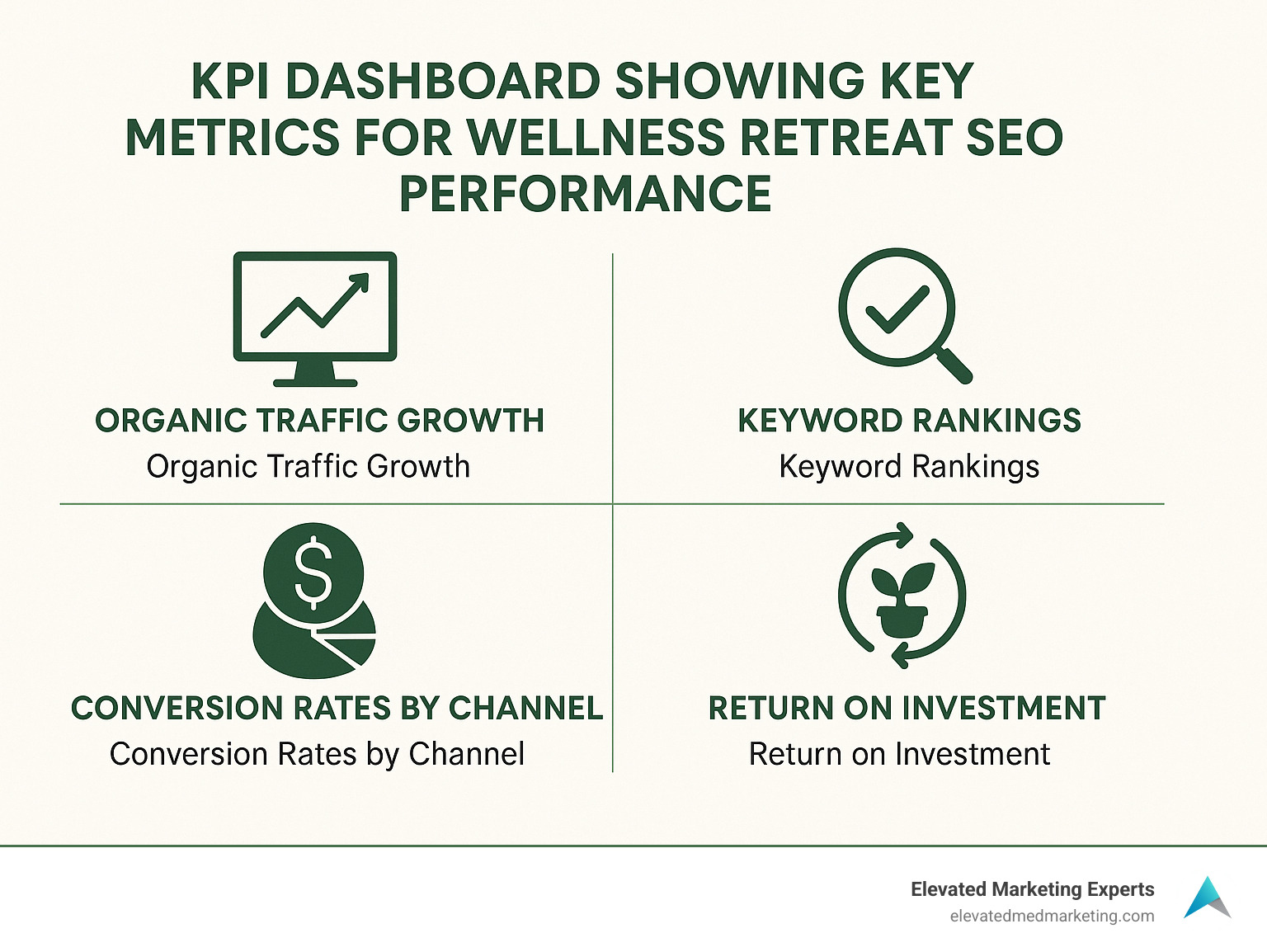
The true power comes when you regularly monitor your key performance indicators with intention. Is your organic traffic growing month over month? Are you climbing in rankings for important retreat keywords? How many site visitors actually convert into retreat bookings? These metrics tell the real story of your SEO for wellness retreats success.
Adapting to Search Evolution
The search landscape isn’t static – it’s constantly shifting beneath our feet. Today’s winning SEO for wellness retreats strategy might need significant adjustments next year.
Voice search is becoming increasingly important as more people ask Alexa or Siri about “yoga retreats near me” rather than typing it. This means crafting content that answers conversational questions naturally. When someone asks “Where can I find a meditation retreat in California?” your content should be positioned to provide that answer.
Google’s algorithm updates can feel like surprise pop quizzes, but they’re actually quite predictable if you focus on what truly matters – creating excellent user experiences. Rather than chasing algorithm changes, build your site with mobile performance, helpful content, and intuitive navigation as priorities.
Emerging technologies like visual search and AI are also reshaping how people find retreat experiences. That stunning photo of your sunrise yoga session? Make sure it has proper alt text and descriptive metadata so visual search engines can understand and surface it to potential guests seeking similar experiences.
Continuous Improvement Cycle
The most successful wellness retreat marketers I’ve worked with accept a rhythm of regular review and refinement:
Monthly, they dive into analytics data to see what’s working and what needs adjustment. This might mean tweaking meta descriptions that aren’t getting clicks or enhancing pages that are already performing well.
Quarterly, they revisit keyword research to identify new opportunities and conduct content gap analysis. Perhaps “forest bathing retreats” is suddenly trending, or “corporate wellness weekends” is gaining traction.
Annually, they step back for a comprehensive SEO audit and strategy revision. This bigger-picture view helps ensure all the tactical adjustments align with long-term goals and market evolution.
This systematic approach ensures your SEO for wellness retreats remains effective even as both search technology and wellness trends continue to evolve. The digital landscape may change, but your ability to connect with those seeking change doesn’t have to.

Frequently Asked Questions about SEO for Wellness Retreats
What timeline should I expect to see results?
When diving into SEO for wellness retreats, it’s important to set realistic expectations. Think of SEO as planting a garden rather than flipping a light switch. Your digital presence needs time to grow and flourish.
In the first 1-3 months, you’ll see behind-the-scenes improvements – better indexing by search engines and improved technical metrics. It’s like preparing the soil before seeing any sprouts.
By months 3-6, you’ll notice your retreat starting to appear in search results for less competitive terms. These early rankings are your first green shoots breaking through.
The real growth happens between 6-12 months, when organic traffic begins flowing more consistently and you’ll see an uptick in retreat inquiries and bookings. This is when your SEO garden starts bearing fruit.
After a year of consistent effort, you’ll have established your retreat’s digital authority, creating a sustainable source of new guests.
Your timeline may vary based on your starting point, local competition, and how consistently you implement your strategy. The beauty of SEO is its cumulative nature – each blog post, optimization, and backlink builds upon previous work, creating compound returns over time.
How does local SEO differ for destination retreats vs. city studios?
The approach to SEO for wellness retreats varies significantly depending on whether you’re running a secluded mountain sanctuary or an urban oasis.
For destination retreats nestled in nature, your strategy should accept the journey. Focus on broader geographic terms that travelers might use when planning a getaway – “yoga retreat Colorado Rockies” or “meditation sanctuary Sedona desert.” Your content should highlight the breathtaking natural setting that makes your retreat special, with rich descriptions that transport readers before they even book. Don’t forget to address practical travel concerns like transportation options and nearby attractions that might improve the retreat experience.
Urban studios offering day or weekend retreats need a different approach. Your potential guests are likely locals seeking convenience, so target hyper-local terms like “weekend wellness retreat Chicago Loop” or “day meditation retreat Manhattan.” Your Google Business Profile becomes absolutely critical – it’s often the first impression for someone searching “wellness retreat near me” on their lunch break. Emphasize your accessibility, nearby parking, and how your retreat offers an escape without the travel time.
Both types of retreats should maintain consistent name, address, and phone number (NAP) information across all online platforms and actively manage reviews. The difference lies in understanding whether your ideal guest is planning a destination journey or seeking a convenient local escape.
Can paid ads replace SEO for wellness retreats?
Thinking about skipping SEO for wellness retreats and just running ads? Consider this analogy: paid ads are like renting a beautiful beachfront property, while SEO is like building your own dream home. One gives immediate access but costs you continuously; the other requires patience but creates lasting value.
When you stop funding ads, your visibility vanishes immediately. Your retreat disappears from search results as if it never existed. In contrast, strong organic rankings continue working for you 24/7, generating inquiries and bookings without ongoing payments.
There’s also a trust factor at play. About 70% of searchers skip paid listings and click on organic results instead. Why? People inherently trust Google’s organic rankings more than paid placements. They know businesses earn those positions through relevance and quality, not just advertising dollars.
The smartest approach combines both strategies in a complementary way:
Use paid ads to promote specific retreats with upcoming dates or to target competitive terms where ranking organically is challenging. Meanwhile, invest in SEO as your long-term foundation, building content that answers the deeper questions potential guests have about wellness experiences.
You can even use insights from your paid campaigns – which keywords convert best, what ad copy resonates – to inform your organic strategy. And don’t forget the power of remarketing ads to gently remind people who found you organically but weren’t quite ready to book.
At Liftd Marketing Experts, we’ve seen the best results come from this balanced approach, creating immediate visibility while building lasting digital equity for your wellness retreat.
Conclusion
Implementing effective SEO for wellness retreats isn’t just another marketing tactic—it’s the bridge connecting your transformative experiences with the people who need them most. As the wellness industry continues its remarkable journey toward that $7 trillion valuation by 2025, the retreats that flourish will be those that have planted their digital flags firmly in the search landscape.
Think of SEO as tending a garden rather than flipping a switch. The strategies we’ve explored together—from researching the perfect keywords to crafting content that resonates, from technical optimizations to local search visibility—work in harmony to create a digital ecosystem that grows stronger with time and attention.
At Liftd Marketing Experts, we’ve walked alongside countless wellness practitioners and retreat centers as they’ve steerd the sometimes-confusing world of search optimization. Our deep roots in the wellness space give us a unique perspective—we understand both the technical side of SEO and the heart-centered language that speaks to those seeking change.
Whether you’re hosting your very first retreat or scaling an established wellness sanctuary, the right SEO for wellness retreats strategy can dramatically change your booking calendar. Start with the fundamentals we’ve covered, and when you’re ready to take things further, consider reaching out for a professional SEO audit to uncover your most promising growth opportunities.
The digital path to your retreat doesn’t have to be overgrown and difficult to find. With thoughtful SEO implementation, you can create a clear, inviting trail that guides the right people directly to your doorstep.
Ready to lift your wellness retreat’s online presence? We’d love to chat about a personalized SEO strategy custom specifically to your unique offerings. Your change journey begins with being found—let’s make sure that happens.


