

SEO for OBGYN’s: Unlock 2025 Patient Growth
Why SEO for OBGYNs is Critical for Patient Growth
SEO for OBGYNs is the process of optimizing your practice’s website to rank higher in search results when patients look for women’s health services. A strong SEO strategy focuses on local visibility in Google’s Local Pack, patient education content about topics like pregnancy and menopause, and a mobile-friendly website that loads quickly. Building trust through positive patient reviews is also essential.
The numbers tell the story. Sites in the top three search results get over 50% of all clicks. A well-optimized OBGYN website can see a 169% increase in appointment requests within seven months.
The patient journey begins online. Whether they are expectant mothers researching pregnancy milestones or women dealing with conditions like PCOS or fertility concerns, they turn to Google for answers first. With over 80% of patients relying on online reviews to choose a provider, your digital presence is as important as your bedside manner.
At Liftd Marketing Experts, we’ve spent over a decade helping healthcare practices grow. Our experience shows that SEO for OBGYNs requires a unique approach that balances patient education, local visibility, and trust-building to drive sustainable practice growth.
What Is SEO and Why It Matters to OBGYN Practices
When a woman in your city needs an OBGYN, her first stop is likely Google. She might search for “pregnancy symptoms third trimester” or “OBGYN near me.” SEO for OBGYN’s is what determines whether she finds your practice or a competitor.
Search Engine Optimization makes your website more visible on search engines. For your practice, this visibility directly translates to patient growth. You want to be among the first results for searches like “prenatal care in Dallas,” as the top three results on Google capture over 50% of all clicks.
Google’s mobile-first index means it prioritizes the mobile version of your site for ranking. With nearly 60% of searches happening on mobile devices, a poor mobile experience can make you invisible to most potential patients. Additionally, Google’s Core Web Vitals measure site speed and user experience, penalizing slow, clunky websites. Beyond rankings, a strong online presence with positive reviews and helpful content builds the trust essential in healthcare.
How SEO Helps OBGYN Clinics Attract More Patients
Effective SEO for OBGYN’s positions your practice in front of people actively seeking your services. By creating helpful blog posts that answer common questions about pregnancy, PCOS, or menopause, you connect with patients early in their journey. Understanding your buyer personas—from expectant mothers to women seeking fertility treatments—allows you to tailor content to their specific needs. Detailed procedure pages and content addressing symptom searches like “pelvic pain” establish your practice as a trusted authority and attract patients when they need care most.
Common SEO Mistakes OBGYN Practices Should Avoid
Many well-intentioned SEO efforts fail due to common mistakes. At Liftd Marketing Experts, we advise practices to avoid these pitfalls:
- Keyword Stuffing: Cramming keywords unnaturally into content hurts rankings. Write for humans, not robots.
- Slow Site Speed: A website that takes more than a few seconds to load on mobile will cause users to leave, signaling a poor experience to Google.
- Inconsistent NAP: Discrepancies in your Name, Address, and Phone number across online listings confuse search engines and harm local rankings.
- Thin Content: Generic articles that don’t thoroughly answer patient questions won’t rank well or build trust. Focus on creating comprehensive, helpful resources.
SEO for OBGYN’s: Keyword Research & Patient-Centric Content
Understanding what patients search for is the cornerstone of effective SEO for OBGYN’s. Tools like Google Trends show that “obgyn” is searched more often than “ob-gyn,” while AnswerThePublic reveals real patient questions that can become content gold mines.
Long-tail keywords, such as “best OBGYN for high-risk pregnancy in Dallas,” are crucial. These specific phrases are used by patients who are often ready to book an appointment. Organizing your website into service silos (e.g., prenatal care, gynecology, fertility) helps both Google and patients understand your offerings. Using FAQ schema to structure common questions can help your answers appear directly in search results, a powerful way to gain visibility.
Identifying High-Intent Keywords for SEO for OBGYN’s
High-intent keywords signal a user is ready to take action. While search volume is important, focus on terms where you can realistically compete. Geo-modifiers like “OBGYN in Dallas” are gold for local practices. Procedure-specific terms such as “IUD insertion cost” reveal patients researching specific treatments and often have high conversion rates. Tools like Keyword Explorer can help identify these valuable keywords.
Creating Patient-Focused Blogs & Resource Hubs
Your website’s blog should answer the questions patients ask you every day. Content ideas are everywhere:
- Prenatal care tips: Expectant mothers constantly research topics from diet to exercise.
- Pap smear frequency: An informative post can ease patient anxiety and explain the importance of the test.
- Menopause management: This content serves a large audience seeking information on symptoms and treatments.
- Patient stories: With consent, anonymous stories add a human touch and build trust.
Write in a warm, reassuring tone, as if you’re speaking to a friend, to build a connection with potential patients.
Using Generative AI—With Human Oversight—for SEO for OBGYN’s
Generative AI tools like ChatGPT can be powerful assistants for content creation, but they require strict human oversight in healthcare. AI is excellent for creating content briefs, outlining posts, and generating initial drafts for common topics. It can also help ensure entity coverage by suggesting related concepts to improve your content’s topical authority.
However, human oversight is critical. AI can provide medically inaccurate information or lack the compassionate tone patients need. Every piece of AI-generated content must undergo a rigorous compliance review by a medical expert. Think of AI as a research assistant; the final clinical accuracy and empathetic touch must come from a human.
Local SEO Foundations: Google Business Profile, Reviews & Multi-Location Strategy
When a patient searches for “OBGYN near me,” they need someone local and available. This is why SEO for OBGYN’s must be built on a rock-solid local foundation.
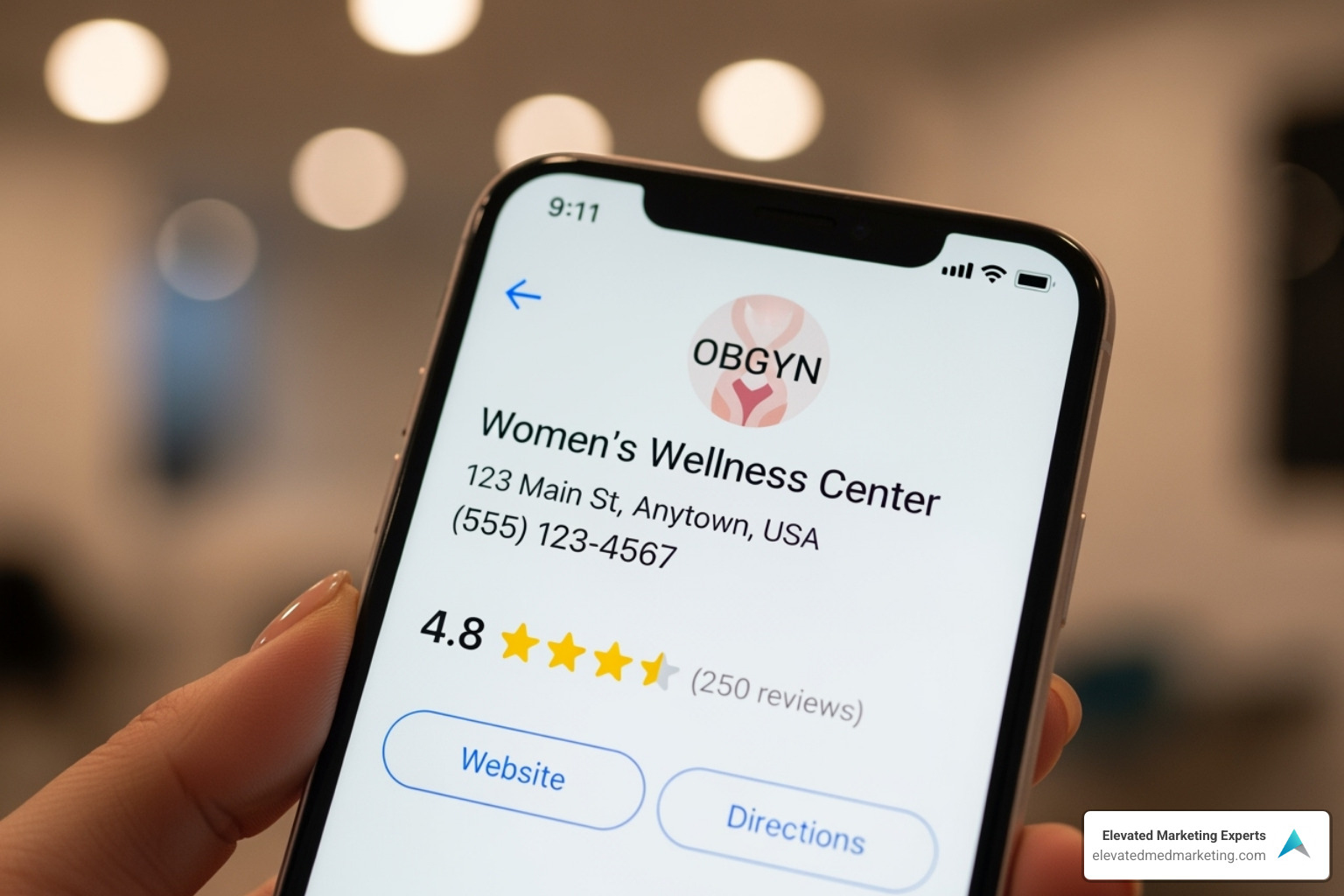
The heart of local SEO is your Google Business Profile (GBP). This free listing controls how you appear in Google Search and Maps. Your Name, Address, and Phone number (NAP) must be perfectly consistent across your GBP, website, and all online directories like Yelp or Healthgrades. These consistent mentions, or citations, build Google’s trust in your practice.
Patient reviews are a major factor, as over 80% of patients use them to choose a provider. A steady stream of recent, positive reviews directly impacts your local ranking. For practices with multiple offices, each location needs its own optimized GBP and dedicated website page.
Optimizing Your Google Business Profile
Your GBP is your digital first impression. To optimize it:
- Complete all information: Fill out every field, including hours, services, and a detailed description.
- Choose specific categories: Use “Obstetrician-Gynecologist” and other relevant secondary categories.
- Upload high-quality photos: Show your office, staff, and waiting areas to create a welcoming feel.
- Use Google Posts: Regularly share updates, health tips, or practice news to show you’re active.
- Monitor the Q&A section: Answer patient questions promptly and professionally.
- Add an appointment link: Make it easy for patients to book directly from your profile.
Building & Managing Online Reviews
Online reviews are digital word-of-mouth. A strong review strategy is essential:
- Solicit reviews systematically: Use post-visit emails or texts with a direct link to your GBP to encourage feedback.
- Respond to all reviews: Thank patients for positive comments. Address negative reviews professionally and offer to resolve the issue offline.
- Use reputation management software: These tools can help monitor reviews and automate requests.
- Gather internal feedback first: This can help you resolve issues privately before they become public negative reviews.
Multi-Location OBGYN Practices
For practices with multiple offices, a coordinated SEO strategy is key:
- Create dedicated location pages: Each office needs a unique page on your website with its specific NAP, hours, and local information.
- Write unique content: Avoid duplicating content across location pages. Highlight what makes each office special.
- Set up individual GBPs: Each location must have its own fully optimized Google Business Profile.
- Centralize data management: Use a system or tool to ensure NAP consistency for all locations across all online directories.
Technical SEO, Site Performance & Schema Essentials
Your website’s technical health is like the unseen wiring in your office—if it’s faulty, nothing else works. For SEO for OBGYN’s, a strong technical foundation is crucial for ensuring your content reaches patients.
At Liftd Marketing Experts, we prioritize the technical basics. A mobile-friendly design is essential, as most patients search on their phones. Site speed is critical; we aim for load times under 2.5 seconds to prevent users from leaving. HTTPS security is non-negotiable for protecting patient information and is a known Google ranking factor. Finally, structured data (schema) helps Google understand your content, which can lead to improved search results.

These elements directly impact your Core Web Vitals, Google’s metrics for user experience. A technically sound website provides a better experience for patients and search engines, leading to more appointments.
Must-Have Technical Elements for OBGYN Websites
Focus on these key technical elements for the biggest impact:
- XML Sitemap: An up-to-date map of your site helps Google find and index your pages quickly.
- Robots.txt: This file tells search engines which parts of your site to ignore, like admin pages.
- Canonical Tags: These prevent duplicate content issues by telling Google which version of a page is the primary one.
- Lazy-Load Images: Improves site speed by only loading images as a user scrolls down the page.
- Clean URL Structure: Simple, descriptive URLs (e.g.,
/prenatal-care) are better for users and SEO. - Internal Linking: Connecting related pages on your site helps search engines understand your content’s context and authority.
Advanced Markup & Accessibility
Advanced technical strategies can further improve your visibility:
- MedicalBusiness Schema: This specialized code tells Google you are a healthcare practice, helping it display relevant information in search results.
- FAQ Rich Snippets: Marking up FAQ pages can make your answers appear directly in Google’s search results, increasing visibility.
- Breadcrumb Schema: This helps users and search engines understand your site’s structure.
- Accessibility (WCAG): Following accessibility guidelines improves user experience for all visitors, which is a positive signal for SEO.
- HIPAA Considerations: Ensure all forms and patient portals are HIPAA compliant to protect patient privacy, a foundational element of trust.
Measuring Success, Avoiding Pitfalls & Leveraging Trends
Success in SEO for OBGYN’s means attracting the right patients who book appointments. This requires tracking the right metrics and adapting to new trends.
We use tools like Google Analytics 4 (GA4) to understand website traffic and user behavior, and Google Search Console to see which keywords are driving clicks. Heatmap tools show how users interact with your pages, while call tracking connects phone appointments back to your digital marketing efforts.
The biggest pitfall is chasing new trends without a solid foundation. Master the fundamentals—quality content, local SEO, and a great user experience—before adding complex strategies. Looking ahead, trends like voice search, AI-powered search summaries, and short-form video are changing how patients find providers. Staying on top of these shifts is key. For example, since 66.1% of consumers find reviews older than 18 months outdated, continuous reputation management is essential.
| Strategy Type | Typical ROI | Time to See Results | Key Benefits for OBGYNs |
|---|---|---|---|
| SEO | High (long-term) | 3-6 months (noticeable) | Sustainable organic traffic, high trust, authority building |
| PPC (Google Ads) | Immediate (short-term) | Days-Weeks | Instant visibility, targeted traffic, quick patient acquisition |
| Social Media Ads | Moderate (medium-term) | Weeks-Months | Brand awareness, community engagement, targeted demographics |
Key Metrics & Reporting Cadence
Focus on metrics that tie directly to practice growth:
- Organic Sessions: The number of visitors finding you through search.
- Conversion Rate: The percentage of visitors who book an appointment or call your office.
- Call Tracking: Identifies which online channels are driving phone calls.
- Local Pack Ranking: Your visibility in the map results for “near me” searches.
- Keyword Rankings: Your position for high-value search terms.
- Google Business Profile Insights: Data on how users interact with your local listing.
We provide monthly reports that translate this data into actionable insights for continued growth.
Future Trends Impacting OBGYN SEO
Stay ahead of these evolving trends:
- Voice Search Optimization: Content should answer natural, conversational questions.
- Generative AI and Search: Google’s AI summaries mean your content must be comprehensive and authoritative to be featured as a source.
- Short-Form Video: Brief, educational videos can boost engagement and appear in search results.
- E-E-A-T Signals: Google increasingly values content backed by professionals with real Experience, Expertise, Authoritativeness, and Trustworthiness.
Frequently Asked Questions about SEO for OBGYN’s
Here are answers to the most common questions we hear from OBGYN practices about digital marketing.
How long does it take to see results?
SEO for OBGYN’s is a long-term strategy, more like a marathon than a sprint. You may see early positive signals within 3 to 6 months, such as increased visibility in local search. However, significant, practice-growing results—like a steady increase in new patient appointments—typically take 6 to 12 months. This is because you are building trust with Google, which rewards consistency and quality over time. The benefit is that once achieved, these organic rankings are durable and provide lasting value.
Should we combine SEO with Google Ads and social media?
Yes, absolutely. An integrated approach is most effective. SEO for OBGYN’s builds long-term authority, while other channels provide immediate and complementary benefits.
- Google Ads offer instant visibility at the top of search results, capturing patient interest while your organic SEO rankings grow.
- Social Media is perfect for sharing your SEO content (like blog posts) and showing the human side of your practice, building community and trust.
When used together, these strategies create a powerful digital presence, ensuring patients can find you through multiple touchpoints.
Can AI completely write our OBGYN blog posts?
The short answer is no, not without significant human oversight. AI tools are excellent assistants for generating topic ideas, creating outlines, and drafting initial content. However, they pose serious risks in a healthcare context.
AI can lack the compassionate, nuanced tone required when discussing sensitive health topics. More critically, it can produce medically inaccurate information, creating a potential danger for patients and a liability for your practice. Furthermore, using these tools without care can raise HIPAA compliance concerns.
Our recommendation is to use AI as a starting point, but every piece of content must be reviewed, edited, and approved by a qualified human with medical expertise to ensure accuracy, empathy, and safety.
Conclusion
Growing your OBGYN practice through digital marketing is achievable. This guide has shown how a strategic approach to SEO for OBGYN’s can transform your online presence. The results are clear: practices that implement comprehensive SEO can see appointment requests increase by 169% in just seven months.
Every day, women in your community are searching online for the expert care you provide. The key is to ensure they can find you. Start with the fundamentals:
- Optimize your Google Business Profile.
- Earn positive patient reviews to build trust.
- Create helpful content that answers real patient questions.
- Ensure your website is fast, secure, and mobile-friendly.
While paid ads offer immediate visibility, organic SEO builds lasting authority and patient trust. The most successful practices combine SEO with other digital strategies for a robust online presence.
At Liftd Marketing Experts, we specialize in search engine optimization for medical practices. We understand the unique challenges healthcare providers face, from HIPAA compliance to communicating with empathy.
Your community needs your expertise. Don’t let potential patients find a competitor simply because their website was easier to find. Schedule a strategy call with our team today to discuss how a custom marketing plan can help you build the thriving practice you envision.


