

Plastic Surgery Google Ads: 7 Powerful Ways for Amazing Results 2025
Why Plastic Surgery Google Ads Are Essential for Practice Growth
Plastic Surgery Google Ads are the fastest way to attract high-intent patients to your practice. When implemented correctly, they can dramatically improve your patient acquisition strategy.
Key Benefits of Plastic Surgery Google Ads:
– Immediate visibility at the top of search results
– Targeted reach to patients actively searching for your procedures
– Measurable ROI with detailed performance tracking
– Control over budget with pay-per-click model
– Ability to compete with established practices
For plastic surgery practices, Google Ads offers a distinct advantage over other marketing channels because it targets patients at the exact moment they’re searching for your services. Unlike social media advertising that “pushes” content to potentially uninterested viewers, Google Ads “pulls” in prospects who are actively looking for procedures you offer.
Most potential patients begin their cosmetic surgery journey with a Google search, making it critical to appear at the top of those results. With 75.1% of clicks going to the top three search results, your visibility in this prime real estate can make or break your patient acquisition efforts.
“Google Ads can deliver a 1.5x increase in new patients for plastic surgery practices within 2-3 months of campaign launch.”
While SEO is important for long-term growth, it typically takes 5-6 months to see significant results. Google Ads, on the other hand, can start driving qualified consultation requests immediately after launch.
However, many practices waste thousands on poorly managed campaigns. Common pitfalls include:
- Targeting overly broad keywords
- Using generic landing pages
- Neglecting ad extensions and assets
- Failing to track conversions properly
- Not complying with healthcare advertising policies
I’m Joe Amaral, and after helping plastic surgery practices optimize their Google Ads campaigns for over a decade, I’ve seen poorly managed campaigns transform into lead-generating machines that deliver a 400% increase in quality leads with proper strategy and implementation.
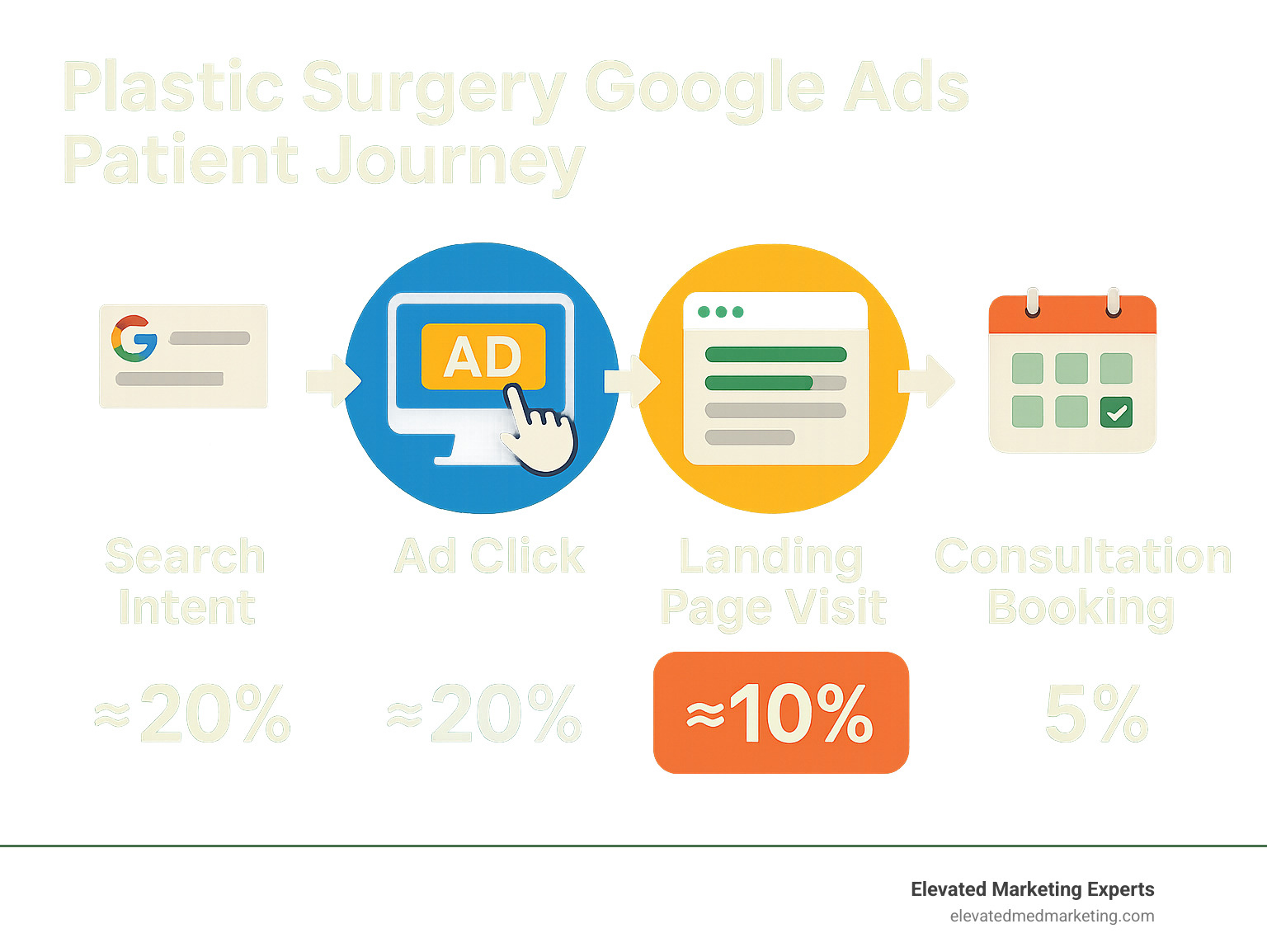
Simple guide to Plastic Surgery Google Ads terms:
– Advanced segmentation techniques
– Google Ads budget optimization
Understanding Plastic Surgery Google Ads Basics
Plastic Surgery Google Ads are a form of pay-per-click (PPC) advertising that puts your practice in front of potential patients at the exact moment they’re searching for your services. The beauty of this system? You only pay when someone actually clicks on your ad—making it accessible for practices of all sizes.
Think of Google Ads as premium digital real estate. When someone searches for “breast augmentation surgeon” or “mommy makeover near me,” your practice can appear right at the top of those results—above even the most established competitors in your area.
Plastic surgeons can leverage several types of Google Ads campaigns:
- Search Ads: Text-based ads appearing at the top of Google search results
- Display Ads: Visual banner ads shown across websites in Google’s Display Network
- YouTube Ads: Video ads playing before or during YouTube content
- Performance Max: AI-driven campaigns running across all Google platforms
- Local Service Ads: Google Guaranteed listings with pay-per-lead pricing
For most plastic surgeons, Search Ads deliver the highest ROI because they capture high-intent prospects actively looking for specific procedures—this is true “pull marketing” at its finest.
| Aspect | PPC (Google Ads) | SEO |
|---|---|---|
| Timeline | Immediate results | 4-6+ months |
| Cost Structure | Pay per click | Ongoing investment |
| Visibility | Top of search results | Organic rankings |
| Targeting Control | Precise targeting options | Limited targeting |
| Adaptability | Quick adjustments possible | Slow to change |
| Longevity | Stops when budget ends | Continues after investment |
| Typical ROI Timeline | 2-3 months | 6-12 months |
As one of our clients once put it: “My Google Ads campaign is like having a 24/7 patient concierge service—it greets interested patients and directs them straight to my virtual front door.”
How Plastic Surgery Google Ads Work
Plastic Surgery Google Ads operate on an auction model, but here’s the interesting part—it’s not just about throwing money at Google. The system actually rewards quality and relevance through something called Ad Rank:
Ad Rank = Maximum Bid × Quality Score
Your maximum bid is simply what you’re willing to pay per click. Quality Score, however, is Google’s 1-10 rating of how relevant and useful your ad is to the searcher. This means a well-crafted, highly relevant ad can actually outperform competitors spending more money but offering less relevant content.
When someone searches for “rhinoplasty specialist,” Google instantly runs an auction that determines if your ad appears, where it appears, and how much you’ll pay when someone clicks. The actual cost per click is calculated using:
Actual CPC = (Ad Rank of the advertiser below you ÷ Your Quality Score) + $0.01
If you’d like a deeper dive into how Google’s ad auction works, check out this overview on Wikipedia.
This formula means improving your Quality Score not only boosts your visibility but can significantly lower your costs—a win-win for your practice.
Intent mapping is another crucial concept in the Plastic Surgery Google Ads world. Different search terms signal different stages in the patient journey:
- Awareness: “what is rhinoplasty recovery like”
- Consideration: “rhinoplasty before and after”
- Decision: “rhinoplasty surgeon near me”
- Action: “book rhinoplasty consultation”
By matching your ad content and landing pages to where patients are in their decision journey, you can dramatically improve your conversion rates.
Benefits of Plastic Surgery Google Ads
The most immediate benefit of Plastic Surgery Google Ads is prime visibility exactly when it matters most. With 75% of all clicks going to the top three search results, appearing in these positions is like having your practice featured on the cover of a magazine that only interested patients read.
Our plastic surgery clients typically see up to a 400% increase in quality leads after implementing optimized Google Ads campaigns. This translates directly to more consultations, procedures, and revenue.
Google Ads also create multiple pathways for patients to reach you:
Phone calls through click-to-call extensions let mobile users contact you with one tap. Form submissions capture prospect information for your team to follow up. Chat features facilitate immediate engagement with interested patients. And location extensions help patients find your physical office.
One facial plastic surgeon we worked with saw their click-through rate increase by over 1,400% and their conversion rate jump by 314%—all while reducing their cost-per-click by 55% and cost-per-lead by an astonishing 96%.
PPC vs SEO for Plastic Surgeons
While Plastic Surgery Google Ads deliver immediate results, SEO builds your organic visibility over time. The most successful practices we work with combine both strategies for maximum impact.
PPC is like turning on a faucet—leads flow immediately but stop when you turn off the tap. SEO is more like planting a garden—it takes longer to grow but continues producing results long after the initial investment.
The synergy between these approaches creates a powerful marketing engine:
PPC provides immediate visibility while your SEO efforts gain momentum. Your SEO research informs PPC keywords and vice versa, creating a data feedback loop. PPC testing reveals high-converting messaging that can strengthen your SEO content. And remarketing ads recapture organic visitors who didn’t convert on their first visit.
Many practices also benefit from the brand lift effect—when potential patients see your practice in both paid and organic results, it creates a powerful trust signal that can significantly increase conversion rates.
At Liftd Marketing Experts, we’ve seen practices that implement this dual approach appear in Google’s top three rankings up to 43,700% more frequently than before, with a corresponding surge in qualified leads and consultations.
More info about Plastic Surgery PPC
Setting Up, Targeting & Budgeting Your Campaign
Setting up effective Plastic Surgery Google Ads requires careful planning and strategic implementation. The foundation of your success begins with proper account structure and targeting parameters.

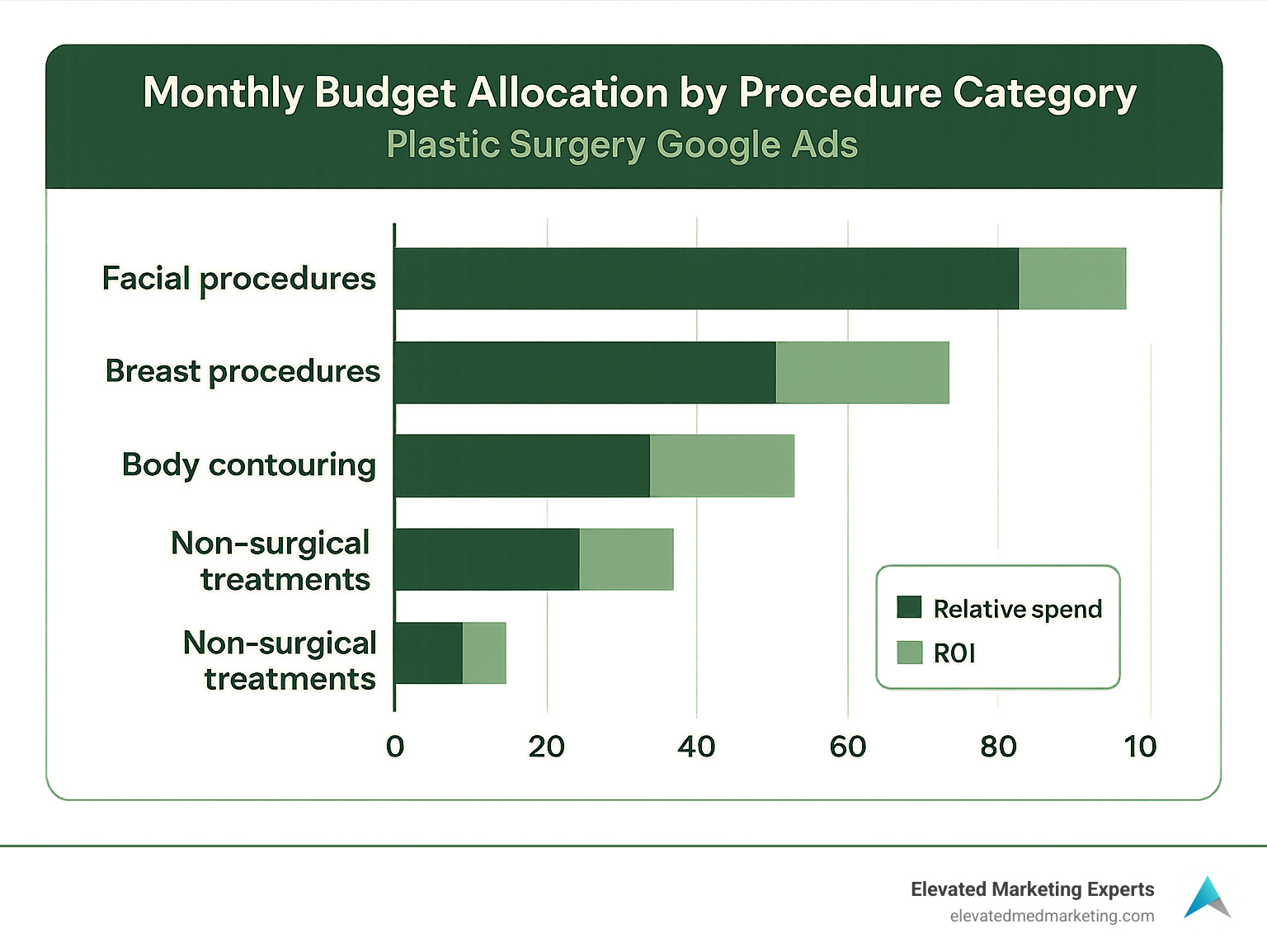
When we help plastic surgeons organize their Google Ads accounts, we typically recommend structuring campaigns around procedure categories. Think of it as creating separate marketing departments for facial procedures (like rhinoplasty and facelifts), breast procedures (augmentation, reduction, lift), body contouring (tummy tucks, liposuction, BBL), and non-surgical treatments (Botox, fillers, lasers).
This approach isn’t just about staying organized—it allows you to allocate your budget more strategically based on which procedures are most profitable for your practice or which ones you’re looking to grow. It also makes it easier to adjust your spending based on seasonal trends (more on that in a bit!).
Location targeting is absolutely crucial for plastic surgeons. Most of your patients will come from within a 15-20 mile radius of your practice for consultations and procedures. That said, if you’re known for a particular specialty or have built a national reputation, you might want to cast a wider net.
When it comes to demographic targeting, I recommend treading carefully. While it might seem logical to target specific age ranges or genders for certain procedures, Google’s demographic data isn’t always as accurate as we’d like. Instead, craft your ad copy and choose keywords that naturally attract your ideal audience. The right messaging will do the targeting work for you.
Don’t forget about negative keywords—they’re just as important as the keywords you actively target! Adding negative keywords like “free” (unless you actually offer free consultations), “cheap” (which tends to attract price-sensitive patients), “Medicaid” or “Medicare” (for non-covered procedures), and “DIY” or “at home” helps ensure your ads only show to people genuinely interested in professional plastic surgery services.
For budgeting, most plastic surgery practices we work with typically invest between $2,000 and $5,000 per month in Plastic Surgery Google Ads. This varies based on how competitive your market is, your geographic location, how many procedures you’re promoting, and seasonal factors that affect patient interest.
Step-by-Step Account Setup
Setting up your Plastic Surgery Google Ads account properly isn’t just a technical exercise—it’s laying the groundwork for your practice’s growth. Here’s how to get started:
First, create or access your Google Ads account at ads.google.com. Use a business email that multiple team members can access—you never want to be locked out of your account if someone goes on vacation! While you’re at it, link your Google Analytics account for more comprehensive data.
Next, define what success looks like by setting up conversion goals. For most plastic surgeons, these include phone calls (we recommend tracking calls that last at least 30 seconds to filter out wrong numbers), form submissions, chat interactions, and appointment bookings.
Proper conversion tracking is absolutely essential—as digital marketing expert Todd Nevins says, “Without proper tracking, you’re essentially flying blind with your ad spend.” Make sure to install the Google Ads tag on your website, configure Google Tag Manager for improved tracking, and set up call tracking numbers so you know exactly which ads are driving phone calls.
When creating your campaign structure, organize by procedure categories, create separate campaigns for search and display networks, and consider dedicated campaigns for your practice’s name and your personal name as a surgeon—people who search directly for you are often your warmest leads!
For campaign settings, start with “Search Network only” for your initial campaigns. Set your geographic targeting (typically that 15-20 mile radius we mentioned), schedule ads to run during business hours when your staff can actually respond to inquiries, and set your daily budget based on your monthly allocation.
Google’s call forwarding numbers are particularly valuable for plastic surgeons. They not only track which calls came from ads but also record call duration, helping you distinguish between serious consultation requests and brief inquiries.
Smart Targeting & Keyword Selection
The right keywords can make or break your Plastic Surgery Google Ads campaigns. For plastic surgeons, we focus on three main keyword categories:
Procedure-specific terms form the foundation of your keyword strategy. These include straightforward terms like “rhinoplasty,” “breast augmentation,” “tummy tuck,” and “mommy makeover.” These terms capture people who know exactly what procedure they’re interested in.
Geographic modifiers help you reach local patients searching in your area with terms like “rhinoplasty in [your city],” “breast augmentation near me,” and “best tummy tuck surgeon [your city].” These searches often indicate higher intent since the person is looking for services in a specific location.
Qualifier terms help you target patients at different stages of their decision journey. Terms like “best rhinoplasty surgeon,” “natural breast augmentation,” “tummy tuck recovery time,” and “mommy makeover cost” can capture people who are researching their options or comparing providers.
Tools like Google’s Keyword Planner can reveal valuable insights about search volume and competition. For example, “rhinoplasty” has an average monthly search volume of 90,500—showing high demand but also significant competition for this term.
When selecting keywords, consider both search intent and match types. Broad Match casts the widest net but can waste budget on irrelevant searches. Phrase Match is more targeted while still capturing variations. Exact Match provides the most precise targeting for high-intent keywords.
For most plastic surgeons just starting with Google Ads, we recommend using phrase match for your core procedure terms and exact match for high-value, high-intent keywords like “best rhinoplasty surgeon [your city].”
Competitor targeting can also be effective—bidding on the names of prominent surgeons in your area can capture patients who are researching multiple options. Just be aware that this strategy may increase your cost per click, as competitor terms often come with a premium.
Budget & Bid Strategy Essentials
Determining the right budget and bid strategy for your Plastic Surgery Google Ads is where science meets art. Here’s our approach:
For new campaigns, start with the “Maximize Clicks” bid strategy to gather performance data. This is like casting a wide net to see what works. After collecting 2-3 weeks of conversion data, consider switching to “Target CPA” (Cost Per Acquisition) or “Target ROAS” (Return On Ad Spend) for procedures with predictable values.
Your budget allocation should reflect both procedure profitability and seasonal trends. We typically recommend higher budgets for summer months when body contouring procedures peak (hello, swimsuit season!), increased spending in early fall for facial procedures before the holiday season (everyone wants to look their best in family photos), and budget adjustments for January when New Year’s resolutions drive interest in transformative procedures.
Several factors influence costs in plastic surgery advertising. Procedure popularity plays a big role—common procedures like rhinoplasty have higher competition and costs. Your geographic location matters too, as major metropolitan areas generally have higher CPCs. Competitor activity in markets with many surgeons can drive up bid prices. And your Quality Score significantly impacts costs—poor ad relevance increases what you’ll pay per click.
Digital marketing expert Huyen Truong recommends using “Google’s Performance Planner tool to help forecast results based on different budget scenarios. This allows you to make data-driven decisions about budget allocation.” For example, if the Performance Planner shows that increasing your budget from $3,000 to $4,000 per month would yield a disproportionate increase in consultations, that additional investment is likely justified.
Don’t overlook time-of-day and day-of-week bid adjustments to stretch your budget. Many practices find that ads perform better during business hours and on certain days of the week. By increasing bids during high-performance periods and decreasing them during low-performance times, you can maximize efficiency without increasing your overall budget.
Ready to take your practice’s Google Ads to the next level? Learn more about Plastic Surgery PPC strategies that can transform your patient acquisition efforts.
Crafting High-Converting Ads & Landing Pages + Compliance Essentials
Creating compelling ad copy and landing pages is where art meets science in Plastic Surgery Google Ads. The most effective ads speak directly to patient concerns while highlighting your unique value proposition.
Google’s responsive search ads allow you to create multiple headlines (up to 15) and descriptions (up to 4) that Google will automatically test and optimize. This format gives you more opportunities to highlight different aspects of your practice:
- Board certification and credentials
- Years of experience
- Before-and-after results
- Patient testimonials
- Financing options
- Recovery time
However, medical advertising has unique compliance requirements. Google maintains strict policies for healthcare advertisers, prohibiting certain claims and requiring transparency. Additionally, HIPAA compliance is non-negotiable when collecting patient information.
Some keywords and phrases are restricted or prohibited in plastic surgery advertising:
- “Guarantee” or “guaranteed results”
- Specific numeric promises (e.g., “lose 10 inches”)
- Unrealistic timeframes (e.g., “instant results”)
- Comparative claims without substantiation
Landing pages must be equally compliant while still driving conversions. The most effective landing pages include:
- Clear, compelling headlines matching search intent
- High-quality before-and-after galleries (with proper consent)
- Prominent contact forms
- Mobile optimization
- Fast loading speed
- Trust signals (certifications, reviews, awards)
“96% of users distrust online ads,” notes digital marketing expert Todd Nevins. “This makes relevancy and authenticity in your ad copy and landing pages absolutely critical.”
Anatomy of a Winning Plastic Surgery Ad
The most effective Plastic Surgery Google Ads follow a proven structure that captures attention and drives action:
- Headlines: Include your primary keyword, unique selling proposition, and call to action across your headlines.
- “Board-Certified Rhinoplasty Surgeon in [City]”
- “Natural-Looking Results | 500+ Procedures Performed”
“Book Your Consultation Today | Financing Available”
Descriptions: Expand on your value proposition and include secondary keywords.
- “Dr. Smith specializes in natural-looking rhinoplasty with minimal recovery time. View our gallery of before & after photos. Serving [City] for 15+ years.”
“Our state-of-the-art facility offers the latest rhinoplasty techniques. Achieve the profile you’ve always wanted. Free consultations available.”
Ad Extensions: These expand your ad’s footprint and provide additional information.
- Sitelink Extensions: Link to specific procedure pages, before/after gallery, financing options
- Callout Extensions: Highlight “Board Certified,” “15+ Years Experience,” “Financing Available”
- Structured Snippets: List procedures like “Rhinoplasty | Facelifts | Eyelid Surgery”
- Call Extensions: Display your phone number directly in the ad
Location Extensions: Show your office address and directions
Display Path: Customize the URL displayed in your ad.
- liftdmedmarketing.com/rhinoplasty-consultation
One of the most powerful elements you can include is social proof. When possible, incorporate review snippets through callout extensions:
“Our rhinoplasty patients report 98% satisfaction based on 200+ reviews”
Scarcity and urgency can also drive conversions when used authentically:
“Limited consultations available this month” or “Summer openings filling quickly”
Landing Page Must-Haves
Your Plastic Surgery Google Ads are only as effective as the landing pages they lead to. For maximum conversion, ensure your landing pages include these critical elements:
- HTTPS Security: Essential for both HIPAA compliance and user trust
- Fast Loading Speed: Pages that load in under 3 seconds perform best
- Mobile Optimization: Over 60% of searches are performed on mobile devices
- Matching Message: The landing page headline should echo the ad copy
- Minimal Form Fields: Ask only for essential information (name, phone, email, procedure of interest)
- Clear Call-to-Action: Make the next step obvious (“Book Consultation” or “Call Now”)
- Trust Signals: Include board certifications, hospital affiliations, and awards
- Social Proof: Feature patient testimonials and reviews
- Before-and-After Gallery: Showcase your work (with proper consent)
- FAQ Section: Address common concerns and objections
“Your landing page should mirror the user’s search intent,” explains digital marketing expert Huyen Truong. “If someone searches for ‘rhinoplasty before and after,’ they should land on a page that prominently features your rhinoplasty gallery.”
The most effective landing pages follow a proven structure:
- Hero Section: Compelling headline, subheadline, and primary CTA
- USP Section: 3-4 key benefits or differentiators
- Social Proof: Testimonials or review snippets
- Procedure Details: Information about the specific procedure
- Surgeon Credentials: Background and qualifications
- Gallery: Before-and-after images
- FAQ: Common questions and answers
- Contact Form: Prominently displayed with minimal fields
Beauty Snap 360, a specialized form tool for aesthetic practices, converts eight times more effectively than traditional contact forms by allowing patients to upload photos and specify concerns before their consultation.
Staying Compliant with Policies & HIPAA
Navigating compliance requirements is essential for Plastic Surgery Google Ads. Google maintains strict healthcare advertising policies, and HIPAA regulations add another layer of complexity.
Google’s healthcare policies prohibit:
- Promoting unapproved pharmaceuticals or supplements
- Making unrealistic claims about results
- Targeting based on health conditions
- Using before-and-after imagery in some markets without proper disclaimers
To maintain HIPAA compliance in your advertising:
- Never include Protected Health Information (PHI) in ads
- Avoid patient names or identifiable information
- Don’t reference specific patient outcomes without documented consent
Example violation: “Jane Smith regained her confidence with our breast augmentation procedure”
Secure landing pages with HTTPS
- Encrypt all form data
- Implement secure data storage
Use HIPAA-compliant form processing
Sign Business Associate Agreements (BAAs)
- Required for third-party tools handling PHI
- Google Cloud requires a BAA for storing patient data
Form processors need BAAs
Manage targeting carefully
- Avoid targeting sensitive attributes
- Use broader categories instead of procedure-specific targeting
Be cautious with remarketing lists
Train staff on HIPAA compliance
- Create internal ad policies
- Establish approval workflows
Document compliance measures
Monitor and audit ads regularly
- Use automated scanning tools
- Conduct manual reviews
- Maintain compliance checklists
“For plastic surgery clinics, failing to meet HIPAA standards can lead to privacy breaches, legal penalties, and loss of client trust,” warns digital marketing expert Ash Sobhe. “But HIPAA compliance can also be leveraged as a marketing advantage, building trust through transparency.”
Prominently featuring your privacy commitment on landing pages can actually increase conversion rates by reassuring potential patients that their information will be handled securely.
Tracking, Optimization & Scaling Over Time
The true power of Plastic Surgery Google Ads lies in continuous optimization based on performance data. Unlike traditional advertising, Google Ads provides detailed metrics that allow you to refine your campaigns for maximum ROI.

When I work with plastic surgery practices, I always emphasize that optimization isn’t a one-time event—it’s an ongoing journey. Think of your Google Ads campaign as a living, breathing entity that needs regular attention and care to thrive.
Successful optimization requires proper tracking setup from day one. Without correctly configured conversion actions, you’re essentially flying blind. I recommend weekly performance analysis to catch trends early, systematic A/B testing of your ad elements, and applying what you learn to make iterative improvements.
“Allow a three-month period before making major adjustments to enable Google Ads algorithms to optimize delivery,” advises digital marketing expert Huyen Truong. “Even non-clicked ads boost brand awareness and credibility by appearing in search results.”
I’ve seen many plastic surgeons get discouraged when immediate results don’t materialize, but patience pays off. Most practices see their cost per acquisition drop by 30% or more after 3-6 months of systematic optimization. This improvement comes naturally as you identify high-performing keywords, pause underperforming ads, refine your audience targeting, improve your Quality Score, and optimize landing page conversion rates.
As your campaigns mature and you’ve mastered the basics, it’s time to expand your horizons. Consider adding Performance Max campaigns (which average 18% more conversions), YouTube video ads featuring patient testimonials, display remarketing to recapture interested prospects, and Local Service Ads with the Google Guarantee badge. This comprehensive approach creates multiple touchpoints in the patient journey.
Measuring Success Metrics
To optimize your Plastic Surgery Google Ads, you need to track the right metrics. I find that many practices focus too much on clicks and not enough on conversions that actually drive revenue.
Your Click-Through Rate (CTR) reveals how compelling your ads are to searchers. For plastic surgery, you should aim for 3-5% on search ads. If you’re seeing lower numbers, your ad relevance or appeal might need work.
Conversion Rate (CR) tells you what percentage of clicks result in meaningful actions like form submissions or calls. The benchmark for plastic surgery landing pages is 3-7%. When I see lower rates, it usually signals a disconnect between what the ad promises and what the landing page delivers.
Cost Per Click (CPC) varies widely in the plastic surgery field, typically ranging from $2-$8 depending on your location and competition. High CPCs might indicate a low Quality Score or particularly competitive keywords.
Cost Per Acquisition (CPA) is where the rubber meets the road—how much are you paying for each lead? For plastic surgery, expect $75-$200 per lead, varying by procedure. The key question: does this CPA make sense given your patient lifetime value?
Quality Score directly impacts your costs and ad position. I always push for scores of 7+ on core keywords. When Google sees your ads as highly relevant, you’ll pay less for better positions.
Impression Share tells you how often your ads are showing up when they could be. Aim for 70%+ for branded terms and 30%+ for non-branded. If you’re falling short, you might need to increase your budget or improve your ad rank.
Return on Ad Spend (ROAS) is the ultimate metric. For established campaigns, target 3:1 or higher—that’s $3 in revenue for every $1 spent. Calculate this using your average procedure value multiplied by your conversion rate.
One real-world example: “The Tennessee Orthopaedic Clinic’s urgent care facilities averaged 750+ phone calls and 250+ self-appointments per month for around $2.68 per conversion.” That’s the power of properly tracked and optimized campaigns.
For truly accurate ROI calculation, track conversions all the way through to completed procedures. This closed-loop reporting requires integration between your Google Ads account and practice management system—something we help our clients set up at Liftd Marketing Experts.
Ongoing Optimization Playbook
Systematic optimization is the key to long-term success with Plastic Surgery Google Ads. I’ve developed a playbook that has consistently delivered results for our plastic surgery clients.
On a weekly basis, review your search terms report. This is gold! You’ll find exactly what people typed before clicking your ad. Add high-performing search queries as exact match keywords, add irrelevant terms as negative keywords, and identify new keyword opportunities you hadn’t thought of.
Also weekly, adjust your bids based on performance. Increase bids for keywords that are converting well, decrease bids for underperformers, and implement bid adjustments for devices, locations, and times that show better results.
Monitor your ad performance closely. Don’t be afraid to pause ads with below-average CTR. Create new ad variations to test against your top performers, and ensure your ad rotation is set to “Do not optimize” for unbiased testing.
Monthly, take a deeper dive into your landing page performance. Compare conversion rates across different pages, run A/B tests on headlines, images, and form layouts, and constantly work to improve page speed and mobile experience.
Also monthly, refine your audience targeting. Review demographic performance data to see which age groups and genders are converting best, adjust location targeting based on conversion data, and test in-market and affinity audiences in observation mode.
Regularly audit your Quality Score factors. Improve ad relevance by incorporating keywords in headlines, boost expected CTR with compelling offers, and optimize landing page experience for relevance and usability.
“Clients have seen up to a 400% increase in quality leads and sales metrics with optimized Google Ads campaigns for plastic surgery,” reports digital marketing expert Ash Sobhe. “Plastic surgery PPC campaigns can reduce wasted Google Ads spending and slash campaign costs by over 30%.”
One technique I’ve found particularly effective is creating a “keyword funnel” that gradually shifts budget from underperforming to high-performing keywords. Start broad, then let the data guide your budget allocation toward terms that drive consultations at the lowest cost.
Local Service Ads, YouTube & Display Expansion
Once you’ve mastered search campaigns, it’s time to expand your Plastic Surgery Google Ads strategy. I’ve seen practices transform their digital presence by adding these powerful formats to their mix.
Local Service Ads (LSAs) are a game-changer for plastic surgeons. They appear at the very top of search results with a Google Guarantee badge, which instantly builds trust. Unlike traditional Google Ads, LSAs operate on a pay-per-lead model—you only pay when someone actually contacts you.
The verification process for LSAs is thorough—Google checks your credentials, licensing, and insurance. But that extra effort pays off with prime placement above both traditional ads and organic results.
I love LSAs for their simplicity and effectiveness, but they do have limitations. You can’t directly link to your website, customize your messaging much, or optimize for specific keywords. And due to HIPAA considerations, you won’t get call recordings with your leads.
YouTube Ads offer something uniquely valuable for plastic surgeons: visual storytelling. Nothing showcases your work better than video. Your patients can share their journeys (with proper consent, of course), you can explain procedures with animations, give virtual office tours, or simply let your surgeon’s personality shine through in interviews.
I typically recommend starting with TrueView In-Stream Ads (the skippable ones that play before YouTube videos). They’re cost-effective since you only pay when viewers watch at least 30 seconds or click through.
Display Remarketing helps you stay connected with website visitors who weren’t quite ready to commit. These visual ads follow your prospects around the web, appearing on news sites, blogs, and other websites within Google’s Display Network (which reaches an impressive 90% of internet users).
Remarketing is particularly powerful for plastic surgeons because the decision to pursue cosmetic surgery often involves weeks or months of research and consideration. By staying visible throughout this process, you remain top-of-mind when they’re finally ready to book.
“Remarketing ads recapture organic visitors who didn’t convert initially,” explains digital marketing expert Ash Sobhe. “This creates multiple touchpoints in the patient journey.”
HIPAA compliance is essential with remarketing. Use anonymized audience segments rather than lists based on specific procedure page visits to protect patient privacy while still delivering effective ads.
For more detailed strategies on expanding your reach, check out our guide to Plastic Surgery Ads Management.
Frequently Asked Questions about Plastic Surgery Google Ads
What budget should a new practice start with?
If you’re just getting started with Plastic Surgery Google Ads, you’re probably wondering about budget. For new practices, we typically recommend starting with $2,000-$5,000 per month. This gives you enough runway to gather meaningful data while keeping risk manageable.
“Spending between $2,000 and $5,000 a month on Google Ads is reasonable for plastic surgeons aiming to attract new patients through targeted campaigns,” advises digital marketing expert Ash Sobhe.
Your ideal budget isn’t one-size-fits-all though. It should reflect your specific situation. If you’re in a major metropolitan area like Los Angeles or New York, you’ll need more budget than a smaller market because competition drives up costs. Similarly, if you’re targeting highly competitive procedures like rhinoplasty or breast augmentation, expect to invest more than for niche procedures.
Many of our most successful clients start by focusing on just one or two of their most profitable procedures. This targeted approach lets you establish proof of concept before scaling up. Once you’re seeing a positive return, you can gradually expand to additional procedure categories.
How long until I see consistent consults?
Patience is key with Plastic Surgery Google Ads, but you won’t be waiting forever. Most practices begin seeing consistent consultation bookings within 1-2 months of launch, with significant improvements by months 2-3.
“Clients typically see a 1.5x increase in new patients at around the 2-3 month mark,” reports digital marketing expert Huyen Truong.
This timeline isn’t arbitrary – it reflects the natural evolution of a campaign:
During weeks 1-2, we’re launching your campaigns and collecting initial data. Your phone might not be ringing off the hook just yet. By weeks 3-4, we’re making our first round of optimizations based on early performance indicators.
The real magic happens in months 2-3, when we refine your targeting and messaging based on what’s working. By months 4-6, we’re scaling successful campaigns and testing new approaches to further improve results.
The patient journey for plastic surgery involves research and consideration. Someone might click your ad, browse your before-and-after gallery, read reviews, and then take a week or two before calling to schedule that consultation. This natural delay is built into our expectations for timeline.
How do Google policies affect before-and-after photos?
Before-and-after photos are gold in plastic surgery marketing, but Google maintains strict policies around their use that you need to steer carefully.
In the United States, you can generally use before-and-after photos in both ads and landing pages, but with important guardrails in place. You absolutely must have written permission from each patient. You’ll need appropriate disclaimers noting that “results may vary.” Photos cannot be digitally improved to improve results, and you can’t imply guaranteed outcomes.
The rules get even stricter in some countries and for certain procedure types, where before-and-after imagery might be prohibited entirely in the ads themselves (though they may still be allowed on your landing pages).
“Even with restrictions, you can effectively showcase results by using general stock imagery in ads while reserving actual before-and-after galleries for your landing pages,” suggests digital marketing expert Ash Sobhe.
When featuring before-and-after galleries on your landing pages, organization matters. Group photos by procedure type for relevance. Include patient age and time post-procedure to set appropriate expectations. Feature diverse body types and demographics to help potential patients see themselves in your results.
Video testimonials can be particularly powerful alternatives when navigating these restrictions. A patient telling their story in their own words creates authentic connection while still showcasing your work.
Always have your legal team review your ad creative and landing pages. The regulations around medical advertising vary by location, and staying compliant isn’t just about avoiding Google penalties – it’s about maintaining your professional reputation.
Conclusion
Implementing effective Plastic Surgery Google Ads is no longer optional in today’s competitive landscape—it’s essential for practice growth. The digital patient journey begins with a search, and your presence at that critical moment can make all the difference.
When done right, Google Ads create the fastest path to increased consultations and procedures. We’ve seen how transformative a well-managed campaign can be for plastic surgeons looking to grow their practice. Our clients typically experience a 30% reduction in cost per lead within just three months, along with a 1.5x increase in qualified consultations.
What makes Google Ads so powerful for plastic surgeons is the predictability it brings to your patient flow. Unlike other marketing channels that can feel like throwing darts in the dark, Google Ads provides clear, measurable results that improve over time.
But here’s the truth that many agencies won’t tell you: this isn’t a “set it and forget it” marketing channel. Success comes from continuous optimization based on real performance data. It’s about making small, strategic adjustments that compound over time.
The plastic surgeons who see the greatest success with Plastic Surgery Google Ads follow these core principles:
They target high-intent keywords specific to their priority procedures, focusing on terms that signal readiness for consultation. They craft compelling ad copy that speaks directly to patient concerns while highlighting their unique expertise and approach. Their procedure-specific landing pages continue the conversation started in their ads, making the path to booking crystal clear.
The most successful practices also track conversions accurately to measure true ROI, not just clicks or impressions. They optimize continuously based on performance data, testing new approaches while doubling down on what’s working. And as they establish success, they expand strategically to additional ad formats like Local Service Ads and YouTube.
Every practice is unique, and your Google Ads strategy should reflect your specific goals, location, and competitive landscape. What works for a facial plastic surgeon in Beverly Hills may not be ideal for a body contouring specialist in Chicago.
At Liftd Marketing Experts, we’ve helped dozens of plastic surgeons transform their patient acquisition strategy through data-driven Google Ads campaigns. We understand the unique challenges and opportunities in aesthetic medicine marketing, and we’re passionate about helping practices reach their full potential.
Ready to transform your practice’s online presence? Contact us today for a free Google Ads audit and consultation. Let’s build a strategy that brings more of your ideal patients through your door.


