

Plastic surgeon Facebook marketing: 7 Powerful Proven Tips 2024
Why Social Media Has Become Essential for Modern Plastic Surgery Practices
Plastic surgeon Facebook marketing has evolved from a nice-to-have into a business necessity, with 78% of patients turning to social media sites like Facebook to find surgeons. The numbers tell a compelling story: 80% of people use social media to find health information, and 41% of survey respondents say social media influences their choice of medical facility or physician.
Quick Answer: Plastic Surgeon Facebook Marketing Essentials
- Compliance First – Follow HIPAA, ASA guidelines, and Facebook’s health policies
- Target Locally – Use 5-10 mile radius targeting for maximum relevance
- Budget Smart – Start with $5-10 daily budget, scale based on performance
- Create Compliant Content – Use neutral imagery, clinical language, avoid before/after photos
- Track Conversions – Install Facebook Pixel, measure cost-per-lead and consultation bookings
- Nurture Leads – Implement retargeting campaigns and email follow-up sequences
With Facebook’s 222 million US users spending roughly 14 hours monthly on the platform, and 98.5% accessing via mobile devices, the opportunity is massive. But the challenge lies in navigating strict medical advertising regulations while creating campaigns that actually convert social media scrollers into consultation bookings.
The stakes are high – agencies report delivering patient leads at 30-70% lower cost than traditional marketing tactics when Facebook campaigns are executed properly. However, disapproved ads, compliance violations, and wasted spend plague practices that attempt to steer these waters without proper guidance.
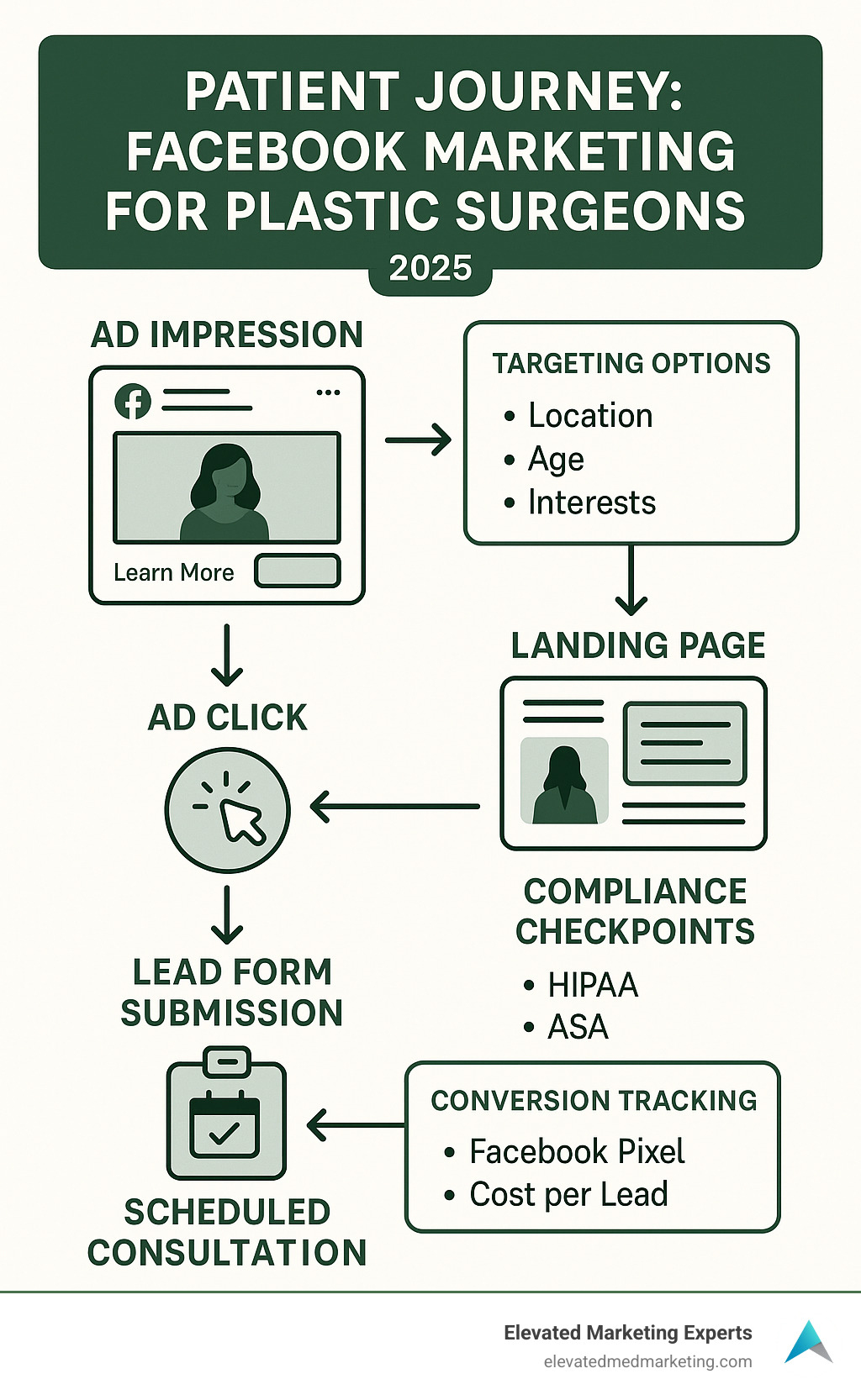
Steer the Rules: Compliance, Ethics & Patient Trust
Plastic surgeon Facebook marketing requires strict adherence to medical advertising regulations. One wrong move can shut down your entire campaign or create regulatory issues. The platform treats medical ads with extra scrutiny, and for good reason – we’re talking about people’s health and bodies.
The biggest trap? Using typical marketing tactics like “limited time offers” or dramatic before-and-after comparisons. Facebook’s medical advertising policies specifically ban these approaches because they can exploit personal insecurities.
Key Regulations Every Clinic Must Know
HIPAA compliance starts the moment someone interacts with your ad. Every pixel you install and lead form you create involves patient data protection.
Advertising Standards Authority (ASA) guidelines prohibit exploiting insecurities or creating negative self-perception. Use clinical, professional language instead of emotional appeals.
Facebook’s health advertising policies prohibit before-and-after photos entirely – not just in ads, but on landing pages too. You can find complete guidelines in Facebook’s official health advertising policies.
Payment plan restrictions may classify financing mentions as financial services, opening new regulatory requirements. Discuss payment options during consultation rather than in ads.
Safeguarding Patient Data & Imagery
Every piece of patient content requires written consent that specifically mentions social media usage. Generic consent forms won’t suffice.
Your landing pages need SSL encryption and secure hosting. Configure pixel events carefully to avoid capturing sensitive information.
Build Credibility Without Breaching Rules
Board certification badges and professional credentials can be prominently displayed when current and verifiable.
Patient testimonials with proper consent provide powerful social proof when focused on patient experience rather than physical changes.
For detailed strategies on building credibility while staying compliant, check out these proven plastic surgery marketing strategies that work within regulatory boundaries.
Build Magnetic Creatives That Convert
Creating Facebook ads that convert consultation bookings while staying compliant requires focusing on education, patient experience, and emotional benefits rather than dramatic physical changes.
Video content consistently outperforms static images in the plastic surgery space, with 74% of in-stream non-skippable Facebook video ads watched until completion. The best-performing videos are short educational pieces explaining procedures, showcasing facilities, or featuring genuine patient testimonials.
Anatomy of a High-Performing Visual
Successful plastic surgery ads use neutral lifestyle shots instead of clinical imagery for awareness campaigns. Professional headshots of surgical teams, bright facility interiors, or comfortable consultation rooms build trust without triggering content restrictions.
Procedure graphics and educational diagrams work excellently for awareness campaigns. Anatomical illustrations showing surgical techniques or recovery timelines provide value while maintaining compliance.
Brand colors and consistent visual identity are crucial for recognition. Develop a style guide with approved color palettes, fonts, and imagery styles, then maintain consistency.
Words That Win Without Violating Policy
Focus on value proposition clarity by highlighting patient experience, qualifications, and consultation process rather than procedure outcomes. “Board-certified plastic surgeon offering personalized consultations” outperforms “Amazing results guaranteed.”
Your call-to-action should feel like an invitation – “Schedule your consultation” or “Learn more about our procedures” guide users without creating pressure.
Use a patient-centric tone that acknowledges concerns and highlights understanding. Position yourself as a trusted advisor, not a salesperson.
Copy Checklist
Integrate plastic surgeon Facebook marketing naturally within ad copy. Use variations like “cosmetic surgery” or “aesthetic procedures” for variety.
Benefit bullets work well in carousel ads, focusing on emotional benefits like “renewed confidence” or “personalized care” rather than specific physical changes.
Include compliance phrases like “Individual results may vary” or “Consultation required to determine candidacy.”
Local trust signals like “Serving [City Name] for over [X] years” establish local authority and accessibility.
Targeting & Funnel Strategy
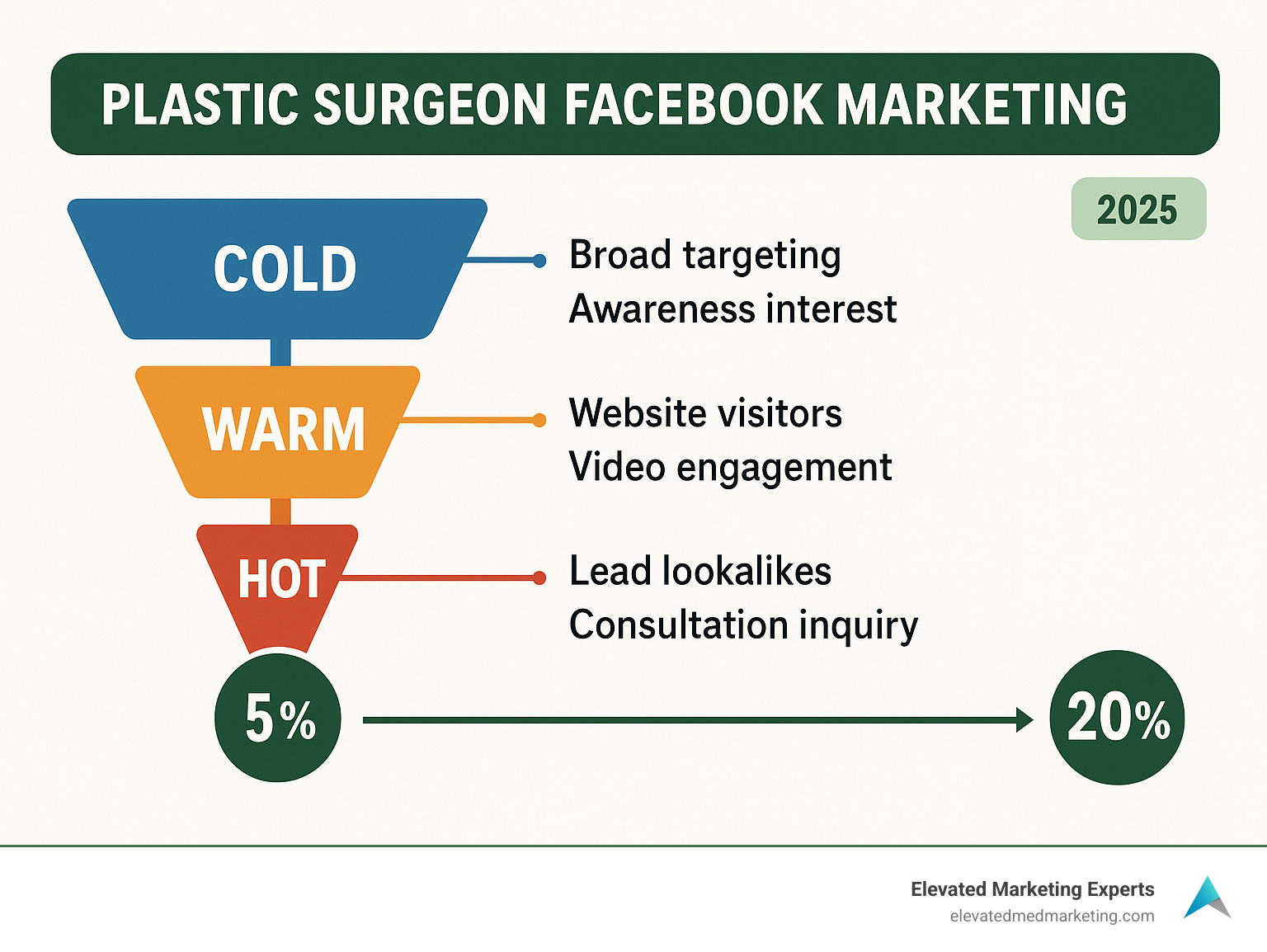
Plastic surgeon Facebook marketing works differently than traditional advertising because cosmetic procedures aren’t impulse purchases. Successful campaigns use a funnel approach, meeting people where they are in their decision journey.
Top-of-Funnel: Awareness Campaigns
Local targeting is crucial – most patients want a surgeon within 10 miles of their home. Start with a 5-10 mile radius around your practice location.
Age targeting should match your procedures: breast augmentation campaigns often work for ages 25-45, while facial procedures might target 35-65.
Interest-based targeting includes obvious targets like “cosmetic surgery” but also “health and wellness,” “beauty,” or “self-improvement” to reach people considering procedures but not actively researching yet.
Video view campaigns deliver views for $0.01-$0.03 each, and every viewer becomes part of a retargeting audience.
Mid-Funnel: Consideration & Education
Lead forms built into Facebook ads work well because people don’t leave Facebook to request information. Less friction means more conversions.
Educational webinars targeting people who’ve engaged with your content provide value while building trust.
FAQ-style content addresses concerns through carousel ads or videos answering “How long is recovery?” or “What credentials should I look for?”
Social media funnel strategies need to align with your overall patient journey.
Bottom-Funnel: Booking the Consultation
Custom audiences from website visitors convert at much higher rates than cold audiences.
Abandoned form retargeting targets people who started but didn’t complete contact forms – these often deliver the highest ROI.
Patient testimonials focusing on consultation experience and care quality work beautifully at this stage.
Budgets, Testing & ROI—From Clicks to Consults
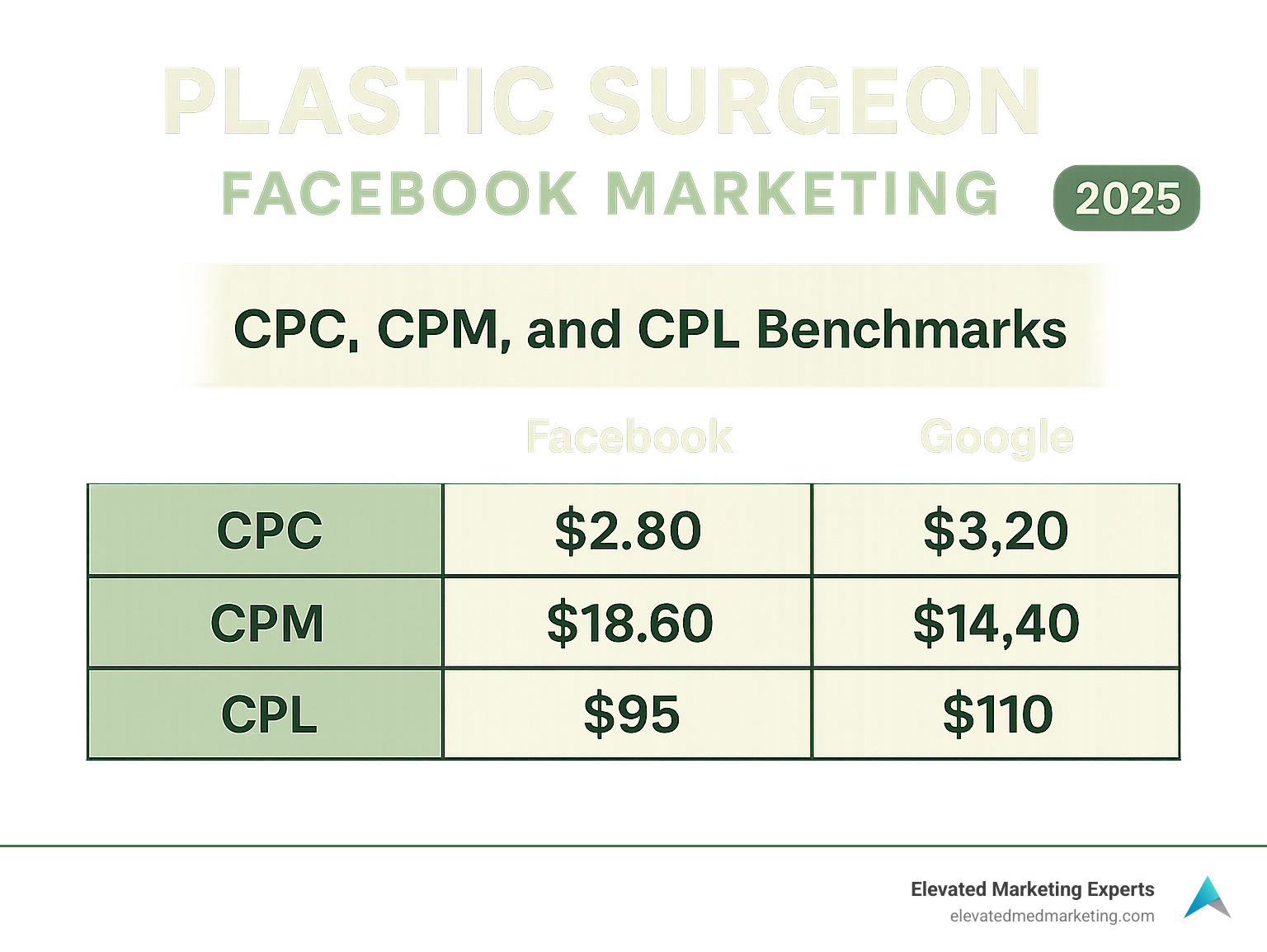
Plastic surgeon Facebook marketing requires patience and strategic budget allocation matching the natural decision-making timeline of cosmetic surgery patients.
Facebook typically delivers lower cost-per-click rates ($2-5 versus $8-15 for Google) but requires higher attribution windows to capture conversions. Facebook campaigns might look less effective in the first 30 days but show stronger performance over 60-90 day periods.
Start with $5-10 daily budgets for link-click campaigns before switching to conversion optimization.
Setting Your Spend & Pacing
Lifetime budgets consistently outperform daily budgets, allowing Facebook’s algorithm to shift spending toward high-performing days.
The learning phase requires approximately 25 conversions before optimization, typically taking 7-14 days of steady spending.
Bid caps prevent runaway spending. Calculate backward from consultation-to-patient conversion rates and average procedure values to determine maximum cost-per-lead thresholds.
Testing Framework
Headlines deserve first testing attention. “Board-Certified Plastic Surgeon” might perform differently than “Personalized Cosmetic Surgery Consultations.”
Audience segments reveal insights about who responds to messaging. Age ranges for breast augmentation might fail for facial procedures.
Follow the one-variable rule – change headlines or images or audiences, never multiple elements simultaneously.
Measuring Success Beyond Likes
Facebook Pixel events track behavior that matters more than engagement metrics. Set up custom events for consultation bookings, form submissions, and phone calls.
CRM integration connects Facebook leads to actual patient lifetime value, enabling optimization for revenue rather than just lead volume.
Attribution windows are crucial for accurate ROI measurement. Use 7-day click and 1-day view attribution initially, then analyze longer timeframes. Lead generation tracking should extend beyond Facebook’s native reporting.
Successful practices understand that cost-per-lead matters less than cost-per-patient and return on ad spend.
2024 Trends & Facebook vs Other Platforms
While everyone talks about TikTok and Instagram Reels, plastic surgeon Facebook marketing remains the workhorse delivering actual patients. Facebook’s 222 million US users spend roughly 14 hours monthly on the platform – serious engagement time from people with financial means for cosmetic procedures.
Why Facebook Still Dominates for Local Leads
Facebook’s robust retargeting capabilities are best. Custom audiences from website visitors, email subscribers, or video watchers enable sophisticated targeting perfect for longer cosmetic procedure sales cycles.
Local business features feel designed for practices like yours. Location-based targeting focuses on people within driving distance, with integrated maps and business profiles.
Detailed analytics provide conversion tracking, attribution windows, and CRM integration showing exactly which ads bring in patients.
When to Expand to Instagram, TikTok & YouTube
Instagram makes sense for younger demographics seeking procedures like breast augmentation. With 166 million US users and 78% aged 18-29, Instagram’s visual nature works well for facility showcasing.
TikTok creates opportunities for educational content and brand building, though limited link-sharing capabilities make it better for awareness than direct lead generation.
YouTube deserves consideration for search functionality and longer-form content. Procedure explanations and patient testimonials establish authority while supporting Facebook campaigns.
Research on platform preferences confirms age-specific targeting aligns with platform demographics. Instagram and TikTok work for ages 17-35, while Facebook and YouTube serve the 36-70 range where most cosmetic surgery patients fall.
These platforms work best together – Facebook drives core lead generation while Instagram and TikTok build brand awareness among younger future patients.
Frequently Asked Questions about Plastic Surgeon Facebook Marketing
Can I show before-and-after photos in my ads?
This is probably the most common question we hear from plastic surgeons, and the answer is a firm no. Facebook’s health advertising policies are crystal clear about this – before-and-after photos are completely prohibited in paid ads for cosmetic procedures.
But here’s what catches many surgeons off guard: this restriction doesn’t stop at your ad creative. It extends to any landing page that users reach through your Facebook ads. So even if your website normally displays before-and-after galleries, you’ll need separate landing pages for Facebook traffic that comply with these policies.
The good news? You can absolutely use before-and-after photos in organic posts on your Facebook page. These aren’t considered paid advertising, so the restrictions don’t apply. Just make sure you have proper patient consent for any imagery you share.
Instead of before-and-after photos in your plastic surgeon Facebook marketing campaigns, focus on building trust through other means. Professional facility photos, surgeon headshots in clinical settings, and educational graphics about procedures all perform well while staying compliant. Patient testimonials with proper consent provide that crucial social proof without violating advertising policies.
What is a realistic monthly budget for a single procedure campaign?
Budget planning for plastic surgery Facebook ads isn’t like budgeting for a local pizza shop. The decision-making process is longer, the stakes are higher, and patients need more touchpoints before they’re ready to book a consultation.
We typically recommend starting with $300-500 monthly for single procedure campaigns. This gives you enough data to test different audiences, creatives, and messaging while allowing Facebook’s algorithm to optimize your campaigns properly.
Your procedure type makes a huge difference in budget planning. Higher-value procedures like breast augmentation, tummy tucks, or facelifts can justify larger budgets because your patient lifetime value is higher. A single breast augmentation patient might be worth $8,000-$12,000 to your practice, so spending $1,000-$2,000 to acquire that patient makes financial sense.
On the flip side, non-surgical treatments like Botox or dermal fillers typically require smaller budgets but higher conversion rates to achieve profitability. These procedures have lower price points, so your cost per acquisition needs to be proportionally lower.
Here’s how we typically split the budget: About 70% goes toward acquiring new audiences, while 30% focuses on retargeting website visitors and people who’ve engaged with your content. This balance ensures you’re constantly bringing in new prospects while nurturing existing leads through your funnel.
How fast can I expect ROI after launching?
Patience is absolutely crucial with plastic surgery Facebook marketing. Unlike e-commerce where someone might buy a product within hours of seeing an ad, cosmetic procedures involve significant research, consideration, and often multiple consultations.
Most campaigns need 30-60 days to show meaningful results. The first 7-14 days are Facebook’s learning phase, where the algorithm is figuring out who responds best to your ads. Then comes the optimization period where performance typically improves as the system learns.
You might start seeing leads within the first week, but actual consultation bookings often take 2-4 weeks. Patients need time to research, discuss with family, and work up the courage to take that first step. Higher-value procedures naturally have even longer sales cycles.
Realistic expectations matter here. We typically see 5-15 leads per month for every $1,000 in ad spend, with consultation conversion rates ranging from 15-25%. Your actual ROI depends heavily on how well you convert consultations into procedures and your average procedure value.
Facebook marketing is playing the long game. While you might get some quick wins, the real value comes from building a consistent pipeline of qualified leads who trust your expertise and are ready to move forward with their procedures.
Conclusion
Plastic surgeon Facebook marketing has become a game-changer for aesthetic practices willing to master its complexities. Practices that execute properly see patient acquisition costs drop by 30-70% compared to traditional marketing methods.
Success requires understanding the delicate balance between compliance and conversion. From navigating medical advertising regulations to crafting compliant creatives, each piece plays a crucial role. The compliance-first approach builds genuine trust with potential patients making significant decisions.
The targeting and funnel strategies reflect how patients actually make cosmetic procedure decisions. Most people need multiple touchpoints – they research, compare, and hesitate before taking that first consultation step.
The technical complexity often overwhelms surgeons managing campaigns themselves. Between Facebook’s changing policies, pixel tracking, and compliant creative development, consistent results require specialized expertise.
At Liftd Marketing Experts, we’ve built our approach around these unique challenges. We understand that plastic surgeon Facebook marketing isn’t like promoting other businesses. The stakes are higher, regulations stricter, and patient journeys more complex.
The opportunity is significant. Facebook’s massive user base and sophisticated targeting let you reach potential patients at exactly the right decision-making moment. However, compliance violations can shut down advertising accounts and create regulatory issues.
Whether starting with Facebook advertising or optimizing existing campaigns, this is a marathon requiring consistent effort, continuous testing, and unwavering compliance attention. Successful practices view Facebook marketing as relationship-building investment, not just quick lead generation.
Ready to see how compliant, conversion-focused Facebook marketing can transform your patient acquisition? We’d love to discuss how our industry-specific expertise can help your practice achieve measurable growth while maintaining the highest regulatory compliance standards.
Learn more about our plastic surgery digital marketing services and find how we can help your practice thrive in the digital age.


