

Med spa Google Ads management: 7 Powerful Success Secrets 2025
Capturing Immediate Leads with Google Ads
Med spa Google Ads management is the process of creating, optimizing, and maintaining Google advertising campaigns specifically for medical spas to attract qualified leads actively searching for aesthetic treatments. Here’s what effective management includes:
- Campaign setup: Structuring ads around high-revenue treatments
- Keyword targeting: Focusing on service-specific terms like “Botox near me”
- Budget allocation: Typically $2,500-$5,000 per campaign monthly
- Compliance management: Navigating healthcare advertising restrictions
- Performance tracking: Measuring cost-per-lead and conversion rates
Med spas using well-managed Google Ads campaigns have seen sales double within a few months, with many reporting significant increases in high-quality leads at costs as low as $4.23 per lead.
In today’s competitive aesthetic market, Google Ads offers an immediate path to capturing potential patients at the exact moment they’re searching for your services. Unlike SEO which takes months to build momentum, a properly structured Google Ads campaign can begin delivering qualified leads within days of launch.
“Over 80% of new patients turn to Google to find medical providers, making Google Ads one of the most effective ways to acquire new patients actively searching for med spa services.”
When patients search for treatments like “laser hair removal near me” or “Botox injections,” your med spa can appear at the top of search results—precisely when they’re ready to book. This “pull marketing” approach captures existing demand rather than trying to create it.
I’m Joe Amaral, founder of Liftd Marketing Experts, with over a decade of experience in digital marketing including specialized Med spa Google Ads management for aesthetic practices across the country. I’ve helped dozens of med spas transform their patient acquisition strategy through targeted Google advertising.
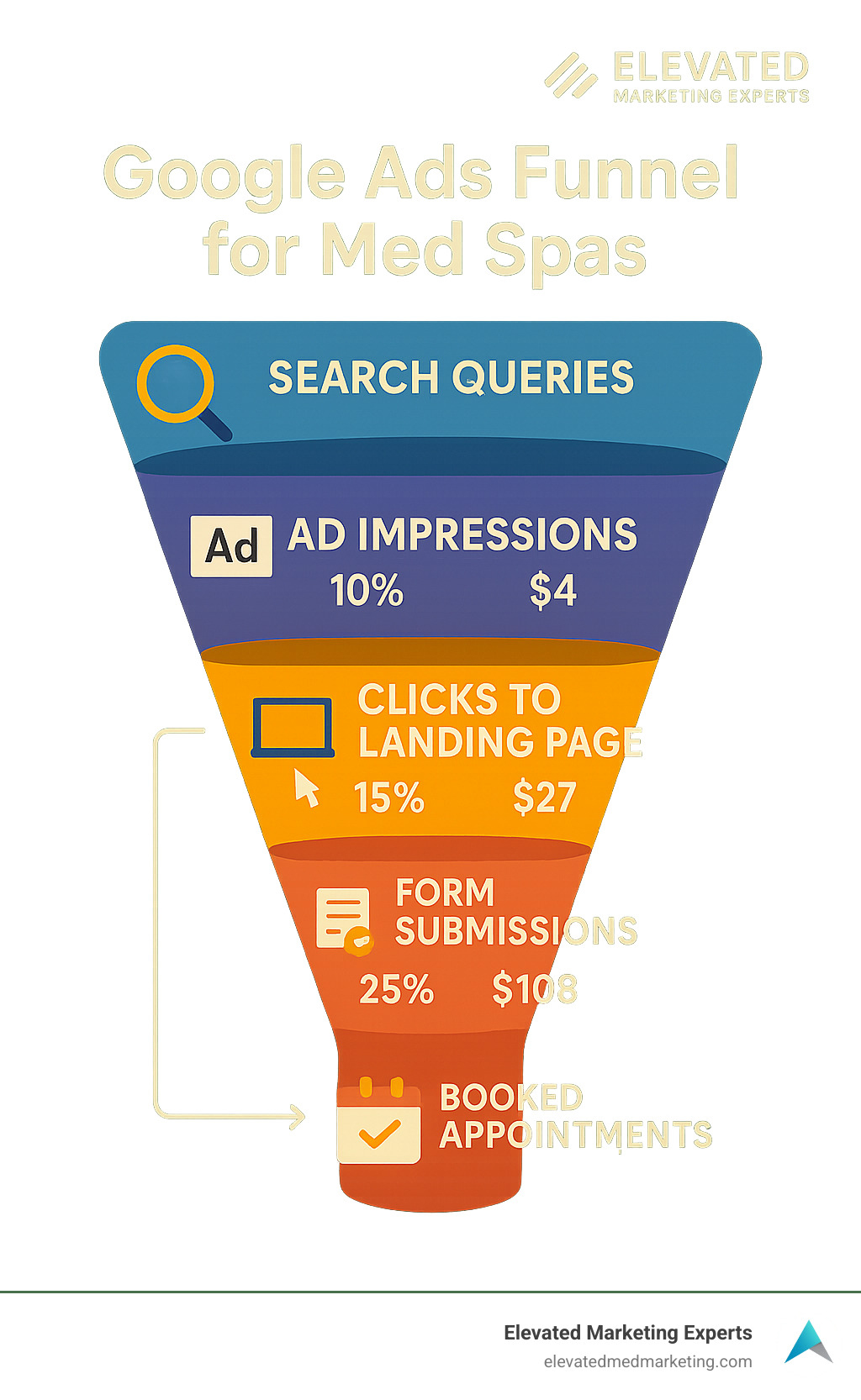
Why Google Ads Matter Right Now
The aesthetic medicine industry becomes more competitive every day. While organic marketing strategies like SEO and social media are valuable for building your brand over time, Google Ads delivers immediate visibility and leads.
Google Ads works on a pay-per-click model, meaning you only pay when someone clicks on your ad. This makes it one of the most cost-effective ways to capture demand that already exists. For med spas looking to:
- Fill appointment calendars quickly
- Launch new treatments or services
- Target specific high-margin procedures
- Compete in saturated markets
- Generate immediate ROI
Google Ads provides the fastest path to growth. A case study from one of our clients showed 763 patient leads at a cost per lead of just $4.23 in 90 days—results that would take organic strategies years to achieve.
Med spa Google Ads management: The Fundamentals
Before diving into campaign creation, let’s understand how Google Ads works specifically for medical spas and aesthetic practices.
Google Ads operates like an auction where advertisers bid on keywords relevant to their business. For med spas, these keywords typically include treatment names (“Botox injections”), problem-based searches (“how to reduce wrinkles”), and location-specific queries (“laser hair removal near me”).
What makes Google Ads so powerful for med spas is its ability to capture existing demand rather than trying to create it from scratch. When someone is actively searching for aesthetic treatments, they’re much closer to booking than someone just scrolling through social media.
| Feature | Google Ads | Facebook Ads |
|---|---|---|
| User Intent | High (searching for solutions) | Low (browsing, not searching) |
| Targeting | Keyword-based (capturing active demand) | Demographic/interest-based (creating demand) |
| Average Cost Per Lead | $4-20 depending on treatment | $15-40 depending on treatment |
| Time to First Lead | Often within 24-48 hours | 1-2 weeks for optimization |
| Best For | Capturing ready-to-book patients | Brand awareness and education |
| Compliance Difficulty | Moderate (clear guidelines) | High (frequently changing policies) |
How Google Ads Work for Med Spas
When a potential patient searches for “Botox near me,” Google instantly runs an auction to determine which ads appear and in what order. Your position depends on three main factors:
First, your bid amount – how much you’re willing to pay when someone clicks your ad. Second, your Quality Score – Google’s rating of how relevant and useful your ad and landing page are to the searcher. And third, your ad format and extensions – how complete your ad is with additional helpful information.
For med spas, local visibility is essential. Your campaigns should target specific geographic areas—typically within a 5-25 mile radius depending on your location’s population density and competition level.
What’s particularly effective for Med spa Google Ads management is the ability to appear in multiple places across Google’s network. Your ads can show at the top of search results, in Google Maps listings, on partner websites, and even on YouTube. Most of our clients start with search ads focused on high-intent keywords before expanding to other formats.
Pull vs. Push: Why Search Beats Social for Lead Quality
One of Google Ads’ biggest advantages is that it’s a “pull” marketing channel rather than “push.” This distinction makes all the difference in lead quality:
With Google Ads (pull marketing), you’re capturing people actively searching for solutions – they already know they want treatment. With social media ads (push marketing), you’re interrupting people while they’re checking on friends or watching videos – they weren’t thinking about aesthetic treatments until your ad appeared.
I’ve seen this difference play out consistently across dozens of med spa clients. One Tennessee clinic generated over 750 phone calls and 252 self-appointments in just one month at $2.68 per conversion using Google Ads – a level of intent and conversion rarely matched on social platforms.
While Facebook and Instagram definitely have their place in your marketing mix (especially for building awareness), Google Ads consistently delivers higher-quality leads who are much closer to making a booking decision.
Compliance Essentials for Aesthetic & Medical Terms
Medical advertising faces stricter regulations than most industries, and Google enforces specific policies around healthcare that directly affect med spa advertising.
Med spa Google Ads management requires careful navigation of these compliance issues. Here are the key areas to understand:
Prescription drug terms must be handled carefully. You cannot explicitly advertise Botox (a prescription drug) in your ad copy. Instead, use terms like “wrinkle treatments,” “anti-aging injections,” or “cosmetic injectables.” You can mention Botox on your landing pages with proper disclaimers, but ad copy itself must avoid direct prescription drug promotion.
Before/after imagery must follow proper guidelines. While incredibly effective for conversions, these images must be presented appropriately to avoid ad disapprovals.
Claims and guarantees need to be factual and supportable. Avoid promising specific results or using absolute terms like “guaranteed” or “permanent.”
HIPAA compliance is non-negotiable. Ensure all lead capture and patient information handling follows proper protocols.
Staying compliant isn’t just about avoiding ad disapprovals—it’s about maintaining your practice’s reputation and avoiding potential legal issues. The latest research on Google Ads medical policy should be reviewed regularly as guidelines do change.
With these fundamentals in place, you’re ready to build campaigns that not only attract new patients but do so within the appropriate guidelines for medical aesthetics. The right Med spa Google Ads management approach balances aggressive growth with proper compliance.
Setting Up Your First High-Performing Campaign
Now that you understand the fundamentals, let’s walk through creating a Google Ads campaign that will actually deliver results for your med spa. I’m going to show you exactly how to set this up right from the start.
Step-by-Step Account & Conversion Tracking Setup
Getting your tracking right is absolutely crucial—without it, you’re essentially throwing money into the dark and hoping for the best.
Start by creating your Google Ads account at ads.google.com (or connect to your existing one). One tip that will save you headaches: immediately switch to Expert Mode instead of using the simplified setup. The simplified version limits your control in ways that will hurt your results.
Before you even think about creating campaigns, set up proper conversion tracking:
Steer to Tools & Settings > Conversions, and add tracking for the actions that actually matter to your business—form submissions, phone calls (make sure to track calls lasting at least 60 seconds to filter out wrong numbers), appointment bookings, and chat interactions.
For phone tracking, I strongly recommend using a third-party call tracking service that integrates with Google Ads. This gives you much richer data about who’s calling and why.
For website forms and bookings, you’ll need the Google tag on your site. If you’re using Google Tag Manager (which makes life much easier), you’ll create a new tag, select Google Ads Conversion Tracking, enter your conversion ID and label, and set it to fire when someone completes a form. Always test before publishing!
Smart Keyword & Negative Keyword Framework
Your keyword strategy can make or break your Med spa Google Ads management success. The best approach is organizing by treatment category, with dedicated ad groups for each service you offer.
Focus on four main types of keywords: treatment-specific terms (like “Botox injections”), symptom-based searches (like “reduce wrinkles”), location-modified terms (“Botox in Phoenix”), and questions (“how much does CoolSculpting cost”).
For match types, a balanced approach works best—use phrase match to capture variations while maintaining intent, and exact match for your highest-converting terms where you want maximum control.
Just as important as what you target is what you exclude. Negative keywords prevent wasting money on irrelevant searches. Always add negatives like “-jobs” (so you don’t show up for people looking for employment), “-school” or “-training” (for those seeking education), “-at home” (for DIY solutions), and “-cheap” (which typically brings low-quality leads).
A well-structured campaign might look like a Body Treatments campaign with separate ad groups for CoolSculpting and Laser Hair Removal, each with their own relevant keywords and negatives.
Budget & Bid Strategy Blueprint
Let’s talk money. For effective Med spa Google Ads management, you need to invest appropriately. Based on our experience with hundreds of med spas, most successful campaigns start with $2,500-$5,000 per month per treatment category.
Your budget should align with treatment revenue—higher-value procedures like surgical treatments or package deals justify higher ad spend, while entry-level treatments like Botox might need less budget but focus more on volume.
When allocating your budget, consider three factors: the profit margin of each treatment (higher margin = more budget), the lifetime value of clients (higher LTV = more budget), and seasonality (increase spending during peak seasons).
For bidding strategy, start with Maximize Clicks to gather data, then transition to Maximize Conversions after you’ve collected 15-30 conversions. This gives the algorithm enough data to optimize effectively.
Be patient—Google Ads typically needs at least 90 days to fully optimize, with significant improvements continuing through 6-12 months of management.
Ad Scheduling: Best Days & Times for Med Spa Leads
Not all hours are created equal when it comes to med spa ads. Our data analysis shows some fascinating patterns:
Tuesday is the star performer with a 15.79% conversion rate—significantly higher than other days. And timing matters too: evening hours (6 PM – 12 AM) shine with a 33.42% conversion rate, followed by morning hours (6 AM – 1 PM) at 29.82%.
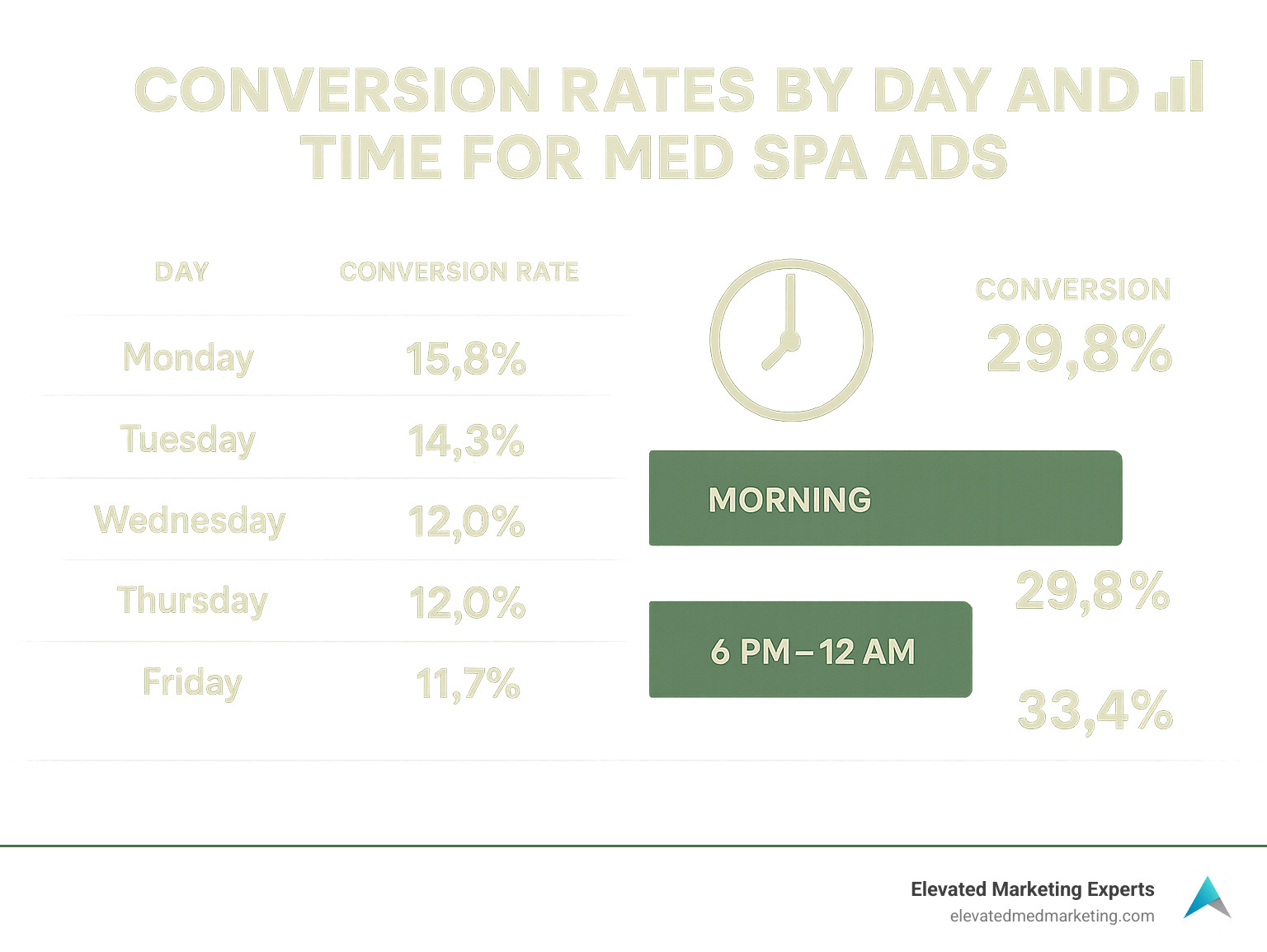
This makes perfect sense when you think about it—people research treatments after work hours or during morning breaks. They’re not typically shopping for Botox during their workday.
My recommendation? Start with even ad delivery for 2-4 weeks to collect your own data, then implement a custom schedule based on when your specific audience is converting. Adjust your bid modifiers to increase bids during these high-performing times, and you’ll see dramatic improvements in efficiency.
Crafting Irresistible Ads & Landing Pages
The heart of successful Med spa Google Ads management isn’t just about bidding on the right keywords—it’s about creating ads and landing pages that make potential patients stop scrolling and start booking.

Writing Click-Magnet Ad Copy That Converts
Let’s face it—your med spa ad is competing with dozens of others for attention. The difference between an ad that gets ignored and one that gets clicked often comes down to how well you speak to what patients really want.
I’ve found that the most effective med spa ads follow a simple but powerful formula. Your headline should immediately grab attention by combining your main keyword with what makes your practice special. Something like “Expert Botox Treatment | Natural Results” tells potential patients exactly what you offer and why they should choose you.
Your second headline works best when it addresses the emotional reason behind the search. People aren’t just looking for “laser hair removal”—they’re looking to feel confident at the beach this summer. That’s why headlines like “Smooth Wrinkles Without Surgery” perform so well.
Don’t forget to create some urgency in your third headline. “Book Now – 20% Off First Treatment” gives people a reason to act today rather than continuing to browse options.
In your description, weave in your credentials, specific benefits, and a clear next step. Something like: “Our board-certified providers deliver natural-looking results. Voted #1 med spa in [City]. New clients receive complimentary skin analysis. Book your consultation today!”
Remember to keep your ads compliant by avoiding direct prescription drug advertising. Instead of “Botox injections,” try “wrinkle reduction treatments” or “cosmetic injectables.” Google’s policies are strict here, and navigating them successfully is a key part of Med spa Google Ads management.
Designing High-Converting Landing Pages
One of the biggest mistakes I see med spas make is sending their carefully targeted ad traffic straight to their homepage. This is like inviting someone to dinner at your house, then making them search through every room to find the dining table!
Instead, create dedicated landing pages for each treatment that continue the conversation your ad started. When someone clicks on your CoolSculpting ad, they should land on a page focused entirely on CoolSculpting—not your general services page.
The most effective med spa landing pages place a clear call-to-action above the fold—meaning visitors see it without scrolling. Your phone number and a simple form should be immediately visible. Every extra field in your form reduces completion rates, so stick to the essentials: name, phone, email, and perhaps treatment of interest.
Social proof is absolutely crucial for aesthetic treatments. People want reassurance that they’ll get good results. Include before-and-after photos (following proper compliance guidelines), patient testimonials, and any credentials or awards your practice has received.
I’ve seen conversion rates nearly double when med spas add a well-designed FAQ section addressing common concerns like pain, downtime, and results timeline. This answers objections before they become reasons not to book.
And don’t forget mobile optimization! Over 60% of med spa searches happen on smartphones, so your pages must load quickly and look great on smaller screens. Three seconds is the maximum acceptable load time before people start abandoning your page.
Leveraging Ad Extensions & Local Proof
Think of ad extensions as free real estate in Google’s search results. They make your ad physically larger and provide valuable information that can improve click-through rates dramatically.
For med spas, location extensions are particularly powerful. They show your address directly in your ad and can display on Google Maps, perfect for “near me” searches. Call extensions add your phone number, making it one tap for mobile users to reach you.
Sitelink extensions let you highlight specific treatments or offers. Instead of hoping visitors steer to your CoolSculpting page, add a direct link with text like “Body Contouring Specials.” Callout extensions showcase quick selling points: “Evening Appointments Available,” “Free Consultations,” or “Board-Certified Providers.”
The local element is crucial for med spas—most patients won’t travel more than 20 miles for treatments. Make sure your Google Business Profile is fully optimized and connected to your ads account. This allows your star rating to appear directly in your ads, instantly building credibility with potential patients.
When implemented correctly, these extensions and local elements don’t just improve click-through rates—they pre-qualify visitors by giving them more information before they click, leading to higher-quality leads and better conversion rates for your Med spa Google Ads management campaigns.
Optimization, Tracking & Scaling for Maximum ROI
Turning your Med spa Google Ads management into a revenue-generating machine isn’t a “set it and forget it” affair. It’s more like tending a garden – with regular care and attention, your campaigns will flourish and grow.

Must-Track Metrics & Benchmarks
Let’s talk about what actually matters when measuring success. Forget vanity metrics – here’s what you should be watching like a hawk:
Your Cost Per Lead (CPL) should ideally stay under $15 for Botox and fillers, while body treatments might run up to $30 per lead. If you’re seeing higher numbers, something needs adjustment.
Healthy Conversion Rates typically hover around 8% or higher from click to form submission. Think about it – that’s 8 potential patients from every 100 visitors!
The Cost Per Acquisition (CPA) reveals what you’re actually paying to get a paying patient in the door. This connects directly to your…
Return on Ad Spend (ROAS), which should be at least 4:1 (or 400%). Simply put, for every dollar spent on ads, you want $4 coming back to your med spa.
Don’t ignore your Quality Score – aim for 7+ on your core keywords. This not only improves your ad positioning but can actually lower your costs.
After working with hundreds of med spas across the country, we’ve seen these realistic benchmarks emerge:
| Treatment | Average CPL | Conversion Rate | Target ROAS |
|---|---|---|---|
| Botox/Fillers | $7-15 | 10-15% | 500%+ |
| Laser Hair Removal | $15-25 | 8-12% | 400%+ |
| Body Contouring | $20-40 | 5-10% | 300%+ |
| Medical Weight Loss | $30-50 | 6-10% | 350%+ |
These numbers will shift based on your location, competitive landscape, and brand positioning. A med spa in Beverly Hills faces different challenges than one in rural Iowa.
Ongoing Optimization Cadence
Success comes from consistency. Create a rhythm for your optimization efforts:
Daily check-ins don’t need to be time-consuming – just make sure campaigns are running properly and perhaps nudge bids up on keywords that are performing well.
Weekly deep dives should include reviewing your search terms report (gold mine alert!), adding negative keywords, and testing fresh ad variations. This weekly habit alone can save you hundreds in wasted spend.
Bi-weekly analysis is perfect for examining device performance (are mobile users converting better than desktop?) and demographic insights that might inform bid adjustments.
Monthly reviews are your chance to step back and look at the big picture – reallocate budget, test new landing page elements, and plan for seasonal opportunities.
One of our clients finded through their search terms report that “mommy makeover non-surgical” was bringing in fantastic leads at nearly half the cost of their main keywords. By adding this as an exact match keyword, their entire campaign performance improved dramatically.
Scaling Winners Without Wasting Budget
When you’ve found what works, scaling intelligently is your next move:
Rather than doubling budgets overnight, increase spending gradually by 10-15% increments on your star performers. This gives the algorithm time to adjust without tanking your results.
Consider expanding your geographic targeting – perhaps widening your radius by a few miles or adding neighboring towns where patients might travel from.
Once you have solid conversion data (at least 15-30 conversions per month), implement target ROAS bidding to let Google’s AI optimize for your revenue goals.
Look for opportunities to introduce similar treatments that would appeal to the same audience. If your CoolSculpting ads are crushing it, maybe it’s time to add campaigns for other body contouring services.
Don’t forget the power of remarketing campaigns targeting website visitors who showed interest but didn’t convert. These typically deliver leads at 30-50% lower costs than your standard campaigns. These warm prospects just need a gentle nudge!
Med spa Google Ads management Reporting Stack
What gets measured gets managed – and improved. Build a reporting system that makes sense of all this data:
A customized Google Data Studio dashboard gives you real-time access to your metrics, perfect for those “how are we doing this week?” moments.
Implementing call recording and tracking helps you assess not just lead quantity but quality. Are callers asking detailed questions about treatments or just price shopping?
CRM integration closes the loop, tracking leads from first click to paying patient and beyond. This is how you prove true ROI.
We provide our clients with monthly executive summaries that cut through the data noise to highlight wins, opportunities, and strategic recommendations. One glance tells you if your campaigns are thriving or need attention.
Our custom dashboards show everything from campaign performance trends to cost per lead by treatment, call vs. form submission breakdowns, and even geographic heat maps showing where your hottest prospects live. We can even project your ROI based on your average patient value.
This level of transparency builds trust and helps practice owners see exactly how their marketing dollars translate to revenue. When you can clearly see that spending $2,000 on Google Ads brought in $12,000 in treatment revenue last month, those marketing budget discussions become much easier!
Want to learn more about maximizing your ad spend? Check out our Pay Per Click Campaign Management Services for specialized support.
Common Mistakes & Compliance Pitfalls to Avoid
Let’s be honest – even the savviest marketers can stumble when it comes to med spa advertising. I’ve seen practices waste thousands of dollars on simple mistakes that could have been easily avoided. Here’s how to make sure you’re not one of them.

Top 7 Errors That Drain Budget Fast
You know that sinking feeling when you check your ad account and realize you’ve been wasting money? I’ve helped dozens of med spas recover from these common budget-draining mistakes.
Using broad match keywords exclusively is like casting a net that’s way too wide. You’ll catch some good fish, but you’ll also pull in seaweed, old boots, and who knows what else. Instead, build your campaigns with a thoughtful mix of match types, emphasizing phrase and exact match for your core treatments.
Neglecting negative keywords might be the costliest mistake I see. One client was unknowingly spending nearly 30% of their budget on people searching for “med spa jobs” and “how to become an injector.” We added comprehensive negative keywords and instantly improved their results without spending an extra penny.
Weak landing pages kill conversion rates. Sending your precious traffic to your homepage is like inviting someone to dinner but not telling them which restaurant. Create dedicated, treatment-specific landing pages that continue the conversation your ad started.
Running ads 24/7 feels right, but the data tells a different story. Your ideal patients aren’t searching equally throughout the day. Focus your budget on high-converting times – those Tuesday evenings are golden for a reason!
Not tracking phone calls is a massive blind spot. For most med spas, 60-70% of leads call rather than fill out forms. Without call tracking, you’re flying blind on most of your conversions. Make sure to count calls over 60 seconds as meaningful leads.
Duplicate keywords across ad groups forces your campaigns to compete against themselves – essentially bidding up your own costs. Keep a clean keyword strategy where each term appears in only one ad group.
Ignoring mobile experience is particularly painful for med spas. When your potential client is scrolling on their phone during lunch break and your page takes forever to load or your form is impossible to fill out on mobile, you’ve lost them forever.
I remember working with a med spa that was spending $7,000 monthly on Google Ads but only tracking form submissions. When we implemented proper call tracking, we finded their actual cost per lead was less than half what they thought! This revelation allowed us to scale their campaigns with confidence, knowing the true ROI.
Staying On the Right Side of Google & the FDA
Medical advertising walks a fine compliance line that other industries don’t face. Both Google and healthcare authorities keep a watchful eye on how aesthetic treatments are marketed.
Before/after photos are powerful but must include clear disclaimers that results may vary. I’ve seen accounts suspended for showcasing dramatic changes without proper context.
Prescription treatments require special handling. While you can’t directly promote Botox in your ad copy, you can certainly discuss “wrinkle relaxers” or “cosmetic injectables” and then elaborate on your landing page with proper disclaimers.
Body image sensitivity matters more than ever. Google (and patients) will reject language that exploits insecurities. Focus on confidence-building and self-care rather than “fixing flaws.”
Medical claims must be factually supportable. That “miracle treatment” language might seem compelling, but it’s a fast track to ad disapproval.
Personalized health information has strict limitations. Never use remarketing for sensitive health conditions – Google explicitly prohibits this practice.
Google’s healthcare policies specifically prohibit promoting unapproved pharmaceuticals, making misleading claims, advertising certain body part improvements, and using manipulative body image language. These policies change frequently, so staying updated is essential for successful Med spa Google Ads management.
To maintain compliance while still effectively marketing your services, focus on benefits rather than specific treatments in your ad copy. Use approved terminology for prescription treatments, implement proper disclaimers on landing pages, maintain separate campaigns for different treatment categories, and regularly check Google’s advertising policies page for updates.
I’ve helped dozens of med spas steer these complex waters, finding the sweet spot between compelling marketing and strict compliance. The key is understanding not just what’s prohibited, but why – then crafting messaging that respects both the rules and your patients’ intelligence.
Integrating Google Ads with SEO & Social for Full-Funnel Growth
While Google Ads excels at capturing high-intent searches, integrating it with other marketing channels creates a comprehensive strategy that nurtures patients at every stage of their journey.
How Paid & Organic Search Work Together
SEO and Google Ads complement each other in several ways:
SERP domination: Appearing in both paid and organic results increases overall visibility and perceived authority.
Keyword intelligence sharing: Use Google Ads data to identify high-converting keywords for SEO content.
Filling visibility gaps: Use paid search to appear for keywords where you don’t rank organically yet.
Branded search protection: Bidding on your brand name prevents competitors from stealing your traffic.
For example, one of our med spa clients uses Google Ads to capture high-intent treatment searches while building out comprehensive SEO content around education topics like “how does CoolSculpting work” and “Botox vs. Dysport differences.”
This approach ensures they capture patients at both the research and booking stages of their journey.
Building Omnichannel Retargeting Loops
Create a full-funnel approach by connecting your Google Ads with other channels:
Google Display remarketing: Show banner ads to previous website visitors.
YouTube remarketing: Create educational videos for people who visited specific treatment pages.
Facebook/Instagram custom audiences: Upload your website visitor lists to create targeted social campaigns.
Email nurturing: Send educational content to leads who weren’t ready to book.
This multi-channel approach significantly improves overall conversion rates. One of our clients saw a 32% increase in total conversions after implementing a coordinated remarketing strategy across Google, Facebook, and email.
“The magic happens when Google Ads captures initial interest, and then our other channels nurture those leads until they’re ready to book. This approach has doubled our patient conversion rate.” — Med Spa Owner
By creating this ecosystem, you’re building multiple touchpoints with potential patients, increasing trust and familiarity with your brand.
Frequently Asked Questions about Med Spa Google Ads
What budget should a med spa start with?
When it comes to Med spa Google Ads management, budget questions are always at the top of the list. Based on our experience with hundreds of clients, we recommend starting with $2,500-$5,000 per month for each campaign or major treatment category.
This isn’t just an arbitrary number—it’s the sweet spot that gives Google’s algorithm enough data to optimize while generating a meaningful volume of leads from day one. Think of it like planting seeds: you need to water them enough to grow, but not so much that you’re wasting resources.
Your ideal budget will depend on several factors. If you’re in a competitive market like Beverly Hills or Manhattan, you might need to start at the higher end of that range. Similarly, if you’re promoting high-ticket treatments like comprehensive body contouring packages, a larger initial investment makes sense given the potential return.
The beauty of Google Ads is its scalability. Once your campaigns are humming along at your target cost per lead and delivering a solid ROI, you can increase your budget to capture more market share. Many of our clients start with focused campaigns for their most profitable treatments, then expand as they see success.
How long until campaigns are fully optimized?
Patience is truly a virtue when it comes to Med spa Google Ads management. While you’ll start seeing leads right away, the journey to a fully optimized campaign follows a fairly predictable timeline:
During the first month, we’re in setup and data collection mode. This is where we establish baselines and make initial adjustments based on early performance indicators. It’s like the first few appointments with a new patient—we’re learning what works and what doesn’t.
By days 30-60, we implement the first round of significant optimizations based on actual performance data. This is where we might adjust bidding strategies, refine targeting parameters, or update ad copy based on what’s resonating with your audience.
The 60-90 day period brings further refinement. By this point, we have enough data to make confident decisions about keyword performance, audience targeting, and creative messaging. We’re fine-tuning the engine rather than building it.
After 90 days, your campaign typically reaches what we call a “mature” state with more predictable performance. However, the optimization never truly stops—the most significant performance gains usually occur between months 3-6 as Google’s algorithm learns from consistent data and our ongoing optimizations take effect.
For truly optimal performance with the lowest possible cost per lead and highest conversion rates, expect a 6-12 month journey of consistent management and refinement. This timeline isn’t unique to med spas—it’s simply how the platform works best.
Which treatments deliver the lowest cost per lead?
Not all aesthetic treatments are created equal when it comes to advertising costs. Based on data from hundreds of med spa clients, certain treatments consistently deliver more affordable leads.
Botox and neurotoxins typically yield the lowest cost per lead, ranging from $7-15. This makes sense—these treatments have high name recognition, relatively low entry points for new patients, and address a common concern (wrinkles) that motivates immediate action.
Laser hair removal follows close behind at $15-25 per lead. The permanent nature of the results creates a compelling value proposition that drives conversions despite the multi-session commitment.
Chemical peels and facial treatments also perform well at $10-20 per lead. These services often serve as excellent “gateway” treatments that introduce new patients to your practice.
Dermal fillers ($12-25) and microneedling ($15-30) round out the top five most cost-effective treatments to advertise.
More complex and expensive treatments like non-surgical body contouring, thread lifts, and comprehensive rejuvenation packages typically have higher acquisition costs—but they also bring higher patient lifetime values that justify the investment.
One strategy we’ve found particularly effective is using lower-cost treatments as entry points to attract new patients, then marketing higher-value services to them once they’re in your ecosystem. This approach maximizes your advertising ROI while building a sustainable patient base.
These benchmarks can vary based on your location, competition, and the specificity of your targeting. Working with an agency experienced in Med spa Google Ads management can help you identify the most cost-effective approach for your specific practice and goals.
Conclusion
Navigating Med spa Google Ads management isn’t just about getting clicks—it’s about building a reliable system that consistently brings new patients through your doors while delivering clear ROI.
After working with hundreds of med spas across the country, I’ve seen how the strategies we’ve covered can transform a practice’s growth trajectory. When implemented properly, these approaches help you:
Connect with patients at their exact moment of need—when they’re actively searching for the treatments you offer. There’s simply no better time to reach someone than when they’re already looking for you.
Lower your acquisition costs while improving the quality of leads. One of my clients initially thought Google Ads “didn’t work” until we optimized their campaigns and cut their cost per lead by 42% in just 60 days.
Create predictable, scalable growth that lets you confidently invest in expanding your practice. Nothing beats the security of knowing exactly how many new patients you can expect each month.
Blend your paid search efforts with your broader marketing strategy for complete coverage of the patient journey. When your Google Ads work in harmony with your SEO, social media, and email marketing, the results multiply.
Stay on the right side of advertising regulations—a critical concern in the aesthetic medicine field that can’t be overlooked.
At Liftd Marketing Experts, helping med spas and aesthetic practices leverage Google Ads for sustainable growth isn’t just what we do—it’s our passion. Our clients typically experience a 50-100% jump in qualified leads within the first 90 days, often while simultaneously reducing their cost per lead by 30-40%.
One of the most satisfying aspects of our work is providing clear attribution of marketing spend to actual patient revenue. There’s nothing quite like the moment when a practice owner sees exactly how many dollars in revenue came from each dollar spent on advertising.
Whether you’re just dipping your toes into Google Ads or looking to improve campaigns that aren’t performing as well as they should, success comes down to consistently applying best practices, regularly optimizing your approach, and letting data—not hunches—guide your decisions.
Ready to transform how your med spa attracts new patients? We’d love to offer you a free Google Ads audit and growth strategy session. We’ll take a deep dive into your current performance and pinpoint specific opportunities to boost your results.
In today’s competitive med spa landscape, mastering digital patient acquisition gives you a tremendous edge. Google Ads provides the most direct route to connecting with patients actively searching for your services—making it the perfect complement to your broader marketing efforts.


