

Introduction
Cosmetic surgery SEO is vital for any plastic surgery clinic seeking to boost online visibility. By implementing targeted SEO strategies, clinics can appear higher on search engine results pages (SERPs), attract more potential patients, and ultimately grow their practice. Here’s a quick snapshot of what you need to know:
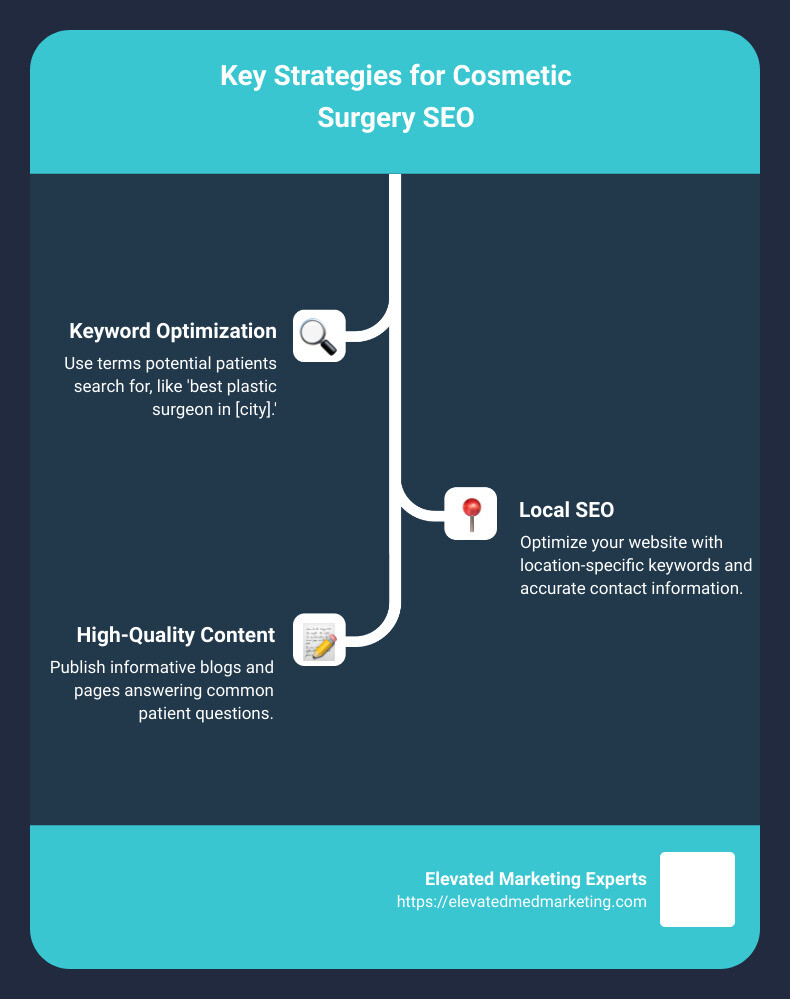
- Keyword Optimization: Use terms potential patients search for, like “best plastic surgeon in [city].”
- Local SEO: Optimize your website content with location-specific keywords and accurate contact information.
- High-Quality Content: Publish informative blogs and pages that answer common patient questions.
- Technical SEO: Ensure your site is fast, mobile-friendly, and easy to navigate.
Understanding how search engine optimization (SEO) works is essential for cosmetic surgeons looking to improve their web presence. With most prospective patients beginning their search for services online, appearing on the first page of Google can make a significant difference in attracting new clients. Not surprisingly, many plastic surgeons are frustrated by their current digital marketing efforts and are looking for effective solutions.
We’ll dive deeper into these strategies throughout the article, breaking down each aspect of cosmetic surgery SEO to help your clinic become more visible and attract high-quality leads. Whether you’re struggling with ineffective ads or just need a comprehensive guide to SEO, this article is tailored to meet your needs.
The Pillars of Effective Cosmetic Surgery SEO
To maximize visibility for your cosmetic surgery clinic, you need a well-rounded SEO strategy. This includes on-page SEO, off-page SEO, technical SEO, and local SEO. Let’s break down each of these pillars to help you understand how they contribute to your clinic’s online presence.
On-Page SEO
On-page SEO focuses on optimizing individual web pages to rank higher and earn more relevant traffic. It involves:
- Content Quality: Create informative, engaging, and medically accurate content. For example, articles on “How Does Plastic Surgery Work?” can attract a lot of traffic and establish your expertise.
- Meta Descriptions: These short snippets describe your page content to search engines. They should be concise, compelling, and include relevant keywords.
- Headers and Subheaders: Use H1 tags for titles and H2/H3 tags for subheadings. This helps search engines understand your content structure.
- Internal Linking: Link to other relevant pages on your site to help users navigate and improve SEO.
Off-Page SEO
Off-page SEO involves activities outside your website to raise your search engine rankings. Key tactics include:
- Link Building: Obtain high-quality backlinks from authoritative websites. Avoid low-quality link farms, as they can harm your SEO.
- Content Marketing: Guest blog on partner sites with links back to your clinic. This can drive traffic and improve your site’s authority.
- Influencer Marketing: Collaborate with industry influencers to gain credibility and attract more visitors.
Technical SEO
Technical SEO focuses on the backend elements of your website. This ensures search engines can crawl and index your site effectively. Important aspects include:
- Site Speed: Improve your site’s loading speed. Google research shows users expect a page to load in less than 3 seconds.
- Mobile Usability: Ensure your site is mobile-friendly. A significant number of users access the internet via mobile devices.
- Structured Data: Use structured data markup to help search engines understand your content. This can improve your visibility in search results.
- Secure Sockets Layer (SSL): Use HTTPS to secure your website. This is crucial for both SEO and user trust.
Local SEO
Local SEO helps your clinic appear in local search results, making it easier for potential patients in your area to find you. Steps to optimize local SEO include:
- Google Business Profile: Claim and optimize your profile. Include accurate NAP (Name, Address, Phone) information.
- Online Reviews: Encourage satisfied patients to leave reviews on Google, Yelp, and RealSelf. Positive reviews can boost your local credibility.
- Local Keywords: Use location-specific keywords like “cosmetic surgeon in Dallas” to attract local searches.
- Maps Integration: Ensure your practice appears on Google Maps. This makes it easier for local patients to find your clinic.
By mastering these four pillars, you can significantly enhance your clinic’s online visibility and attract more high-quality leads. Next, we’ll delve into how to craft a winning keyword strategy to further boost your SEO efforts.
Crafting a Winning Keyword Strategy
A successful keyword strategy is the backbone of effective cosmetic surgery SEO. It ensures that your website ranks high in search results, attracting the right audience. Let’s break it down into four key components: Keyword Research, Target Audience, Competitor Analysis, and Long-Tail Keywords.
Keyword Research
To start, you need to understand how potential patients search for your services. Tools like Google’s Keyword Planner can help you find the most relevant keywords.
Steps to effective keyword research:
- Start Broad: Begin with general terms like “cosmetic surgery” or “plastic surgeon.”
- Narrow Down: Focus on specific services you offer, like “rhinoplasty” or “breast augmentation.”
- Consider Long-Tail Keywords: These are longer, more specific phrases like “best rhinoplasty surgeon in Miami.”
Target Audience
Knowing your audience is crucial. Are they young adults looking for aesthetic enhancements or older individuals seeking anti-aging solutions? Understanding their needs helps you select the right keywords.
Questions to ask:
- Are they just starting to consider surgery, or are they ready to book an appointment?
- Are they looking for cosmetic improvements or medical corrections?
Competitor Analysis
Analyzing your competitors can offer valuable insights. Look at the keywords they rank for and the content they produce.
Steps for competitor analysis:
- Identify Top Competitors: Search for your services and note the top-ranking websites.
- Analyze Keywords: See what keywords these sites rank for.
- Content Review: Examine the type of content they produce. Are they using blog posts, videos, or infographics?
Long-Tail Keywords
Long-tail keywords are longer phrases that are less competitive and more specific. They may have lower search volumes but often lead to higher conversion rates.
Examples of long-tail keywords:
- “Affordable tummy tuck in Los Angeles”
- “Top-rated facelift surgeon in New York”
- “Breast augmentation recovery tips”
Using long-tail keywords can help you attract highly targeted traffic. For instance, instead of just “abdominoplasty,” you might use “abdominoplasty before and after photos.” This phrase is more specific and likely to attract users ready to make a decision.
By focusing on these four components, you can develop a robust keyword strategy that attracts the right audience and boosts your cosmetic surgery SEO.
Enhancing On-Page SEO for Cosmetic Surgery Clinics
Site Content
High-quality, informative content is the backbone of effective cosmetic surgery SEO. Your website should educate and engage visitors. Include detailed descriptions of procedures like rhinoplasty, breast augmentation, and facelifts. Make sure each service has its own page with at least 1,000 words of content. Google rewards longer, well-written content.
Example: If you specialize in breast augmentation, your page should cover the procedure, recovery tips, and FAQs. Use keywords naturally throughout the text, but avoid keyword stuffing.
“High-quality content not only educates your visitors but also helps search engines understand the relevance of your site,” says Eric St Cyr.
Meta Descriptions
Meta descriptions are short snippets that describe the content of your web pages. They appear in search engine results and can influence click-through rates. A compelling meta description should be concise, include relevant keywords, and entice users to click.
Example: For a page on breast augmentation, your meta description might be: “Learn about breast augmentation procedures, recovery tips, and patient testimonials from the best plastic surgeon in Detroit.”
User Experience
User experience (UX) is crucial for keeping visitors on your site and encouraging them to explore further. A well-structured, easy-to-navigate website can significantly improve engagement metrics, which indirectly benefits your SEO.
- Logical Site Architecture: Organize your site so visitors can easily find what they need. Place the services menu prominently and ensure each procedure is easy to locate.
- Engaging Content: Use images, videos, and testimonials to make your content more engaging.
- Mobile-Friendly Design: Ensure your website is responsive and provides a seamless experience across all devices.
Example: If a user searches for “nose job near me” and lands on your rhinoplasty page, they should quickly find detailed information about the procedure, patient reviews, and an easy way to contact you.
Page Speed
Page speed is a critical factor in both user experience and SEO rankings. Slow-loading pages can lead to higher bounce rates, which negatively impact your SEO.
- Optimize Images and Media: Compress images and videos to reduce load times.
- Use Tools: Test your site speed with tools like Lighthouse. If the audits indicate a problem, follow the recommended fixes or seek professional help.
- Accelerated Mobile Pages (AMP): Consider using AMP to speed up mobile pages.
Example: A fast-loading, mobile-optimized site can keep users engaged longer, reducing bounce rates and improving your SEO.
By improving your site content, meta descriptions, user experience, and page speed, you can significantly enhance your on-page cosmetic surgery SEO.
Next, we’ll explore how to leverage local SEO for greater reach.
Leveraging Local SEO for Greater Reach
Local SEO is crucial for cosmetic surgery clinics aiming to attract patients in their geographic area. Let’s dive into some pivotal tactics you can use to enhance your local presence.
Google Business Profile
Claiming and optimizing your Google Business Profile (GBP) is a game-changer. This free tool places your clinic directly in front of local searchers. Imagine a potential patient searching for “cosmetic surgery near me” and finding your clinic at the top. Here’s how to make the most of it:
- Complete Your Profile: Ensure your profile is 100% complete with accurate NAP (Name, Address, Phone) information. Inconsistent data can hurt your rankings.
- Add Photos and Updates: Regularly update your profile with photos of your clinic, staff, and before-and-after images. Post updates about services, promotions, or events.
- Engage with Reviews: Respond to both positive and negative reviews. Engaging with reviews builds trust and shows you care about patient feedback.

Online Reviews
Online reviews are powerful. They influence potential patients’ decisions and impact your local SEO. According to the research, Google reviews are a huge ranking factor. Here’s how to leverage them:
- Encourage Reviews: Ask satisfied patients to leave a review. Make it easy by sending them a direct link to your review page.
- Avoid Fake Reviews: Never encourage fake reviews. Authenticity is key. Google penalizes fake reviews, which can hurt your rankings.
- Respond to Reviews: Acknowledge positive reviews and address concerns in negative ones. This shows you value patient feedback and are committed to improving.
Local Keywords
Local keywords are essential for appearing in searches specific to your area. Conduct keyword research focusing on location-specific terms. Tools like Google’s Keyword Planner, Ahrefs, and SEMrush can help.
Example Keywords:
– “cosmetic surgery in [Your City]”
– “rhinoplasty surgeons near me”
– “best plastic surgeons in [Your Area]”
Maps Integration
Integrating Google Maps on your website can significantly enhance your local SEO. It helps potential patients find your clinic easily and boosts your local search rankings.
- Embed Google Maps: Embed a Google Map with your clinic’s location on your contact page.
- Add Directions: Provide clear directions to your clinic from major landmarks or highways.
- Optimize for Mobile: Ensure the map is mobile-friendly for users searching on their phones.
By leveraging these local SEO tactics, your cosmetic surgery clinic can achieve greater visibility and attract more local patients. Next, we’ll explore how to build authority with off-page SEO strategies.
Building Authority with Off-Page SEO
Off-page SEO is all about building your clinic’s reputation and authority online. This involves getting other websites to link to yours, creating valuable content, working with influencers, and maintaining a strong social media presence. Let’s dive into each of these strategies.
Link Building
Link building is the process of getting other reputable websites to link to your site. These are called backlinks. High-quality backlinks can boost your site’s credibility and improve your search engine rankings.
- Quality over Quantity: Focus on getting links from reputable sites. For example, a link from a well-known medical association is more valuable than many links from low-quality sites.
- Guest Posts: Write articles for other blogs or websites. In return, you can get a link back to your site. This is a great way to show your expertise and build relationships.
- Directories: Get listed in quality directories. These listings can provide valuable backlinks and help patients find you.
Content Marketing
Content marketing involves creating and sharing valuable content to attract and engage your audience. This can include blog posts, videos, infographics, and more.
- Educational Content: Write blog posts that answer common questions about cosmetic surgery. For example, explain the differences between procedures or share recovery tips.
- High-Quality Content: Ensure your content is well-researched and medically accurate. This builds trust with your audience and encourages other sites to link to your content.
- Guest Blogging: Write guest posts for authoritative sites in the medical field. This not only gives you backlinks but also exposes your expertise to a wider audience.
Influencer Marketing
Influencer marketing involves partnering with individuals who have a large following on social media or other platforms. These influencers can help promote your clinic to their audience.
- Choose the Right Influencers: Look for influencers who have a strong following in the health and beauty space. They should align with your brand values and have a genuine interest in your services.
- Collaborations: Work with influencers to create content, such as reviews or testimonials. This can provide social proof and attract new patients.
- Local Influencers: Partner with local influencers to reach potential patients in your area. They can help boost your local SEO efforts and bring more foot traffic to your clinic.
Social Media Presence
Maintaining an active social media presence can significantly boost your online visibility and SEO efforts.
- Engaging Content: Share before-and-after photos, patient testimonials, and behind-the-scenes looks at your clinic. This can attract and engage potential patients.
- Consistency: Post regularly to keep your audience engaged. Use a mix of content types, such as images, videos, and stories.
- SEO-Friendly Posts: Use relevant keywords and hashtags in your posts to increase visibility. For example, include terms like “cosmetic surgery” and your location.
- Link Back to Your Site: Always include a link to your website in your social media profiles and posts. This drives traffic to your site and improves your SEO.
By implementing these off-page SEO strategies, your cosmetic surgery clinic can build authority, attract more visitors, and improve its search engine rankings.
Technical SEO: Ensuring a Solid Foundation
When it comes to cosmetic surgery SEO, having a strong technical foundation is crucial. This ensures search engines can easily crawl and index your site, leading to better visibility. Let’s break down the key elements: Site Speed, Mobile Usability, Structured Data, and Secure Sockets Layer (SSL).
Site Speed
Site speed is critical. If your pages take too long to load, visitors will leave, and search engines will penalize your rankings. Google’s research shows that 53% of mobile users abandon sites that take longer than 3 seconds to load. Use tools like Lighthouse to test your site speed and find areas for improvement.
Mobile Usability
A significant number of searches for cosmetic surgery services are done on mobile devices. Therefore, your site must be mobile-friendly. A responsive design ensures your site looks good and functions well on all devices. Google even prioritizes mobile-friendly sites in its rankings.
Structured Data
Structured data helps search engines understand your content better. By using schema markup, you can provide detailed information about your services, such as types of procedures, locations, and reviews. This can improve your chances of appearing in rich snippets and other enhanced search results.
Secure Sockets Layer (SSL)
SSL certificates are essential for securing your website. They encrypt data transferred between your site and its visitors, providing a layer of security that builds trust. Google also considers SSL a ranking factor, so make sure your site uses HTTPS.
By focusing on these technical SEO aspects, your cosmetic surgery clinic can build a solid foundation for better search engine visibility. Next, we’ll dive into frequently asked questions about cosmetic surgery SEO.
Frequently Asked Questions about Cosmetic Surgery SEO
What is the most effective SEO strategy for cosmetic surgery clinics?
The most effective SEO strategy for cosmetic surgery clinics is a comprehensive approach that includes on-page, off-page, technical, and local SEO.
On-page SEO involves optimizing the content on your website. This includes using relevant keywords like “breast augmentation” and “rhinoplasty,” creating informative blog posts, and ensuring your meta descriptions are compelling and keyword-rich.
Off-page SEO focuses on building your site’s authority through backlinks from reputable sites. For example, Dr. Smith saw a 50% increase in website traffic after securing high-quality backlinks from medical journals and industry blogs.
Technical SEO ensures your site is fast, mobile-friendly, and secure. With nearly 60% of searches happening on mobile devices, a mobile-friendly design is non-negotiable. Plus, Google favors sites that load quickly and use HTTPS.
Local SEO is crucial for attracting patients in your area. Optimize your Google Business Profile, collect online reviews, and use local keywords like “cosmetic surgeon in [Your City].” This helps your clinic appear in local search results and on Google Maps.
How long does it take to see results from SEO efforts?
SEO is a long-term investment. Typically, you can expect to see noticeable improvements in 3 to 6 months. However, the timeline can vary based on several factors:
- Competition: If you’re in a highly competitive market, it might take longer to rank higher.
- Quality of Content: High-quality, relevant content can speed up the process.
- Backlinks: The more high-quality backlinks you acquire, the faster you’ll see results.
- Technical Health: A well-optimized site with fast loading times and mobile usability will rank quicker.
For example, after implementing a comprehensive SEO strategy, Dr. Smith’s clinic saw a 20% increase in patient inquiries within six months.
Can cosmetic surgery clinics handle SEO in-house or should they outsource?
Handling SEO in-house can be challenging due to the time and expertise required. SEO is not a “set it and forget it” task; it involves continuous monitoring, updating, and optimizing.
Pros of In-House SEO:
– Control: You have full control over your SEO strategy.
– Immediate Changes: Quick implementation of changes and updates.
Cons of In-House SEO:
– Time-Consuming: SEO requires ongoing effort and can take time away from patient care.
– Expertise: SEO involves various skills, from keyword research to technical optimization.
Pros of Outsourcing SEO:
– Expertise: Agencies have specialized knowledge and tools. For instance, WebFX, named the top SEO company in the U.S. by Clutch, offers comprehensive SEO services tailored to cosmetic surgery practices.
– Efficiency: Agencies can implement strategies faster and more effectively.
Cons of Outsourcing SEO:
– Cost: Outsourcing can be more expensive than handling SEO in-house.
– Less Control: You may have less direct control over the strategy and implementation.
In summary, while in-house SEO offers more control, outsourcing to a specialized agency like Elevated Marketing Experts can provide expertise and efficiency, ultimately leading to better results.
Next, we’ll wrap up our guide by discussing the continuous efforts needed for successful SEO and how to stay ahead of trends.
Conclusion
When it comes to cosmetic surgery SEO, it’s not just about setting up your website and forgetting about it. SEO is a continuous journey, and staying ahead of trends is crucial for maintaining and improving your online visibility.
Elevated Digital Marketing
At Elevated Marketing Experts, we understand that each cosmetic surgery clinic is unique. That’s why we tailor our SEO strategies to fit your specific needs and goals. From comprehensive keyword research to crafting engaging content, we cover all aspects to ensure your practice stands out online.
One of our success stories involves a plastic surgery practice in Beverly Hills. After implementing a targeted SEO campaign, they saw a significant increase in website clicks and client intakes. By focusing on procedures like breast augmentation and rhinoplasty, they were able to connect with their target audience more effectively.
Continuous SEO Efforts
SEO is not a one-time task. It requires ongoing efforts to refine and optimize your strategies. Google Analytics and the Search Console are invaluable tools for monitoring your performance. Regularly analyze metrics such as traffic increases, page views, and inbound links to identify what’s working and what needs improvement.
For example, a practice in Miami saw a boost in patient inquiries by focusing on local SEO. They targeted keywords like “facelift Tampa” and “breast augmentation specialist,” securing top positions in search results. This shows the importance of continuous keyword research and content updates.
Staying Ahead of Trends
The digital landscape is always evolving, and so should your SEO strategies. Keep up with changing trends and search terms to ensure your content remains relevant. Monthly keyword research can help you stay on top of what people are searching for.
Page-loading speed is another critical factor. Google research shows that users expect a website to load in less than 3 seconds. Optimizing your site for speed can significantly improve user experience and your search engine rankings.
Final Thoughts
Elevated Marketing Experts is committed to helping your practice thrive in the digital age. Our tailored SEO packages are designed to boost your online presence and attract more patients. SEO is a marathon, not a sprint. Continuous efforts and staying ahead of trends are key to long-term success.
For more information on how we can help you elevate your online presence, contact us today.
By following these guidelines and leveraging expert help, your cosmetic surgery clinic can achieve remarkable online visibility and growth.


