

How to Market to Doctors: 7 Powerful Proven Steps 2025
Why Marketing to Doctors Is Critical in Today’s Healthcare Landscape
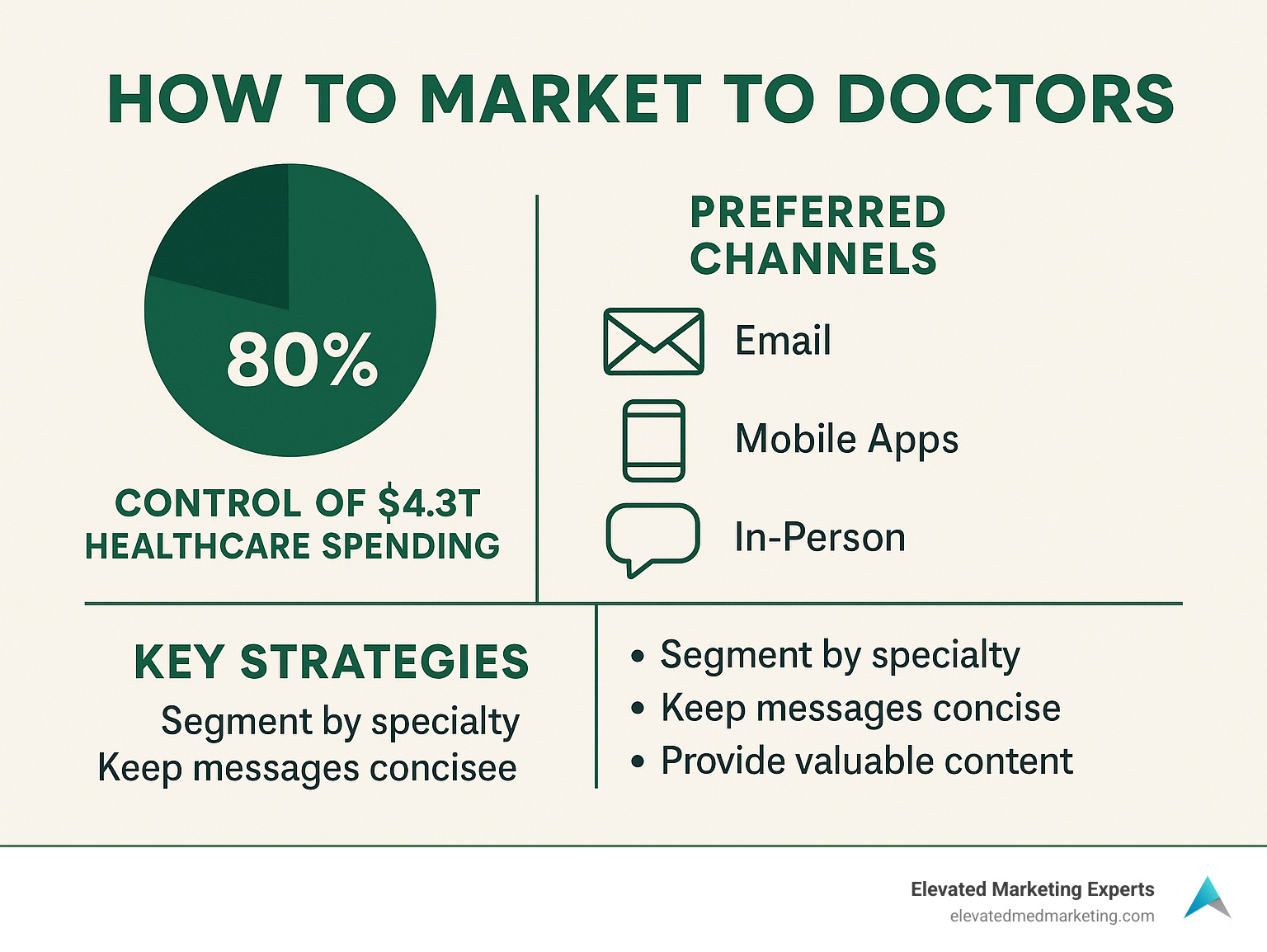
How to market to doctors effectively requires understanding their unique challenges and preferences. Here’s a quick overview of key strategies:
- Target precisely – Segment by specialty, practice setting, and career stage
- Engage gatekeepers – Build relationships with support staff who control access
- Use mobile-friendly content – Doctors consume most content on mobile devices
- Lead with value – Focus on patient outcomes and practice efficiency
- Be concise – Get to the point quickly; doctors are extremely time-constrained
Physicians control approximately 80% of all healthcare spending in the U.S., which totaled nearly $4.3 trillion in 2021. This enormous influence makes doctors one of the most valuable yet challenging audiences to reach with marketing messages.
Marketing to doctors isn’t like marketing to other professionals. Physicians are inundated with promotional materials, extremely busy (seeing 11-20 patients daily), and highly skeptical of marketing claims. They’re also well-screened from advertising through gatekeepers and technology.
Most doctors now consume information on mobile devices rather than desktops, with over 56% of healthcare website traffic coming from mobile sources. This means your marketing must be concise, mobile-optimized, and deliver value immediately.
The competition for physicians’ attention is fierce. Pharmaceutical companies alone spend approximately $30 billion annually targeting doctors, and healthcare advertising is projected to grow from $40.11 billion in 2023 to $52.1 billion by 2028.
I’m Joe Amaral, and through my experience founding multiple digital marketing companies, I’ve helped healthcare organizations develop targeted strategies for how to market to doctors that cut through the noise and deliver measurable results. Let me show you how to connect with this valuable audience effectively.
How to Market to Doctors: Step-by-Step Framework

When it comes to how to market to doctors, throwing random tactics at the wall simply won’t stick. Physicians aren’t just any audience – they’re incredibly busy professionals who control roughly $2 million each in healthcare spending annually. That’s why a thoughtful, structured approach is essential.
Think of it as creating a roadmap rather than taking a spontaneous road trip. The healthcare landscape has its own unique terrain, with regulatory guardrails and professional expectations that shape how doctors receive marketing messages.
Let’s look at how traditional and digital approaches stack up in today’s physician marketing landscape:
| Aspect | Traditional Marketing | Digital Marketing |
|---|---|---|
| Channels | Print journals, direct mail, conferences, in-person detailing | Email, social media, websites, webinars, video content |
| Cost | Higher per impression | Lower per impression, scalable |
| Targeting | Limited, broad audience segments | Precise, down to individual specialties and behaviors |
| Measurement | Difficult to track ROI | Detailed analytics and attribution |
| Engagement | One-way communication | Interactive, two-way dialogue |
| Time to Market | Weeks to months | Hours to days |
| Physician Preference | Declining, especially among younger doctors | Increasing, with 56% reporting improved visibility via digital |
With pharmaceutical giants pouring $30 billion yearly into physician marketing, smaller players need to be smarter, not bigger. Thankfully, digital channels have leveled the playing field, giving organizations of all sizes a chance to connect meaningfully with doctors – if they follow the right framework.
Identify & Segment Your Physician Audience
The phrase “marketing to doctors” is about as specific as “cooking food” – it’s just too broad to be useful. The first crucial step is defining exactly which physicians you need to reach.
Start by thinking about specialty and subspecialty distinctions. A dermatologist and a cardiologist might both be doctors, but they operate in completely different worlds with unique challenges and interests. Even within cardiology, an interventional cardiologist has different priorities than a heart failure specialist.
Practice setting dramatically influences how doctors make decisions. Hospital-employed physicians (now representing nearly 75% of doctors) steer different approval processes than those in private practice. A solo practitioner can make quick decisions, while a hospital-based physician might need to work through committees and administration.
Don’t overlook geographic location – healthcare delivery varies significantly by region due to regulations, reimbursement patterns, and patient demographics. What works in Boston might fall flat in Boise.
Career stage shapes a doctor’s receptivity to different messages. Early-career physicians are often more open to new approaches, while established doctors might prioritize efficiency and practice improvement.
For truly powerful segmentation, consider incorporating claims data to reveal actual treatment patterns, referral networks to identify influential physicians, and prescription data to understand medication preferences.
From these segments, build rich physician personas that capture not just demographics but the human elements that drive behavior. Doctors wear multiple hats:
As clinical professionals, they focus on patient outcomes and evidence-based practice. As business managers, they worry about efficiency and practice viability. And as individual people, they have personal interests, career goals, and lives beyond medicine.
As one of our clients once told me, “I spent months pitching the same message to all pediatric specialists before realizing that neonatologists and adolescent medicine doctors might as well be in different specialties entirely.”
Map the HCP Journey
Once you’ve identified your physician segments, it’s time to map their journey. Think of this as understanding the physician’s career story and where your solution fits into their narrative.
Early-career physicians (those first 5 years in practice) are establishing their clinical expertise while building patient relationships. They’re often digital natives, more receptive to new technologies, and hungry for educational resources. They’re finding their footing professionally while possibly juggling young families and substantial student debt.
Mid-career physicians (roughly 5-15 years in) are hitting their stride clinically while potentially taking on leadership roles. They’re making significant investments in their practices and looking for solutions that improve their growing reputation. Many are balancing peak career demands with family responsibilities.
Established physicians (15+ years) bring wisdom and influence to the table. They’re often in positions to shape organizational decisions while perhaps contemplating their legacy and eventual transition plans. They value efficiency and solutions that improve their well-established practice patterns.
At each stage, physicians have different questions, concerns, and information needs. By mapping these journeys, you can deliver the right message at exactly the right moment.
As healthcare marketing expert Nick Agbonyani puts it: “Doctors don’t want generic messages—they want content that gets who they are, what stage they’re at in their careers, and what actually helps their patients.” This personalized approach is what separates effective physician marketing from the noise.
Engage Support-Staff Gatekeepers
Want to know the secret passage to a physician’s attention? It’s through their support staff. Practice managers, nurses, medical assistants, and administrative professionals aren’t just obstacles to overcome – they’re essential allies in your marketing efforts.
I like to think of support staff as the “backstage pass” to physician practices. These professionals often:
Screen communications, determining what deserves the doctor’s limited attention. Pre-evaluate potential products and services, offering their recommendation before the physician ever sees your materials. Implement new systems, making them the practical experts on what works in daily practice. And perhaps most importantly, they influence purchasing decisions based on real-world workflow impacts.
Building relationships with these gatekeepers requires a genuine approach:
Identify the right people – In smaller practices, the office manager might hold the keys. In larger organizations, department administrators or nurse managers often have significant influence.
Speak to their priorities – Support staff typically value efficiency and reduced administrative burden above all else. Show how your solution makes their lives easier, not just the doctor’s.
Offer implementation support – The best product in the world fails if it’s too complicated to adopt. Provide clear training materials and ongoing support that eases the transition.
Respect their expertise – These professionals know their practice inside and out. Acknowledge their insights rather than trying to work around them.
Build authentic connections – Take time to understand their specific challenges and become a trusted resource, not just another vendor pushing a product.
One approach that’s worked well for our clients is developing separate materials specifically addressing staff concerns. The support team member who champions your solution internally will ultimately be far more persuasive than any external marketing message.
As one practice manager told me, “I’m the first line of defense for my doctors. If you can show me how something makes our practice run better, I’ll make sure the physicians hear about it.”
Selecting High-Impact Channels & Tactics
With physicians being bombarded by marketing messages from all directions, channel selection becomes crucial for breaking through the noise. Research shows that doctors are increasingly digital-first in their information consumption, with mobile adoption among U.S. physicians reaching near-universal levels.

Let’s be honest – doctors are busy people who barely have time to eat lunch, let alone wade through marketing materials. The secret to getting their attention isn’t just about being in the right place; it’s about meeting them where they naturally spend their limited time and offering something genuinely valuable when you do.
Digital First: Email, Social & Video
Today’s physicians might have stethoscopes around their necks, but they also have smartphones in their pockets. According to industry research, 70% of Americans are active on social media, and a whopping 80% of internet users look up health information there. What’s more telling is that 60% of patients trust doctors’ social media posts, and 41% use social platforms to choose healthcare providers.
When it comes to email marketing, think “short and sweet.” Mobile optimization is non-negotiable since 56% of healthcare traffic comes from mobile devices. Craft subject lines that scream benefit rather than sales pitch, and remember that doctors, like all of us, check their phones during downtime – early mornings with coffee, lunch breaks, or evening wind-down time.
Social media isn’t just for vacation photos anymore. While LinkedIn remains the professional networking gold standard, don’t discount personal platforms. Younger doctors are scrolling Instagram (71% of users are under 35), while their more established colleagues are likely on Facebook (where 72% of 50-64 year-olds hang out). The key is sharing thoughtful content that makes them think, not promotional material that makes them cringe.
As for video content, keep it brief! A doctor might give you two minutes of attention if you’re lucky. Short-form videos featuring peer physicians discussing real cases will always outperform glossy productions. Video marketers report 66% more qualified leads – numbers that speak volumes in the healthcare space.
“Doctors are like the rest of us—they scroll through social media, stream shows, shop online,” explains one healthcare marketing expert. “If you can meet them where they already are, with messages that feel authentic, you’re way ahead of the game.”
Don’t forget about remarketing – it’s like getting a second chance to make your case with physicians who’ve already shown interest by visiting your website or engaging with previous content. This approach consistently delivers better results than cold outreach.
In-Person & Hybrid Touchpoints
Even in our digital world, face-to-face connection still matters tremendously in healthcare. There’s something about a handshake (or elbow bump these days) that builds trust in ways pixels simply can’t.
Lunchtime learning sessions remain surprisingly effective. The formula is simple: bring food for the entire office (not just the doctors), keep your presentation under 20 minutes, focus on education rather than selling, and leave behind something useful that won’t just gather dust. The administrative staff will remember your kindness, and that goodwill is marketing gold.
When planning CME events, doctors are required to earn continuing education credits – so offering valuable learning opportunities positions you as a helpful resource rather than just another vendor. At conferences, don’t just stand behind your booth; create meaningful networking spaces where physicians can connect with each other.
The humble meet-and-greet shouldn’t be underestimated. Brief “hallway visits” with referring physicians or quick five-minute introductions over a sandwich can establish relationships that digital campaigns might take months to build.
Many successful organizations implement physician liaison programs with dedicated relationship managers for key accounts. When possible, hiring medical professionals as representatives adds credibility and ensures your messengers speak the same language as your audience.
A word of caution about gifts and meals: small treats are perfectly acceptable, but regulatory limitations exist for good reason. Focus first on building genuine relationships – the best gift you can offer is understanding a physician’s challenges and helping solve them.
Paid Media & Data Platforms
Smart use of paid media and physician data platforms can dramatically improve your targeting precision, helping you reach exactly the right doctors with messages that resonate.
When it comes to Google Ads, think specificity. Target particular medical search terms and conditions, use radius targeting to reach physicians in specific geographic areas, and create landing pages optimized for easy next steps. Search captures intent – these are physicians actively looking for solutions.
Programmatic advertising has revolutionized physician marketing by allowing precision targeting across devices. Geofencing around hospitals, medical offices, and conferences can deliver your message exactly when and where it matters most. Connected TV (CTV) offers a way to reach physicians during their downtime, when they might be more receptive to new ideas.
Building your own first-party data is increasingly valuable in a privacy-focused world. With proper consent, track engagement across channels for a unified view of each physician’s interests and needs. Use progressive profiling to deepen your understanding over time, allowing for increasingly personalized communication.
Don’t overlook specialized physician platforms like Doximity, which reaches an impressive 80% of US doctors. Their self-service advertising options give you greater control while allowing targeting by specialty, practice setting, and even prescribing patterns. AI-driven audience targeting can help you find similar physicians to those already engaging with your content.

The most sophisticated marketers now connect physician and patient data (in privacy-compliant ways) to measure the true impact of their efforts on patient outcomes. This closed-loop approach enables continuous optimization based on actual clinical impact rather than just clicks and views.
As one expert beautifully puts it: “It’s not about bombarding clinicians with ads; it’s about creating content experiences they value.” The right data platforms help you deliver these valuable experiences to precisely the physicians who need them most – making your marketing feel less like an interruption and more like a helpful resource.
Crafting Personalized, Compliant Messaging That Resonates
Creating content that actually engages physicians requires a deep understanding of how doctors consume information and make decisions. Research on clear English effectiveness shows that even highly educated professionals prefer clear, straightforward language over complex jargon.
When crafting physician-focused content, follow these principles:
Don’t bury the lead – Get to the point immediately; physicians will not wade through lengthy introductions to find your value proposition.
Use plain language in active voice – Studies show that 80% of highly educated people prefer simpler, active sentences to complex, passive ones. You can use medical terminology when appropriate, but frame it in clear, straightforward English.
Structure content in “bite, snack, meal” format – Provide a headline (bite), summary (snack), and full detail (meal) so physicians can choose their level of engagement based on available time.
Focus on outcomes, not features – Emphasize patient benefits and practice improvements rather than product specifications.
Tell stories through case histories – Even prestigious medical journals use case studies to engage expert readers; they’re more memorable than raw statistics.
The Power of Thought Leadership
Physicians are bombarded with promotional content but genuinely value educational resources that help them improve patient care. Thought leadership content builds trust and positions you as a partner rather than just another vendor.
Effective thought leadership formats include:
Whitepapers & Research Summaries
– Synthesize latest research on relevant clinical topics
– Include expert commentary and practical applications
– Ensure rigorous sourcing and evidence-based conclusions
– Keep design clean and professional with clear data visualization
Webinars & Virtual Roundtables
– Feature respected peer physicians as presenters
– Focus on solving clinical or practice challenges
– Include interactive elements like polling and Q&A
– Provide valuable takeaways and follow-up resources
Case Studies & Success Stories
– Highlight measurable outcomes and patient benefits
– Include specific methodologies that can be replicated
– Present balanced perspectives including challenges faced
– Obtain proper permissions and maintain patient privacy
Peer-to-Peer Content
– Facilitate knowledge sharing between physicians
– Create platforms for discussion of best practices
– Showcase innovative approaches from respected colleagues
– Build community around shared challenges and solutions
As one marketing expert notes, “Thought leadership is more effective than overt advertising in a saturated market.” By providing genuinely valuable information rather than just promotional messages, you establish credibility that makes physicians more receptive to your solutions.
Personalization at Scale
Today’s technology allows for unprecedented personalization of physician marketing, delivering content custom to individual preferences, specialties, and practice settings. This personalized approach dramatically improves engagement and conversion rates.
Key personalization strategies include:
Dynamic Content Delivery
– Adapt website content based on specialty, geography, or previous engagement
– Customize email content for different physician segments
– Deliver different case studies or testimonials based on practice setting
– Adjust calls-to-action based on the physician’s stage in the decision journey
AI-Driven Segmentation
– Use machine learning to identify patterns in physician behavior
– Create micro-segments based on engagement patterns
– Predict which content will resonate with specific physicians
– Continuously refine targeting based on interaction data
Personalized Landing Pages
– Create specialty-specific entry points to your website
– Pre-populate forms with known information to reduce friction
– Show relevant testimonials from peers in similar practices
– Highlight solutions to specialty-specific challenges
According to marketing platform Instapage, personalized landing pages can increase conversion rates by up to 68%. For physician marketing, where attention is scarce and competition fierce, this level of personalization can be the difference between being ignored and making a meaningful connection.
Staying On the Right Side of Regulations
Marketing to physicians requires careful navigation of numerous regulations, including HIPAA, GDPR, the Sunshine Act, and various industry codes of conduct. Non-compliance can result in severe penalties and damage to your reputation.
To ensure compliant physician marketing:
Privacy Policies & Data Handling
– Implement robust privacy policies covering all data collection
– Obtain explicit consent for data use in marketing
– Maintain secure systems for physician data storage
– Regularly audit data handling procedures
Opt-In Requirements
– Use clear opt-in mechanisms for all communications
– Make unsubscribe options prominent and simple
– Document consent and preference changes
– Honor opt-out requests promptly
Compliant Gift & Meal Policies
– Understand Sunshine Act reporting requirements
– Keep gifts modest and primarily educational
– Document all transfers of value to physicians
– Ensure meals are reasonable and appropriate
Data Clean Rooms & Privacy-Safe Analytics
– Use privacy-enhancing technologies like data clean rooms
– Implement privacy-safe measurement techniques
– Ensure third-party vendors maintain compliance
– Consider differential privacy techniques for sensitive data
Compliance isn’t just about avoiding penalties—it’s about building trust. Physicians are highly sensitive to privacy concerns, both for themselves and their patients. Demonstrating a commitment to ethical marketing practices strengthens your relationship with the physician community.
Measuring Success & Optimizing ROI

Let’s face it – if you can’t measure it, you can’t improve it. This is especially true when how to market to doctors requires such a significant investment of time and resources. As healthcare advertising becomes more competitive (and let’s be honest, more expensive), your ability to track what’s working and continuously fine-tune your approach gives you a serious edge.
The journey to effective measurement starts with clearly defined key performance indicators (KPIs) that align with what you’re actually trying to achieve. For physician marketing, think beyond simple click metrics. What really matters might be:
Engagement metrics tell you if doctors are actually consuming your content. Are they opening those carefully crafted emails? Downloading your thought leadership pieces? Sticking around to watch your videos or attending your webinars?
Conversion metrics reveal when interest transforms into action. This could be completing a form, requesting an appointment, or signing up for a trial of your service.
Relationship metrics help you understand the depth of your connection. Are physicians coming back for more content? Have referral patterns changed? What’s your Net Promoter Score looking like?
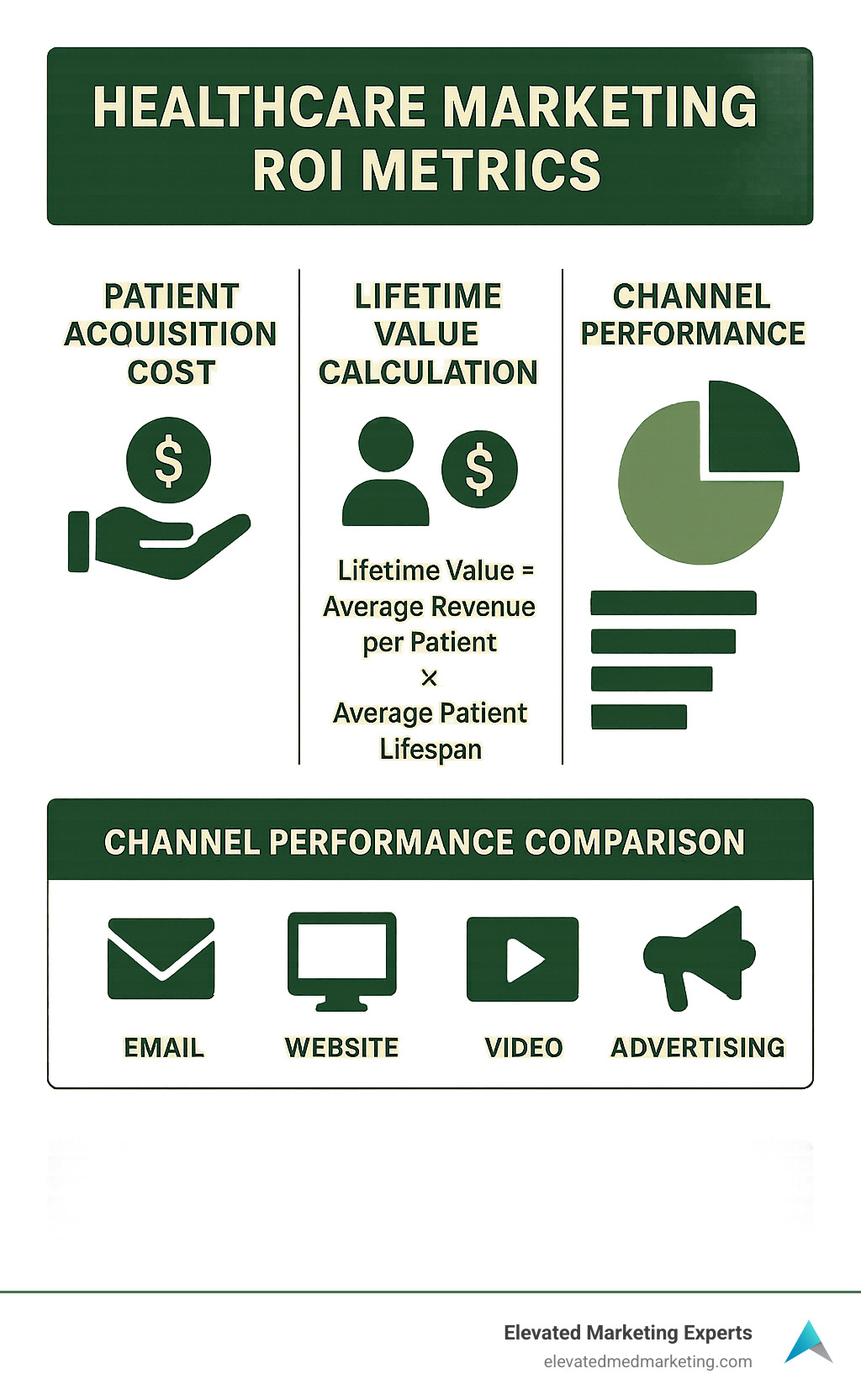
Business metrics translate marketing activities into dollars and cents. What’s your Patient Acquisition Cost (PAC)? What’s the lifetime value of each new relationship? And ultimately, what’s your true ROI?
When it comes to attribution, single-touch models (like giving all credit to the first or last click) rarely tell the whole story. Physicians rarely make decisions based on a single marketing touchpoint. Instead, consider implementing multi-touch models that recognize the complex journey doctors take before deciding to engage with your organization.
Data & Dashboarding
Numbers without context are just… well, numbers. To make your physician marketing data truly actionable, you need robust dashboarding and analytics systems that turn raw data into insights you can actually use.
Real-Time Dashboards give you an at-a-glance view of what’s happening right now. Tools like Google Looker Studio let you create customized reports that speak to different stakeholders in your organization. Your CMO might want to see high-level ROI trends, while your content team needs granular engagement metrics. Make sure these dashboards include trend analysis so you can spot shifts over time, and ensure they’re mobile-friendly for those moments when you need to check performance between meetings.
Funnel Metrics help you visualize how physicians move from first awareness to active engagement to actual conversion. Where are doctors dropping off in their journey? Which touchpoints are most effective at moving them to the next stage? By measuring velocity through the funnel for different specialties, you can identify which physician segments convert more quickly and adjust your approach accordingly.
Cohort Analysis groups physicians based on when they first engaged with your content, letting you track how these relationships develop over time. Maybe cardiologists from your Q1 campaign are showing stronger long-term engagement than those from Q2. This type of analysis helps you identify which acquisition channels produce the highest-value relationships, not just the most initial clicks.
When calculating ROI, remember to balance short-term metrics with long-term value. If your Patient Acquisition Cost is $100 but each patient generates $500 in profit, your marketing is working beautifully even if the initial cost seems high. As one of our healthcare marketing clients recently told me, “I stopped worrying about cost per lead when I realized certain leads were worth ten times more than others.”
Continuous Improvement Loop
The secret sauce of successful physician marketing isn’t a one-and-done approach – it’s creating a structured process for continuous improvement. Think of it as the scientific method applied to your marketing efforts.
A/B Testing lets you experiment with different elements of your campaigns to see what resonates most with physicians. Try different headlines, images, and calls-to-action. Compare how different specialties respond to various approaches. Start with high-impact elements like email subject lines (they determine whether your message even gets opened!), then implement winning variations quickly across your campaigns.
Creative Refresh keeps your content feeling current and relevant. Even your best-performing assets will eventually experience fatigue as physicians see them repeatedly. Regularly update your case studies and testimonials, refresh design elements while maintaining brand consistency, and incorporate new research findings to show you’re on top of industry developments.
Competitive Benchmarking helps you understand how you stack up against others vying for physician attention. Monitor competitor messaging and positioning. Track share of voice in physician channels. Analyze their content strategies to identify gaps you can fill. Sometimes the best opportunities come from seeing what others are missing.
The magic happens when you create a feedback loop where insights from your measurement directly inform adjustments to your targeting, messaging, and channel strategy. This iterative approach leads to continuously improving results and more efficient use of your marketing resources.
The most successful marketers aren’t those with the biggest budgets – they’re the ones who measure carefully, learn constantly, and adapt quickly. Want to learn more about creating content that resonates with physicians? Check out our content marketing services for additional insights.
Frequently Asked Questions about How to Market to Doctors
How to market to doctors when budgets are limited?
Let’s face it – not everyone has a pharmaceutical giant’s marketing budget. The good news? You don’t need deep pockets to make meaningful connections with physicians.
When working with tighter resources, it’s all about being smarter, not louder. Focus on quality over quantity by identifying which physician segments offer the highest potential value to your business. A targeted approach to your most promising prospects will always outperform scattered efforts across too many segments.
Your existing channels are gold mines for cost-effective outreach. Email marketing to physicians already in your database typically delivers outstanding ROI, especially when messages are personalized and valuable. Your organic social media and thoughtful content marketing can work harder for you without requiring additional spend.
Content creation doesn’t need to break the bank either. Develop cornerstone pieces that you can repurpose across multiple formats – turn that detailed whitepaper into blog posts, social snippets, email content, and presentation materials. This approach stretches your content budget while maintaining consistent messaging.
Perhaps the most overlooked budget-friendly strategy is building strong referral relationships. As one physician marketing specialist told me, “A warm introduction from a trusted colleague is worth more than a thousand cold calls.” Implement a systematic approach to nurturing referrals from your existing physician contacts.
When you do spend on advertising, make those dollars count with hyper-targeted paid social campaigns. A modest budget focused on precisely the right specialists can dramatically outperform larger spends on broader audiences.
Consistency trumps volume every time. A small, sustained effort focused on the right physicians will generate better results than occasional splashy campaigns that quickly fade.
How to market to doctors in saturated specialties?
When everyone’s fighting for the same physicians’ attention, standing out requires more than just shouting louder or spending more.
The most successful marketers in competitive specialties find the gaps others have missed. Look for underserved niches within popular specialties – perhaps pediatric dermatologists or rural orthopedists receive less targeted outreach than their urban counterparts. These physicians may be more receptive to relevant messages that address their specific challenges.
Pay attention to emerging needs that established competitors haven’t yet recognized. The healthcare landscape evolves constantly, creating new pain points and opportunities. Being first to address these emerging concerns positions you as an innovator rather than just another vendor.
Thought leadership becomes particularly valuable in crowded markets. Invest in original research or unique insights that truly advance the conversation in your specialty. This approach requires more effort but creates differentiation that’s difficult for competitors to replicate.
Take personalization to the next level by using data to create hyper-custom experiences for different physician segments. Generic competitors typically blast the same message to everyone, so customized communications that acknowledge physicians’ specific practice settings and challenges will naturally stand out.
Building community around shared interests or challenges can also cut through the noise. As one marketing director put it: “Most companies just want to sell to doctors. We created a space where they could connect with each other, and suddenly they wanted to connect with us too.”
The key is avoiding the temptation to compete on the same terms as everyone else. Most marketing aimed at doctors looks and sounds remarkably similar – clinical, feature-focused, and forgettable. Standing out requires a fundamentally different approach, not just more aggressive messaging.
How to market to doctors while staying HIPAA-compliant?
Navigating compliance requirements doesn’t mean sacrificing marketing effectiveness – it just requires thoughtful planning and systems.
The foundation of HIPAA-compliant physician marketing is maintaining clear separation between patient and physician data. Create distinct systems and processes for your physician marketing activities to avoid inadvertently mixing protected health information with marketing databases.
When using patient data to inform your physician marketing strategy (like identifying referral patterns or treatment trends), ensure proper de-identification following HIPAA guidelines. This allows you to leverage valuable insights without compliance risks.
Your marketing technology stack deserves careful attention too. Establish proper Business Associate Agreements (BAAs) with all vendors who might have access to protected health information, including your CRM, email platform, and analytics tools.
Don’t underestimate the human factor in compliance. Train everyone on your marketing team about HIPAA requirements and specific protocols for physician communications. A simple mistake from someone who doesn’t understand the rules can create significant liability.
Documentation matters tremendously in compliance. Maintain clear records of physician opt-ins for marketing communications and honor preference changes promptly. This not only keeps you compliant but builds trust with physicians who appreciate your respect for their preferences.
Regular compliance audits of your physician marketing activities provide peace of mind and catch potential issues before they become problems. Schedule these reviews quarterly to stay ahead of changing regulations and practices.
Physicians themselves are highly sensitive to privacy concerns – both for their patients and their own data. Demonstrating strong compliance practices doesn’t just keep you legally safe; it reinforces your credibility as a trustworthy healthcare partner who understands their world.
At Liftd Marketing Experts, we’ve helped countless healthcare organizations steer these compliance challenges while still creating effective physician marketing programs that drive real results.
Conclusion & Next Steps
Marketing to physicians effectively requires a strategic, data-driven approach that respects their unique challenges and preferences. By implementing the framework we’ve outlined—from precise audience segmentation to personalized messaging to rigorous measurement—you can build meaningful relationships with doctors that drive business results.
Key takeaways for successful physician marketing include:
- Meet doctors where they are – increasingly on mobile devices and digital platforms
- Respect their time – with concise, value-focused messaging
- Engage the entire practice – including influential support staff
- Lead with education – through thought leadership and peer insights
- Measure what matters – with sophisticated attribution and ROI analysis
At Liftd Digital Marketing, we specialize in helping aesthetic and wellness practices connect with physicians through targeted digital strategies. Our experience in the healthcare space gives us unique insight into how to market to doctors effectively while navigating the complex regulatory landscape.
Physician marketing is a marathon, not a sprint. The most successful programs focus on building long-term relationships and delivering consistent value rather than pursuing quick wins. By taking a patient, strategic approach, you can develop a physician marketing program that delivers sustainable competitive advantage.
Ready to take your physician marketing to the next level? Learn more about our content marketing services or contact us for a personalized strategy session custom to your specific goals.


