

Data-driven marketing strategies: 5 Powerful Proven Wins 2025
The Power of Data-Driven Decision Making in Marketing
Data-driven marketing strategies are systematic approaches that leverage customer data analysis to inform marketing decisions, personalize customer experiences, and optimize campaign performance in real-time.
Quick Answer: What are effective data-driven marketing strategies?
- Customer Segmentation – Divide your audience based on behavior and demographics
- Personalization – Tailor content and offers to individual preferences
- Predictive Analytics – Forecast customer behavior and campaign outcomes
- Multi-channel Attribution – Track touchpoints across the customer journey
- A/B Testing – Continuously test and refine marketing elements
- Real-time Campaign Optimization – Adjust tactics based on live performance data
- Data-informed Content Creation – Develop content based on audience insights
The digital landscape has transformed how businesses connect with customers. With the world expected to produce a staggering 181 zettabytes of data by 2025, marketers now have unprecedented access to insights about their audience’s behaviors, preferences, and journeys.
Yet despite this wealth of information, only 53% of marketing decisions are actually based on data. This represents a massive missed opportunity, as businesses that implement data-driven marketing strategies drive five to eight times more ROI than those that don’t.
“Marketing needs to be data-driven in order to compete—robust data leads to more accurate insights, quicker decisions, and more effective campaigns.”
The benefits of adopting a data-driven approach are clear:
- Improved targeting and personalization
- Improved campaign performance and ROI
- More efficient budget allocation
- Better customer experiences
- Competitive advantage in crowded markets
However, many organizations struggle with implementation challenges:
- Data silos and integration issues
- Privacy and compliance concerns
- Data quality and reliability
- Lack of data literacy among teams
- Difficulty translating insights into action
I’m Joe Amaral, and through founding multiple digital marketing companies and implementing data-driven marketing strategies across various industries, I’ve witnessed how analytics can transform marketing performance from guesswork into precision. In this comprehensive guide, I’ll share proven approaches that have helped businesses like yours achieve measurable results through data-informed decision making.

Simple guide to Data-driven marketing strategies terms:
– Conversion rate optimization tips
– Cross-promotion opportunities
Data-Driven Marketing 101: Definition, Principles & Benefits

What Is Data-Driven Marketing?
Data-driven marketing is like having a conversation with your customers where you actually listen before you speak. Instead of shouting your message and hoping someone hears it, you’re analyzing real customer behaviors, preferences, and needs to craft messages that truly resonate.
Unlike traditional marketing that often relies on gut feelings and general assumptions, data-driven approaches tap into the gold mine of insights your customers are already giving you. At Liftd Marketing Experts, we’ve watched this shift transform results for our plastic surgery and medical spa clients in remarkable ways.
When Dr. Miller’s practice switched from broad-based advertising to targeted campaigns based on website behavior patterns, their consultation bookings jumped 32% in just two months. That’s the power of letting data guide your marketing decisions.
Traditional vs. Data-Driven Marketing
| Aspect | Traditional Marketing | Data-Driven Marketing |
|---|---|---|
| Decision basis | Intuition, general market research | Customer data, behavioral analytics |
| Targeting | Broad demographic groups | Precise segments, individual-level |
| Personalization | Limited, one-size-fits-all | Extensive, custom experiences |
| Timing | Predetermined campaign schedules | Real-time, trigger-based activation |
| Measurement | Delayed, often imprecise | Immediate, accurate attribution |
| Optimization | Periodic, manual adjustments | Continuous, often automated |
| ROI | Lower, harder to measure | 5-8× higher, clearly attributable |
The Benefits of Data-Driven Marketing
The magic of implementing data-driven marketing strategies goes far beyond just better campaign metrics—it transforms how you connect with potential patients.
Deeper patient understanding comes naturally when you analyze actual behavior rather than assumptions. One of our medical spa clients finded their ideal patients weren’t who they thought they were after analyzing their website traffic and conversion patterns.
More confident decision-making follows when every marketing choice has concrete data behind it. The guesswork disappears, and so does the anxiety about whether you’re spending your budget wisely.
Personalization that feels magical becomes possible at scale. When 80% of customers are more likely to choose businesses that provide personalized experiences, this matters tremendously. Your potential patients don’t want to feel like just another face in the crowd.
Conversion rates that make you smile emerge when your messaging matches what patients actually care about. We helped a facial plastic surgeon increase their consultation bookings by 47% simply by implementing behavior-based email sequences that responded to specific patient interests.
Smarter budget allocation happens naturally as data reveals which channels truly drive results. Why spend thousands on platforms that don’t convert when your data can show you exactly where your ideal patients are responding?
Competitive edge in crowded markets is perhaps the most valuable benefit, with 64% of marketing executives strongly agreeing that data-driven approaches help them outperform competitors. In the competitive aesthetics industry, this advantage is priceless.
Future-focused predictive abilities develop as you gather more historical data, allowing you to anticipate patient needs before they even express them. Imagine reaching out with exactly the right procedure information just as a potential patient begins their research journey.
With the digital world projected to produce a mind-boggling 181 zettabytes of data by 2025, the insights available to aesthetic practices will only grow richer. Yet surprisingly, 87% of marketers admit data remains their most under-used asset—creating a golden opportunity for practices ready to accept data-driven approaches.
For aesthetic medicine specifically, data-driven marketing strategies prove exceptionally valuable because patients researching cosmetic procedures typically engage in extensive online research, leaving digital breadcrumbs that can inform your entire marketing approach.
More info about Content Marketing and SEO
Building a Future-Proof Data Stack: Collection, Integration & Compliance
Creating effective data-driven marketing strategies requires a solid foundation. Think of your data infrastructure as the engine that powers all your marketing decisions – when built properly, it lets you collect valuable insights while respecting privacy boundaries.
Data Collection: Prioritizing First-Party Data
In today’s privacy-conscious world, first-party data has become marketing gold. This is information collected directly from your audience – the digital equivalent of conversations you have with patients in your practice.
Your practice likely already collects this valuable data through:
- Website analytics showing which procedures interest visitors
- CRM systems tracking patient inquiries
- Email engagement metrics revealing what content resonates
- Social media interactions highlighting community interests
- Patient surveys providing direct feedback
- Transaction records showing service popularity
- Call tracking revealing what questions prospects ask
For aesthetic practices we work with, magic happens when combining different data types. Imagine knowing a prospect spent 15 minutes on your “mommy makeover” page before calling – your team can immediately provide relevant information during that first conversation.
Research shows 82% of marketers plan to increase their use of first-party data, especially as third-party cookies continue to fade away. Your own data tells the most accurate story about your patients.
Data Integration: Breaking Down Silos
Only 8% of companies store all their data in one place. The rest struggle with fragmented information scattered across different platforms. It’s like trying to complete a puzzle when pieces are stored in different rooms!
This fragmentation creates real headaches:
You can’t see the complete patient journey. Your reports show different numbers depending on the source. Determining which marketing efforts actually drove that consultation becomes nearly impossible. And your team wastes hours manually compiling reports instead of acting on insights.
The solution? Create a unified data ecosystem connecting your website analytics, CRM, email platform, ad accounts, social media, and call tracking. For our medical aesthetics clients, we typically build centralized dashboards that pull everything together, giving you that coveted “single view” of your marketing performance.
Real-Time Dashboards: Making Data Actionable
Having data is just the starting point—being able to understand and act on it quickly is where change happens. Well-designed dashboards turn complex numbers into clear insights by visualizing trends, highlighting unusual patterns, and alerting you when metrics fall outside expected ranges.
For aesthetic practices, we focus dashboards on metrics that directly impact your bottom line: cost per lead by channel, consultation conversion rates, procedure interest by demographic, patient acquisition cost, lifetime patient value, and return on ad spend. When designed thoughtfully, even team members who consider themselves “non-technical” can use these insights to make better decisions.
Data Privacy and Compliance: The Non-Negotiable Foundation
Implementing data-driven marketing strategies in healthcare requires careful attention to privacy regulations. This isn’t just about avoiding fines—it’s about maintaining patient trust.
Key considerations include GDPR compliance if you serve European patients, CCPA/CPRA requirements for California residents, and maintaining clear boundaries around HIPAA-protected information.
We help our clients implement practical safeguards: transparent consent management so patients understand what data you’re collecting, collecting only what’s truly necessary, secure encrypted storage, regular compliance audits, and clear documented processes for handling information.
Rather than seeing compliance as a limitation, we view it as building patient trust. When people know you respect their privacy, they’re more willing to share information that helps you serve them better.
Building Data Literacy Across Teams
According to research, 81% of marketers find implementing data-driven strategies extremely complicated. This often stems from a data literacy gap—the ability to read, understand, and communicate with data.
For aesthetic practices, we take a human approach to building this skill. Rather than overwhelming your team with technical jargon, we focus on practical understanding: regular training sessions using real examples from your practice, simplified dashboards that highlight actionable insights, clear documentation of what each metric means for your business, and gradual introduction of more advanced concepts as confidence grows.
Building this strong foundation positions you perfectly to implement the powerful data-driven marketing strategies we’ll explore next. With the right infrastructure in place, you’ll make decisions based on real patient insights rather than guesswork.
More info about Advanced Segmentation Techniques
Data-Driven Marketing Strategies That Actually Work

Let’s roll up our sleeves and dive into the strategies that actually move the needle. After working with dozens of aesthetic practices, I’ve found that theory only gets you so far—what really matters are data-driven marketing strategies that deliver real results for real businesses like yours.
These aren’t just ideas I’ve read about in marketing blogs. These are battle-tested approaches we’ve implemented for plastic surgeons and medical spas who wanted to transform their patient acquisition. The beauty is that you don’t need to implement everything at once—start with what aligns best with your practice’s current goals and data capabilities.
Customer Segmentation: The Heart of Data-Driven Marketing Strategies
Think of segmentation as organizing your patient database into meaningful groups that actually make sense for your practice. When you speak directly to specific needs, your message resonates so much more powerfully.
For aesthetic practices, I’ve found three types of segmentation deliver exceptional results:
Demographic clusters help you tailor messaging based on who your prospects are. A 35-year-old mom interested in mommy makeovers needs completely different messaging than a 60-year-old considering facial rejuvenation. Income levels also drastically affect how you should position your services—premium pricing messaging works for some segments but alienates others.
Behavioral scoring takes things a step further by looking at what people actually do, not just who they are. When someone visits your Brazilian Butt Lift page three times in a week, that tells you something much more valuable than their age or zip code. We track patterns like email opens, consultation request behaviors, and treatment interest indicators to understand where patients are in their decision journey.
Psychographic profiles might sound fancy, but they’re simply about understanding motivations. Some patients are primarily concerned with results, while others focus more on recovery time or discretion. Some are quick decision-makers, while others research for months before booking a consultation.
I remember working with a plastic surgeon in Florida who was sending the same email newsletter to everyone in her database. When we segmented her list based on website behavior and sent targeted content, her email engagement jumped by 37% and consultation bookings increased by 42%. That’s the power of speaking directly to specific interests rather than broadcasting generic messages.
Some user-friendly tools that make segmentation accessible include HubSpot for larger practices, ActiveCampaign for mid-sized businesses, and even MailChimp offers basic segmentation capabilities for those just getting started.
According to McKinsey research, 71% of consumers now expect personalized interactions, and 76% get frustrated when businesses don’t deliver. Proper segmentation is what makes that personalization possible.
Hyper-Personalization at Scale
Once you’ve established meaningful segments, you can create experiences that make each prospect feel truly understood—without having to manually customize every interaction.
Dynamic content deployment sounds technical but is actually quite simple with today’s marketing platforms. Imagine your website automatically showing different before/after photos based on the procedures someone has been researching. Or email campaigns that adjust their messaging based on whether someone is a first-time visitor or a returning patient.
One of my favorite success stories comes from a medspa client who implemented dynamic homepage content. When visitors who had previously viewed CoolSculpting pages returned to the site, they saw CoolSculpting before/after images on the homepage. This simple change increased their time on site by 23% and lead form submissions by 31%—all without creating any additional content.
Recommendation engines work like Netflix suggestions, but for aesthetic procedures. “Patients who were interested in this treatment also considered…” can be incredibly effective, especially for cross-selling complementary procedures. These recommendations can appear on your website, in emails, or even be suggested by your consultation team.
Lifecycle-triggered communications deliver the right message at exactly the right moment. Instead of sending generic monthly newsletters, imagine automatically sending a perfectly timed email when someone views your Brazilian Butt Lift page multiple times but doesn’t book a consultation. The message addresses common BBL questions and perhaps offers a special consultation incentive—exactly when they’re actively considering the procedure.
A medical spa client implemented exactly this approach and saw their conversion rate jump to 28% for these targeted emails compared to just 7% for their standard newsletter. The best part? Once set up, these systems run automatically, delivering personalized experiences without ongoing manual effort.
My advice? Start simple. Use names and procedure interests in your emails. Then gradually implement more sophisticated techniques as you gather more data and build confidence in your approach.
More info about Content Strategy Services
Predictive Analytics & AI: The Next Frontier for Data-Driven Marketing Strategies
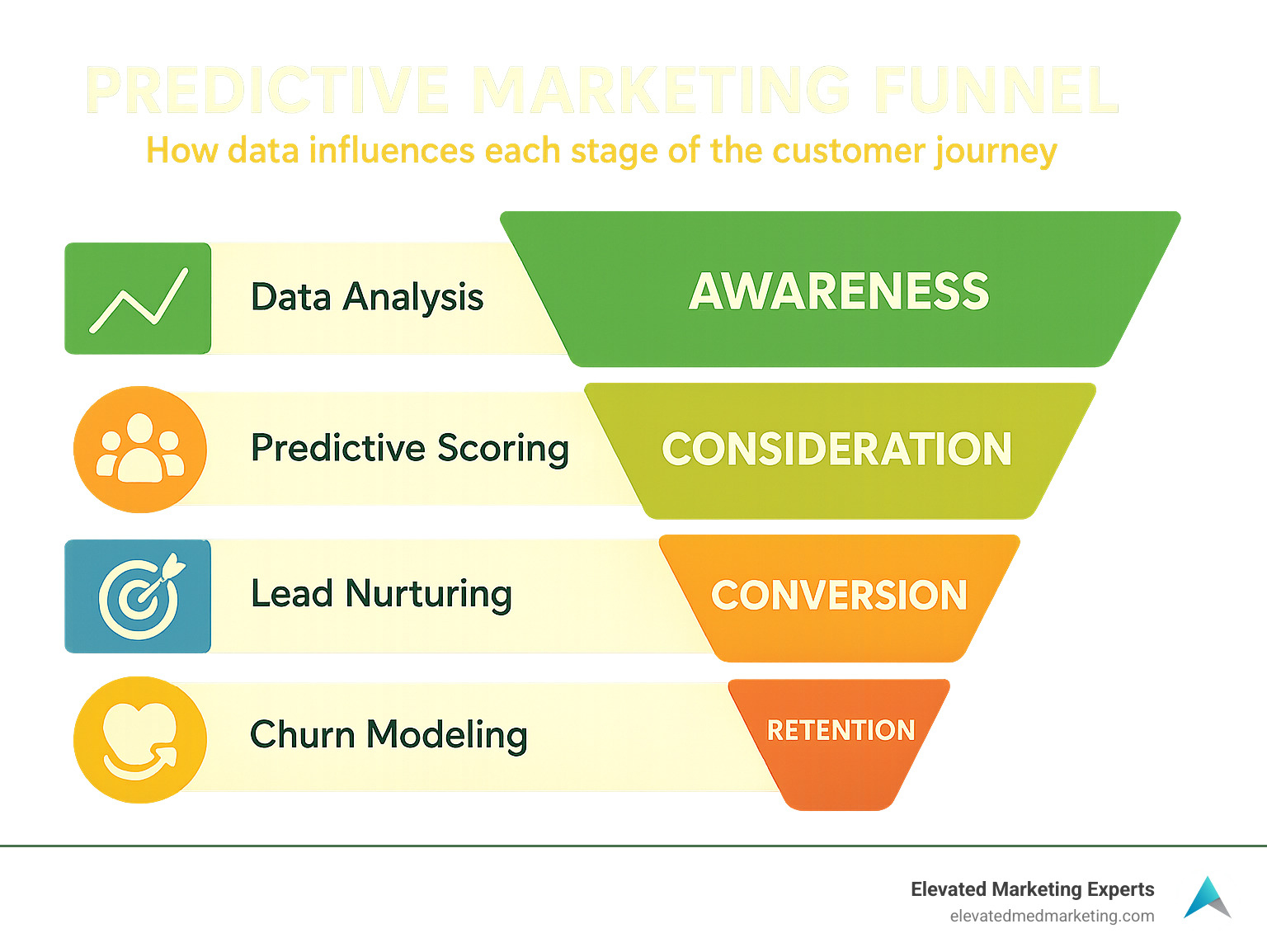
Now we’re entering exciting territory. While segmentation looks at who people are and personalization responds to what they’ve already done, predictive analytics helps you anticipate what they’re likely to do next.
Patient lifetime value prediction helps you identify which new patients are likely to become your most valuable long-term relationships. By analyzing factors like demographics, initial treatment choices, and how they respond to follow-ups, you can identify patterns that predict future spending. This lets you invest more in acquiring and retaining these high-value patients.
Churn prediction and prevention is like having an early warning system for patient retention. The algorithms can spot subtle signs that someone might be drifting away—maybe they’ve stopped opening emails, or it’s been longer than usual since their last visit. This gives you the chance to reach out proactively before they’re gone for good.
Lead scoring and prioritization ensures your team focuses on the most promising prospects first. Not all consultation requests are created equal—some people are just price shopping while others are ready to book. A good predictive model can tell the difference by looking at factors like website behavior, form responses, and how they compare to your best existing patients.
Look-alike modeling is like finding your patient soulmates. Once you know who your ideal patients are, AI can help you find more people just like them who aren’t patients yet. This dramatically improves targeting efficiency for your ads and outreach.
I worked with a plastic surgery practice that was struggling with their consultation conversion rate. We implemented a predictive lead scoring model that analyzed 14 different variables to rank consultation requests by conversion probability. By having staff prioritize the highest-scored leads for immediate follow-up, the practice increased their consultation-to-procedure conversion rate from 35% to 51%. That’s nearly 50% more procedures from the same number of consultations!
The good news is you don’t need a data science degree to implement these approaches. Modern marketing platforms increasingly include these capabilities in user-friendly interfaces. According to research, 93% of marketers believe AI will positively impact their organizations, making now the perfect time to begin exploring these capabilities.
Scientific research on predictive analytics
Measurement, Attribution & Continuous Optimization
Even the most brilliant data-driven marketing strategies fall flat without proper measurement and ongoing refinement. This is where the rubber meets the road.
Key Performance Indicators (KPIs) need to be meaningful for your specific practice. For aesthetic businesses, I recommend tracking acquisition metrics like cost per lead by channel and consultation-to-procedure conversion rates. Engagement metrics help you understand how people interact with your content, while revenue metrics like average procedure value and return on ad spend show the bottom-line impact.
Multi-touch attribution helps you understand which marketing touchpoints actually influence conversions. Did someone book because they saw your Google ad? Or was it the Instagram post they viewed later? Or perhaps the email sequence that finally convinced them? Understanding this journey helps you invest in what’s actually working.
There are several attribution models, from simple ones like first-touch (giving credit to whatever first brought someone to your practice) to sophisticated data-driven models that algorithmically determine influence. My advice? Start simple and get more complex as your data maturity increases.
A/B testing framework is your path to continuous improvement. Instead of guessing what will work better, systematically test different approaches. For example, does showing pricing information on your landing pages increase or decrease consultation requests? Only testing will tell you for sure, and the results often surprise even experienced marketers.
I worked with a medical spa that was convinced their detailed procedure descriptions were helping conversions. When we tested a simplified version focused on benefits rather than process, consultation requests increased by 23%. Without testing, they would have continued with the less effective approach indefinitely.
Budget reallocation based on performance is where all this data pays off in real dollars. When you know exactly which channels, campaigns, and messages are delivering results, you can shift resources accordingly. I’ve seen practices double their results without increasing their budget simply by reallocating funds from underperforming to high-performing channels.
Optimization isn’t a one-time event—it’s an ongoing process. The most successful practices create a culture of continuous testing and refinement rather than set-it-and-forget-it campaigns.
More info about Pay Per Click Marketing
Frequently Asked Questions about Data-Driven Marketing
What types of data are most valuable for data-driven marketing?
Not all data is created equal when it comes to powering your marketing efforts. For aesthetic practices like yours, certain data types consistently deliver the strongest results:
Website behavior data tells the true story of what potential patients are interested in—sometimes better than they could articulate themselves. When someone spends 15 minutes exploring your rhinoplasty before-and-after gallery, they’re signaling genuine interest, even if they haven’t filled out a contact form yet.
CRM data serves as your practice’s institutional memory. Those detailed records of patient history, procedure interests, and communication preferences form the backbone of meaningful personalization efforts. This is why keeping your CRM updated and organized is absolutely worth the effort.
Email engagement metrics offer a window into what resonates with your audience. When a prospect consistently opens emails about non-surgical treatments but ignores content about surgical options, they’re giving you valuable guidance about their preferences.
Conversion path data helps you understand the journey your patients take. We’ve found that most aesthetic patients interact with 7-10 touchpoints before booking a consultation, making this insight crucial for optimizing your marketing funnel.
Post-procedure satisfaction data closes the loop and helps you refine both your medical and marketing approaches. Happy patients become your best referral sources!
The real magic happens when you connect these data sources. For example, one of our plastic surgery clients finded that website visitors who viewed their financing page before requesting a consultation were 3× more likely to book a procedure—valuable insight for their consultation team.
How can small teams start implementing data-driven strategies on a budget?
You don’t need a Fortune 500 budget or a team of data scientists to become more data-driven. Here’s your practical roadmap to get started:
Begin by focusing on your first-party data—the information you already own through your website, email platform, and patient records. This is not only cost-effective but also more reliable than third-party data.
Implement Google Analytics 4 if you haven’t already. It’s completely free and provides surprisingly sophisticated insights when properly set up. Just make sure you’re tracking important events like form submissions and call button clicks.
Rather than trying to analyze everything at once, start with your most important marketing channel. If most of your patients come through Google Ads, begin there. Master one channel before expanding to others.
Most marketing platforms have robust built-in analytics that often go underused. Take time to explore the reporting features in your email platform, social media accounts, and ad platforms—you might be surprised by the insights already available.
Create simple dashboards using Looker Studio (formerly Google Data Studio) to bring key metrics together in one place. This free tool connects with most marketing platforms and gives you a holistic view of performance.
Develop a testing culture within your team. Even simple A/B tests on email subject lines or ad headlines can provide valuable insights without requiring fancy tools. One of our medspa clients increased their consultation bookings by 22% just by testing different call-to-action phrases.
Most importantly, schedule regular time for analysis. Data only becomes valuable when you actually use it to inform decisions. Block 30 minutes each week to review your key metrics and identify one improvement opportunity.
Becoming data-driven is an evolution. Start small, celebrate wins, and gradually expand your capabilities as you see results.
How do I stay compliant with privacy regulations like GDPR or CCPA?
Navigating privacy regulations while implementing data-driven marketing strategies can feel like walking a tightrope, but it’s entirely possible to be both compliant and effective.
Transparent consent forms the foundation of ethical data practices. Be crystal clear about what information you’re collecting and how you’ll use it. Vague privacy policies and pre-checked consent boxes aren’t just legally risky—they erode patient trust.
Build your data collection systems with privacy-first design. This means considering privacy implications from the beginning, not trying to retrofit compliance later. For aesthetic practices, this is particularly important given the sensitive nature of your services.
Practice data minimization by collecting only what you genuinely need. Ask yourself: “Do we really need this piece of information to provide value to our patients?” If not, don’t collect it.
Implement appropriate security measures for all patient data. This includes encryption, secure servers, and regular security updates. A data breach can devastate both your practice’s reputation and your marketing effectiveness.
Establish clear access controls within your team. Not everyone needs access to all patient information. Limit permissions based on job responsibilities.
Make sure you can fulfill deletion requests when patients ask to have their information removed. This capability is explicitly required by regulations like GDPR and CCPA.
Conduct regular audits of your data practices to ensure ongoing compliance. Privacy regulations evolve, and your compliance approach should too.
Maintain thorough documentation of consent and data processing activities. If regulators ever question your practices, good documentation will be your best defense.
For aesthetic practices, it’s especially important to maintain clear separation between marketing data and protected health information (PHI) covered by HIPAA. These are governed by different regulations and require different handling.
Working with knowledgeable partners who understand both marketing requirements and healthcare privacy considerations (like us at Liftd Marketing Experts) can help you steer this complex landscape with confidence.
More info about Plastic Surgeon Content Creation
Conclusion
The shift to data-driven marketing strategies isn’t just another trend—it’s a fundamental change that can revolutionize how aesthetic practices connect with potential patients.
Throughout my years at Liftd Marketing Experts, I’ve had the privilege of watching practices transition from “I think this might work” to “I know exactly what’s working.” The difference is remarkable, and the results speak volumes:
Practices that accept data don’t just see incremental improvements—they experience transformative growth. One of our plastic surgery clients went from struggling to fill their consultation calendar to having a waitlist within three months of implementing the data-driven approaches we’ve covered in this guide.
What makes this approach so powerful isn’t complicated technology or advanced algorithms (though those certainly help). The real magic happens when you build a culture that values evidence over assumptions. When your team starts asking “What does the data tell us?” before making decisions, you’ve already won half the battle.
Starting your data journey doesn’t need to be overwhelming. Begin with one strategy that aligns with your most pressing challenge. Is it lead quality? Focus on segmentation. Conversion rates? Implement testing. Patient retention? Look at personalization opportunities.
Progress beats perfection every time. The practices that see the greatest success aren’t necessarily those with the most sophisticated tools—they’re the ones who consistently apply what they learn and make incremental improvements over time.
Whether you’re just beginning to explore data-driven marketing or looking to refine your current approach, we’re here to help. At Liftd Marketing Experts, we specialize in translating complex data into practical strategies that drive real results for aesthetic practices just like yours.
Ready to transform your marketing from guesswork to precision? Let’s talk about how we can help you leverage the power of data to attract more of your ideal patients and grow your practice predictably and sustainably.


