

Custom Pages Keywords: Elevate Your 2025 Growth
Why Custom Pages Keywords Are the Foundation of Medical Practice Growth
Custom Pages Keywords pair the exact phrases patients search with dedicated pages that answer their questions and move them toward booking. This simple concept drives measurable growth for plastic surgeons and medical spas.
Key components
- Custom pages: Focused landing, service, or location pages built around a single treatment or offer.
- Keywords: Phrases such as “botox injections near me” or “breast augmentation consultation” that reveal patient intent.
- Strategic integration: Placing those terms naturally in titles, copy, and meta fields so search engines and readers immediately understand the topic.
Primary benefits
- Higher rankings for profitable procedures
- Better alignment between search intent and on-page content, boosting conversions
- Lower advertising costs through stronger Quality Scores
- A smoother user experience that encourages appointment requests
Remember: 33 % of all clicks go to the top three Google results. If your CoolSculpting or rhinoplasty page isn’t optimized for the exact words people type, those clicks (and consultations) land with a competitor.
I’m Joe Amaral, and after building patient-acquisition systems for multiple medical marketing agencies, I’ve seen that a disciplined Custom Pages Keywords strategy is the cornerstone of sustainable practice growth.
Additional resources:
Understanding the Foundation: What Are Custom Pages and Keywords?
Let’s clarify what “custom pages” and “keywords” mean for your practice and how they work together to bring qualified patients through your doors. Think of it this way: if your website is a medical office building, Custom Pages Keywords are the specialized departments with clear signage that guide the right patients to the right services.
What Are Custom Pages and Why Do They Matter?
Imagine a patient searching for “lip fillers near me” and landing on your general homepage. It’s confusing. This is where custom pages are essential.
A custom page is a specialized web page with one clear purpose: to address a specific patient need and guide them toward booking an appointment. It’s like a dedicated consultation room for each service.
Here’s why custom pages are powerful for medical practices:
Landing pages are ideal for specific campaigns, like a promotion on dermal fillers. Sending traffic to a dedicated page that focuses only on that offer results in higher conversion rates because visitors see exactly what they clicked for.
Service pages give each procedure its own spotlight, such as “Breast Augmentation in Miami” or “Laser Hair Removal Phoenix.” When someone searches for these treatments, they find a page that speaks directly to their needs, complete with procedure details, photos, and pricing.
Location pages are crucial if you serve multiple areas. A page optimized for “Botox near Midtown NYC” will always outperform a generic page in local searches.
The magic is in the user experience. When patients find what they’re looking for, they engage more and book consultations. This focused approach also makes A/B testing more effective, as you can test different headlines or calls-to-action to see what resonates. Tools like HubSpot’s drag-and-drop website builder make creating these pages straightforward. As we explore in our guide to Best Medical Spa Website Design, a well-designed custom page is a conversion machine.
The Role of Keywords in Digital Strategy
Keywords are the words and phrases your potential patients type into Google. Understanding their intent is everything.
Someone searching “what is botox” has informational intent; they’re learning. But a search for “book botox appointment near me” shows transactional intent; they’re ready to become a patient.
Local intent is gold for medical practices. Searches like “best plastic surgeon near me” show someone is actively looking for local services and will likely convert quickly.
Many practices mistakenly chase short-tail keywords like “botox.” These are highly competitive and often too broad. A user might want information, pricing, or a provider in another state.
Long-tail keywords are where smart practices win. Phrases like “non-surgical facelift cost in Los Angeles” have less competition and much higher conversion rates because they show specific intent from a user in a specific location.
The Custom Pages Keywords strategy combines these elements. Your custom page about microneedling becomes the perfect destination for someone searching “microneedling for acne scars near me.” The page content matches their search intent, Google sees the relevance, and your practice ranks higher. This targeted approach is powerful for medical practices, and our expertise in Keywords for Beauty and Search Engine Optimization helps practices capitalize on these high-intent searches.
The Strategist’s Playbook: Identifying and Researching Custom Page Keywords
Finding the right search terms for each custom page combines deep patient insight with hard data. Here’s the three-step framework we use at Liftd Marketing Experts.
Step 1: Understand Patient Intent and Brainstorm
Start by putting yourself in a patient’s shoes. Map their journey from first curiosity (“why do I have wrinkles at 35”) to action (“best botox provider in Chicago”). These early thoughts become seed keywords that you’ll refine later.
Consider the language real people use. Patients say “I look tired,” not “I need facial rejuvenation.” Capturing this problem-solution phrasing is gold for keyword ideas and for Creating a Content Marketing Strategy.
Step 2: Leverage Keyword Research and Competitor Analysis
Move from brainstorming to validation with tools such as Google Keyword Planner, SEMrush, and Ahrefs. Look for a healthy mix of search volume (demand) and keyword difficulty (competition). A 1,000-search-per-month phrase is useless if you’re competing with national health portals.
Next, study competitors. What phrases do top-ranking practices target? How are their pages structured? Services like AppTweak reveal gaps you can exploit – especially in crowded fields such as Search Engine Optimization for Cosmetic Surgery Practices.
Step 3: Prioritize and Map Keywords to Pages
A long-tail, local strategy wins in medical aesthetics. Instead of “plastic surgery,” pursue “mommy makeover recovery time in Dallas.” These phrases may show lower volume, but they convert far better because they match very specific intent.
Assign one primary and a few related secondary keywords to each page. This prevents internal competition and clarifies relevance for search engines. For example:
- “microneedling for acne scars in Sacramento” (local + specific problem)
- “consultation for breast augmentation Miami” (high intent)
- “non-surgical facelift cost Florida” (price research)
Used consistently, this approach turns every custom page into a magnet for high-value patients – a principle we expand on in our guide to Spa SEO Keywords.
On-Page Mastery: Strategic Keyword Placement on Custom Pages
Once you’ve identified your Custom Pages Keywords, the next step is to weave them into your pages naturally. This process involves communicating effectively with both potential patients and search engines, not just cramming keywords everywhere.
Core On-Page Elements for Custom Pages Keywords
Every element on your custom page signals its topic to search engines. Here are the most important ones for your rankings.
Your page title is your first impression. Place your primary keyword near the beginning and keep it under 60-70 characters to avoid it being cut off in search results. Instead of “Nose Surgery Services,” use “Rhinoplasty in Miami – Expert Nose Surgery by Dr. Johnson.” It’s specific, local, and informative.
Meta descriptions are your 160-character sales pitch in search results. While not a direct ranking factor, a compelling description with your keywords improves click-through rates, which Google notices.
Header tags (H1, H2, H3) create a content roadmap. Your H1 should include your primary keyword and serve as the main headline. Use H2s and H3s for subheadings, including secondary keywords where they fit. This improves both SEO and readability.
Clean URLs are surprisingly powerful. Use “yourpractice.com/rhinoplasty-miami” instead of a messy, generic URL. It’s user-friendly and tells search engines what the page is about.
These elements form a strong SEO framework, which is central to our SEO Content Creation Services. For more tips, Shopify offers excellent advice on writing effective title tags.
Content and Media Optimization
Now for the heart of your page: the content that educates and converts patients.
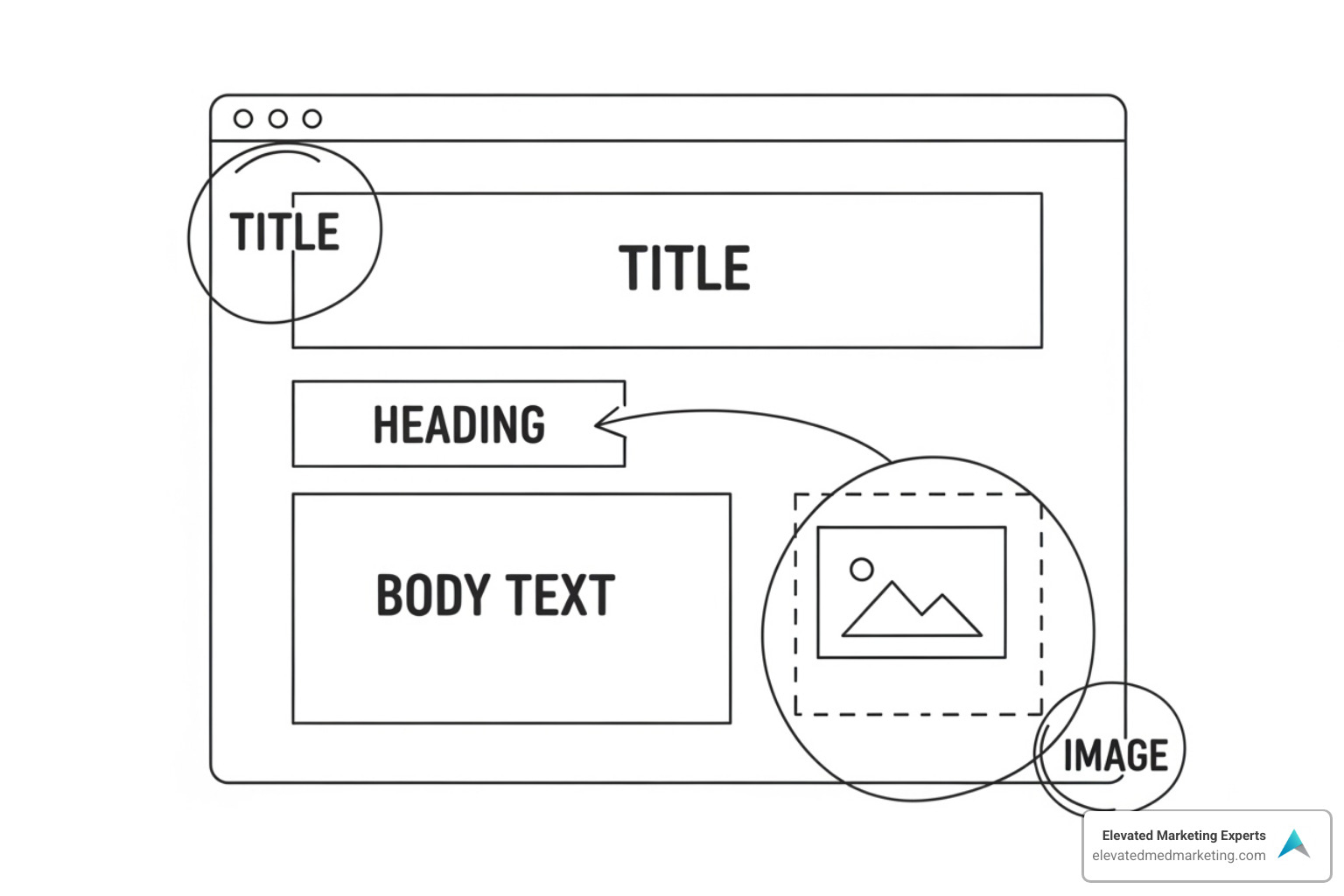
Your body content should use keywords in natural, helpful language. Mention your primary keyword in the first paragraph, then weave it and related terms throughout the text conversationally. Write for humans first. Aim for at least 300 words of valuable content on service pages, not fluff.
Image optimization is often overlooked. Use descriptive alt text for your images to help visually impaired users and give search engines context. Instead of “image1.jpg,” use “Patient after rhinoplasty procedure showing natural-looking results.” It’s helpful and keyword-rich.
Internal linking creates pathways through your site, keeping visitors engaged. On your rhinoplasty page, link to your gallery with anchor text like “view our rhinoplasty results.” This helps users and shows search engines how your content is connected.
When these elements work together, your content flows naturally while being strategically optimized. This holistic approach is the backbone of effective Content Marketing and SEO that converts visitors into patients.
Advanced Tactics: Maximizing Impact and Avoiding Pitfalls
Let’s explore advanced tactics to make your Custom Pages Keywords strategy more effective and resilient. We’ll cover common pitfalls, the role of keywords beyond organic search, and some persistent SEO myths.
Best Practices to Avoid Common SEO Mistakes
Avoiding these common traps is as important as implementing best practices:
- Keyword Stuffing: Avoid unnaturally cramming keywords into your content. Google’s algorithms penalize this practice. Focus on natural language and providing value; if it sounds awkward to a reader, it’s bad for SEO.
- Keyword Cannibalization: This happens when multiple pages target the same primary keyword, forcing them to compete against each other. This dilutes your authority. The solution is to give each custom page a unique primary keyword and user intent.
- Duplicate Content: Identical content on multiple URLs confuses search engines. Use 301 redirects or
rel=canonicaltags to indicate the authoritative version. For international sites, usehreflangtags. - Content Quality: Google prioritizes high-quality, unique, and valuable content. Don’t just rehash information; provide in-depth content that answers user questions with rich media like videos and infographics. Quality content leads to lower bounce rates and higher rankings. Tools like AIOSEO’s TruSEO score can guide your efforts.
Focusing on genuine value makes your Website Content Strategy more robust.
How Keywords Impact SEO and PPC Performance
Custom Pages Keywords are also intrinsically linked to your paid advertising success, especially in Google Ads.
- SEO Impact: Well-chosen keywords are the foundation of organic SEO, leading to higher rankings, more traffic, and increased authority and trust.
- PPC Impact: In Google Ads, keywords are fundamental to your Quality Score, which determines your ad costs and positions. A higher Quality Score means lower costs. Custom pages improve this by enhancing:
- Ad Relevance: Your ad copy should match your keywords.
- Landing Page Experience: Your custom landing page must be highly relevant to the keyword. A user clicking an ad for “lip fillers” should land on a dedicated lip filler page, not a generic homepage. This excellent experience boosts your score.
- Expected Click-Through Rate (CTR): Relevant keywords and landing pages lead to higher CTRs, another positive signal.
This synergy between SEO and PPC is crucial for maximizing conversions. Our article, From Keywords to Conversions: Mastering SEO Content Marketing Services, digs deeper into this integration.
The Truth About Meta Keywords in Modern SEO
Let’s address the outdated “meta keywords” tag.
The truth is simple: meta keywords are irrelevant for Google’s ranking algorithm. Google officially confirmed in 2009 that they do not use this tag as a ranking signal because it was abused for spamming. Most other major search engines have followed suit.
It’s crucial to distinguish the outdated tag from the concept of “keywords” we’ve discussed. Today, Custom Pages Keywords refers to the strategic use of search terms within your visible content, titles, and headings – not a hidden list in your HTML. Spend your time on strategies that actually move the needle.
Frequently Asked Questions about Custom Page Keywords
Here are answers to the most common questions medical practice owners ask about Custom Pages Keywords. Clarity on these points is crucial for your SEO strategy.
How many keywords should I target on a single custom page?
Focus on one primary keyword and 2-4 secondary, related keywords per page. Your primary keyword is the main topic, and the secondary keywords are supporting subtopics. For example, if your primary keyword is “breast augmentation Miami,” secondary keywords might be “breast implants Miami” and “cosmetic breast surgery.”
This approach creates a comprehensive resource around a single topic, providing clear signals to search engines without confusing them or your potential patients.
How long does it take to see results from optimizing custom pages with keywords?
SEO is a long-term strategy. While some changes can be indexed quickly, you’ll typically see significant ranking improvements in 3-6 months. This timeline depends on factors like your website’s existing authority, market competition, and the consistency of your efforts. Patience and persistence are key; the practices that stick with their strategy see the most dramatic, long-term results.
Can I use the same keyword on multiple custom pages?
This is not recommended as it can cause “keyword cannibalization,” where your own pages compete against each other in search results. This confuses Google and dilutes your authority across multiple pages instead of concentrating it on one strong page.
Instead, give each custom page its own unique primary keyword and user intent. For example, have a service page for “rhinoplasty in Miami” (for those ready to book) and a separate blog post for “what to expect during rhinoplasty recovery” (for those still researching). This ensures each page serves a distinct purpose and maximizes your search visibility.
Conclusion: Changing Keywords into Conversions
Mastering Custom Pages Keywords is about more than climbing search rankings; it’s about connecting with patients who need your services. A strategic approach turns your digital presence into a magnet, attracting the right people at the right time in their decision-making process.
When a patient searches for “non-surgical facelift options near me,” your optimized custom page becomes the bridge between their need and your expertise. This is where real business growth happens.
Every element, from patient intent research to strategic keyword placement, works together. The result is higher search rankings, lower ad costs, better patient experiences, and ultimately, more consultations booked.
At Liftd Marketing Experts, we specialize in building these comprehensive digital strategies for plastic surgeons and medical spas. Our industry expertise allows us to address the unique challenges and opportunities in aesthetic medicine.
This approach compounds over time. Each optimized custom page becomes a 24/7 patient acquisition tool, delivering a return on your investment for years to come.


