

Cosmetic Surgery Content Strategy: 10 Powerful Steps 2025
Why A Strategic Content Approach Transforms Patient Acquisition
A Cosmetic Surgery Content Strategy isn’t just nice to have—it’s essential for practices looking to thrive in today’s digital-first world. At its core, this strategy is a thoughtful roadmap for creating, publishing, and sharing valuable information that connects with potential patients while positioning your practice as the go-to authority in aesthetic medicine.
For surgeons juggling busy schedules and patient care, an effective content approach does the heavy lifting in your marketing. Think of it as your practice’s digital ambassador, working 24/7 to educate prospects about procedures, showcase recovery journeys, and ultimately fill your consultation calendar.
What makes a winning strategy? It starts with educational content that answers the questions patients are actually asking. Add in visual proof through carefully curated before-and-after galleries that respect patient privacy while demonstrating your skill. Deliver these assets through platform-specific channels that meet different demographics where they already spend time. All this happens within compliance-conscious frameworks that protect both patients and your practice, with measurable KPIs tying directly to bottom-line growth.
Here’s the business case: content marketing costs 62% less than traditional advertising while generating three times as many leads. For cosmetic surgeons specifically, practices with strategic content plans see conversion rates six times higher than those without. That’s not just impressive—it’s transformative.
The aesthetic medicine landscape is more competitive than ever. As the pandemic-driven surge in procedures normalizes, standing out requires more than surgical excellence—it demands a cohesive digital presence that builds trust long before a patient walks through your door.
Your content strategy functions as a digital handshake—often the first impression potential patients have of your practice. With 77% of patients researching providers online before booking, the quality of this impression directly impacts your consultation schedule and revenue.
I’m Joe Amaral, and I’ve seen how a well-crafted Cosmetic Surgery Content Strategy can dramatically increase qualified patient inquiries. Through developing strategic, compliant content plans across multiple channels, I’ve helped practices just like yours transform their digital presence into a powerful patient acquisition engine.
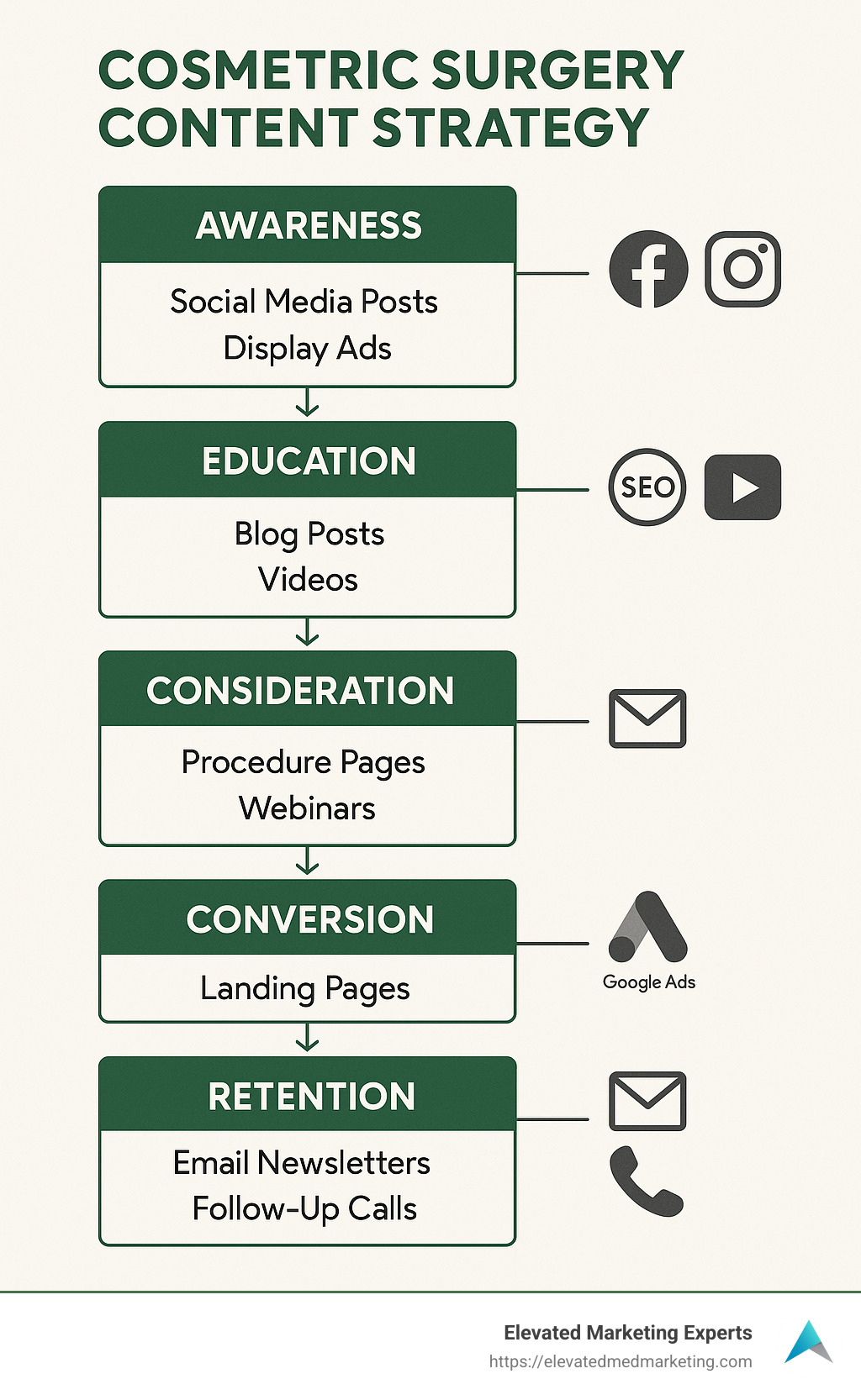
Important Cosmetic Surgery Content Strategy terms:
– Google Ads bidding strategies
– Plastic surgery blog topics
Understanding Cosmetic Surgery Content Strategy
A cosmetic surgery content strategy isn’t just throwing a few blogs on your website or randomly posting photos on Instagram. It’s a thoughtful, intentional approach to sharing your practice’s story in a way that guides potential patients from curiosity to consultation.
Think of your content strategy as a conversation with patients before they even meet you. It’s the difference between shouting into the void and having a meaningful dialogue that builds trust and connection.
What makes a strategy different from simply creating content? It’s all about intention and measurement. As Presley Van noted in a recent industry study, “A compelling before-and-after photo gallery is perhaps the most persuasive element on a plastic surgeon’s website.” But even the most dramatic changes won’t convert viewers into patients without strategic context and promotion.
The numbers don’t lie: 63% of readers make purchasing decisions based on blogs rather than magazines, and the most successful content marketers (66% of them!) have clear strategies guiding their efforts. It makes financial sense too—content marketing costs 62% less than traditional marketing while generating three times as many leads.
According to scientific research on social media impact, about half of cosmetic procedure patients say social media influenced their decision. Yet surprisingly, only 15% of plastic surgeons post content daily, despite over 70% of millennials checking social platforms multiple times daily. That’s a huge missed opportunity!
Why a Cosmetic Surgery Content Strategy Drives Conversions
A well-crafted cosmetic surgery content strategy boosts conversions in several powerful ways:
First, it keeps your practice top-of-mind through consistent brand awareness. When someone finally decides they’re ready for that procedure they’ve been considering, guess whose name pops into their head? The surgeon whose informative videos they’ve been watching for months.
Quality content also pre-qualifies your leads. When patients reach out after engaging with your educational materials, they’re already informed and more likely to move forward. They’ve essentially educated themselves through your content before even speaking with you.
Trust-building is perhaps the most valuable benefit. As one industry expert puts it, “An educated patient is often a confident and satisfied patient.” By providing transparent, accurate information upfront, you establish credibility that pays dividends in the consultation room.
Finally, don’t underestimate the emotional connection. Cosmetic surgery decisions are deeply personal. Content that acknowledges fears and emotional motivations creates powerful bonds with potential patients.
The proof is in the numbers: practices with strategic content plans see conversion rates six times higher than those without. Why such a dramatic difference? Because patients arrive at consultations already educated, emotionally invested, and ready to take the next step.
Core Elements of an Effective Cosmetic Surgery Content Strategy
Building an effective cosmetic surgery content strategy requires five essential components:
Patient Personas form the foundation of everything you create. These detailed profiles go beyond basic demographics to understand motivations, concerns, and digital behaviors. Your “Millennial Mom” persona might be researching mommy makeovers on Instagram, while your “Senior Professional” persona might prefer in-depth website articles about facelifts.
Content Pillars are the main themes that showcase your expertise while addressing patient interests. These typically include procedure education, recovery information, before-and-after galleries, and authentic patient stories. Each pillar supports different stages of the patient journey.
Your Editorial Calendar brings structure and consistency to your publishing efforts. It accounts for seasonal trends (hello, pre-summer body contouring surge!) and procedure popularity cycles, ensuring you’re talking about the right topics at the right times.
Choosing the right Distribution Channels means meeting potential patients where they already spend time. Research shows Instagram generates significantly higher engagement for plastic surgery content than Twitter—knowing these platform-specific differences helps you invest your time wisely.
Finally, Content Governance provides guidelines for maintaining quality and minimizing risk. This includes compliance protocols, consistent brand voice, visual standards, and approval workflows to ensure everything you publish reflects your practice’s values.
As one industry expert notes, “Content marketing is simply the way of communicating and engaging with potential patients. You need to start thinking like a journalist—focus on what compels potential patients to act.”
When these five elements work together, your content doesn’t just attract attention—it builds relationships that turn curious browsers into confident patients.
Building Patient-Centric Content Pillars
The foundation of any successful cosmetic surgery content strategy is a set of patient-centric content pillars—core themes that address what your potential patients most want to know. These pillars should be evergreen (maintaining relevance over time) while allowing for timely additions that leverage seasonal interests or trending topics.

When I work with cosmetic surgery practices, I always recommend building your content around five key pillars that patients consistently seek out. Procedure education is the backbone—patients want detailed explanations about techniques and expected outcomes before they ever book a consultation. Think articles like “Understanding Different Types of Breast Implants” that answer those initial questions.
Recovery FAQs are absolute gold for reducing pre-op anxiety. One practice I worked with saw 40% fewer worried calls after we published comprehensive recovery guides. Patients simply want to know what their life will look like during recovery—how much pain to expect, when they can return to work, and when they’ll see final results.
Let’s be honest—before-after galleries are often where potential patients head first. As Seth Winterer puts it, “Pictures can speak a thousand words.” But these galleries work best when they feature relatable patients with similar concerns to your target audience, not just your most dramatic changes.
The emotional power of patient testimonials simply can’t be overstated. They provide an impressive 89% effectiveness rating in influencing decisions because they tell the story behind the change. When patients share how their confidence improved or how they finally felt comfortable in swimwear again, that resonates far more than technical details about a procedure.
Finally, don’t forget content showcasing your safety protocols and credentials. In an industry where trust is everything, patients need reassurance about your qualifications and commitment to their wellbeing.
For a deeper dive into building these pillars effectively, check out our guide on Content Strategy for Plastic Surgeons.
Mapping Pillars to Each Funnel Stage
Different content serves different purposes throughout the patient journey. When crafting your cosmetic surgery content strategy, you’ll want to match your content to where patients are in their decision-making process.
At the top of the funnel (awareness stage), focus on educational content that addresses common concerns. Blog posts like “How to Know If You’re Ready for a Facelift” or social media posts highlighting industry trends work well here. This is where you’re building initial trust and awareness, not pushing for consultations yet.
The middle of the funnel (consideration stage) is where more detailed content shines. Create in-depth procedure pages that honestly discuss benefits, risks, and recovery timelines. This is also the perfect place for those before-and-after galleries and comparison content like “Surgical vs. Non-Surgical Options for Facial Rejuvenation.” At this stage, patients are actively evaluating their options.
When patients reach the bottom of the funnel (decision stage), they need that final push to book a consultation. Virtual consultation information, transparent pricing content, compelling patient testimonial videos, and clear calls-to-action are what convert interested browsers into scheduled appointments.
Don’t forget about retention and advocacy content for existing patients. Post-procedure care guides, loyalty program information, and patient celebration content keep your community engaged and encourage referrals.
As one of my favorite marketing mentors always says, “You need to apply the ‘Why Should I Care’ test to every piece of content.” This becomes so much easier when you understand which funnel stage you’re targeting with each content piece.
Tailoring Topics for Diverse Demographics
One of the biggest mistakes I see in the aesthetic industry is treating all potential patients the same way. A sophisticated cosmetic surgery content strategy recognizes that different age groups have distinct concerns, platform preferences, and content consumption habits.
Gen Z patients (18-25) are all about prevention and minimally invasive options. They respond to authentic, educational content about “prejuvenation” treatments and trending procedures like liquid rhinoplasty. They’re digitally native and appreciate content that feels genuine rather than sales-focused.
Millennial patients (26-41) often focus on post-pregnancy body changes and early signs of aging. Visual, story-driven content about mommy makeovers or recovery timelines resonates strongly with this group. They value both emotional connection and practical information about value and results.
Gen X patients (42-57) typically seek facial rejuvenation and body contouring solutions. They appreciate detailed, evidence-based content that balances emotional and logical appeals. Topics like “The Science Behind Facial Aging” or comparative analyses of different treatment options perform well with this demographic.
Baby Boomer patients (58-76) prioritize safety and long-term results. Comprehensive, print-friendly content addressing medical considerations for cosmetic surgery after 60 or the longevity of results helps address their specific concerns. This group often spends more time researching and appreciates thoroughness.
Nearly two-thirds of people believe social media before-and-after pictures influence procedure trends. By tailoring your content to address the specific concerns of each demographic, you create more meaningful connections with potential patients across all age groups.
The best content doesn’t just inform—it makes patients feel understood and valued even before they walk through your doors.
Choosing and Optimizing Content Formats
Creating a diverse mix of content is like cooking with different ingredients—each format adds something special to your Cosmetic Surgery Content Strategy. Just as your patients have unique preferences, they also consume content in different ways depending on their needs and where they are in their journey.

I’ve seen how blogs and articles become the foundation of many successful practices. They’re like the slow-cooking stew of your content kitchen—they take time to prepare but deliver rich, satisfying results that keep bringing people back. One well-researched blog post about rhinoplasty can continue driving organic traffic for years.
Explainer videos are where your personality really shines. Think of them as your chance to sit down with potential patients over coffee. They’re particularly effective for explaining complex procedures like facelifts or tummy tucks. The numbers back this up too—video emails consistently get better engagement than text-only messages.
The social media world loves short-form videos through Reels and TikTok. I recently worked with a plastic surgeon who gained over 100,000 followers in just six months by creating bite-sized educational content. These quick videos are perfect for addressing common questions like “Does Botox hurt?” or “How long does swelling last after a nose job?”
Nothing speaks louder than results. Your before-after galleries are the visual proof that builds confidence in your skills. They’re often the most-viewed section of cosmetic surgery websites for good reason—they answer the ultimate question: “Can this surgeon help someone like me?”
Let’s not forget about patient testimonials. These stories touch on both physical changes and emotional changes, creating powerful social proof. When Sarah shares how her rhinoplasty not only changed her profile but also gave her the confidence to pursue public speaking, that resonates on a level that clinical descriptions never could.
Smart content repurposing maximizes your efficiency. As one marketing expert told me, “One exceptional piece of content has the potential to drive strong traffic and leads across multiple channels.” That comprehensive blog post about mommy makeovers? It can transform into several Instagram posts, a YouTube video summary, an email newsletter, and infographic elements—all while maintaining consistent messaging.
Blogs, Guides & Long-Form Assets for SEO
Long-form content is the backbone of your SEO strategy. These assets don’t just educate potential patients—they signal to Google that you’re a trustworthy authority in cosmetic surgery.
When creating SEO-driven content, focus on semantic keywords rather than awkwardly stuffing exact phrases into your text. Write naturally about rhinoplasty and include related terms like “nose job,” “nasal reshaping,” and “septoplasty” where they make sense. Google’s algorithms are smart enough to understand the relationships between these terms.
Demonstrating E-E-A-T (Experience, Expertise, Authoritativeness, and Trustworthiness) is especially crucial for medical content. Have the actual surgeon review content for accuracy and include their credentials. This not only improves your search rankings but also builds patient confidence.
Your comprehensive procedure pages should feel like a complete resource. Each service deserves its own dedicated page with benefits, potential risks, recovery information, frequently asked questions, and visual examples. I’ve seen conversion rates double when practices upgrade from thin service pages to in-depth resources.
Don’t forget about strategic internal linking. When your breast augmentation page naturally links to related content about implant options or recovery tips, you keep potential patients engaged longer and help search engines understand your site structure.
77% of patients rely on search engines before booking an appointment. Your long-form content is often their first meaningful interaction with your practice—make it count.
For more detailed guidance on this topic, check out our SEO Content Strategy resource.
Visual Proof: Before-After Photos & Patient Stories
Before-and-after galleries are the show-stoppers in your Cosmetic Surgery Content Strategy. With 89% of consumers citing testimonials as highly influential in their decisions, these visual elements convert browsers into consultation bookings.
To create truly compelling visual proof, maintain consistent photography standards. Use the same lighting, backdrop, angles, and patient positioning for all before-and-after photos. This consistency isn’t just professional—it ensures fair comparisons and builds trust with potential patients who might be skeptical of “too good to be true” changes.
Always obtain proper HIPAA-compliant consent before using patient images or stories. This isn’t just legally required—it’s ethically essential. The extra step of securing written permission protects both your patients and your practice.
The most effective galleries add context to changes. Pair photos with patient age, concerns addressed, procedure details, and recovery timeline. This context helps potential patients relate to the examples and visualize their own potential results. “That patient had the same concerns I do” is a powerful thought that moves people closer to booking.
Don’t forget to watermark your images with your practice name or logo. This protects your intellectual property and ensures brand reinforcement when images inevitably get shared across social platforms.
Make sure to showcase diverse patients in your galleries. Include various ages, body types, ethnicities, and concerns to help more potential patients see themselves in your work. Representation matters—when patients can identify with your examples, they’re more likely to feel comfortable choosing your practice.
Video & Live Streams: High-Trust Accelerators
Video content creates emotional connections that text and images simply can’t match. It’s like inviting potential patients into your practice for a personal conversation—without them having to leave their couch.
Surgeon introduction videos give potential patients a feel for your personality and approach. Keep these brief (under two minutes) and focus on being yourself rather than reciting credentials. Patients want to know if they’ll feel comfortable with you as much as they want to know about your training.
Procedure explainers break down complex surgeries into understandable segments. I’ve seen these videos significantly reduce pre-consultation anxiety and lead to more informed discussions during appointments. Patients arrive with realistic expectations and better questions.
Nothing builds trust like hearing from someone who’s already taken the journey. Patient testimonial videos that capture authentic stories about both physical and emotional changes resonate deeply with potential patients. One practice I worked with saw consultation requests increase by 35% after adding video testimonials to their website.
Office tours familiarize potential patients with your environment and team before they visit. This simple video format reduces anxiety about the unknown and helps patients feel more comfortable when they arrive for their consultation.
Live Q&A sessions create real-time connections with your audience. These interactive streams address common questions and concerns while showcasing your expertise and approachability. The unscripted nature of these sessions often reveals your authentic personality better than any scripted content could.
Tools like CaptureMD can simplify video production for busy practices. You don’t need Hollywood-quality production—patients are seeking a connection with their surgeon more than perfect lighting or editing. A genuine, educational approach builds more trust than overly polished marketing videos ever could.
Authenticity trumps perfection when it comes to video content. Your surgical skills may be precise, but your marketing can be warmly human.
Social Media Blueprint by Age Demographic
Social media isn’t just important for your Cosmetic Surgery Content Strategy – it’s essential. With studies showing that social media influences 93% of consumer buying decisions, choosing the right platforms for your practice can make or break your digital marketing efforts.

Think of your social media strategy as a conversation with different generations of patients. You wouldn’t talk to your 25-year-old niece the same way you’d chat with your 65-year-old neighbor, right? The same principle applies online.
Research consistently shows Facebook leads the pack for overall patient engagement for plastic surgery practices, with Instagram coming in second. But here’s the thing – this varies dramatically by age group. While your 30-something patients are scrolling Instagram reels, your 70-year-old patients might be checking their Facebook feed once a day.
What’s shocking is the opportunity gap here: only about 15% of plastic surgeons post content daily, yet more than 70% of millennials check social media multiple times every day. That’s a whole lot of potential patients waiting to find your practice!
When engaging with followers, timing matters. Today’s consumers expect responses within 15 minutes to an hour. A quick, thoughtful reply can turn a curious browser into your next consultation.
If you’re considering influencer partnerships (and you should!), do your homework first. Tools like HypeAuditor, Modash, and Upfluence can help you verify that an influencer’s engagement is genuine before you invest your marketing dollars.
As researchers noted in the Journal of Aesthetic Surgery, “Social media has been demonstrated to serve as a critical tool for plastic surgeons, facilitating patient engagement, peer-to-peer education and learning, and outreach to the broader public community.”
Instagram & TikTok for <35: Cosmetic Surgery Content Strategy in Micro-Video
For your younger patients, Instagram and TikTok aren’t just apps – they’re digital hangouts where authenticity rules and educational micro-content thrives.
The key to success with under-35 patients is keeping it real while staying professional. One surgeon I worked with gained an impressive 50,000 followers in just three months by creating educational content that cleverly incorporated trending sounds. The content was medically accurate and valuable, but the delivery felt fresh and current.
When crafting captions, keep them punchy but packed with keywords. Instagram’s algorithm loves descriptive terms like “breast augmentation,” “cosmetic,” and “aesthetic” in captions. Think of these keywords as little digital magnets pulling potential patients toward your content.
Young patients crave authenticity above all else. A brief behind-the-scenes glimpse of your team preparing for surgery (while maintaining HIPAA compliance, of course) often generates more engagement than a polished promotional video. They want to feel like they’re getting the inside scoop.
For this demographic, focus content on their most common procedures: rhinoplasty, breast augmentation, and non-surgical treatments like injectables. Educational content that tackles myths head-on performs exceptionally well – think “5 Things No One Tells You About Rhinoplasty Recovery” or “The Truth About Lip Fillers.”
Facebook & YouTube for 35-70: Cosmetic Surgery Content Strategy Through Education
The 35-70 crowd approaches cosmetic procedures differently – they’re thorough researchers who value comprehensive education and want to see social proof before making decisions. For these patients, Facebook and YouTube should be cornerstones of your Cosmetic Surgery Content Strategy.
Live video is pure gold with this demographic. Our data consistently shows that Facebook Live sessions with the actual surgeon (not just staff) yield significantly higher engagement rates. These patients want to see the doctor’s expertise and bedside manner firsthand.
YouTube offers the perfect platform for in-depth educational content. While younger patients might prefer 30-second TikToks, this group appreciates 10-minute videos thoroughly explaining procedures, showing recovery timelines, and discussing results. They’ll actually watch the whole thing!
Private Facebook groups create a sense of community while giving you a controlled environment for sharing information. One practice I worked with created a “Mommy Makeover Journey” group where patients could connect, share experiences, and ask questions. It became their most powerful conversion tool for that procedure.
This age group responds strongly to emotional testimonials addressing both physical and psychological changes. While younger patients focus on aesthetics, this demographic wants to hear how a procedure improved someone’s quality of life or restored their confidence.
Unlike their younger counterparts, the 35-70 crowd is actually receptive to promotional content – as long as it comes with educational value. A special offer on a mommy makeover is much more effective when paired with a comprehensive guide to the procedure.
LinkedIn & Blogs for 70+: Authority & Professionalism
For your older patients, particularly those over 70, LinkedIn and blog content establish the professional authority they expect before considering cosmetic procedures. These platforms allow for detailed education in formats this demographic finds comfortable and trustworthy.
Thought leadership is key here. Articles establishing your surgeon’s expertise, credentials, and experience resonate deeply with older patients who place high value on qualifications. They want to know they’re in experienced hands.
Professional imagery matters tremendously. Our A/B testing consistently shows that photos featuring a smiling surgeon in a white coat significantly outperform casual images with this demographic. They expect their doctor to look like a doctor.
Don’t underestimate the power of print-friendly formats. Many older patients prefer to print information for later reference or to discuss with family members who often influence their decisions. Making your content easily printable shows you understand their needs.
Safety-focused content addressing medical considerations, recovery support, and long-term results is particularly important for this age group. They’re generally more concerned about potential complications and recovery time than younger patients.
Clear, consistent before-and-after photographs remain extremely powerful with this demographic, who may be less influenced by video content. They appreciate being able to study results carefully, so high-quality images with good lighting are essential.
For the 70+ crowd, focus your content on their most common procedures: blepharoplasty, facelifts, and neck lifts. Frame these procedures in terms of quality-of-life improvements rather than purely aesthetic benefits to resonate more effectively.
Compliance, Privacy, and Ethical Guardrails
Creating an effective Cosmetic Surgery Content Strategy isn’t just about attracting new patients—it’s about doing so responsibly. The aesthetic medicine field requires special attention to privacy and ethical considerations that go beyond typical marketing concerns.

Think of compliance as the foundation that supports everything else in your content strategy. Without it, even the most beautiful marketing campaigns can crumble under regulatory scrutiny.
HIPAA compliance forms the cornerstone of any medical marketing effort. Every before-and-after photo, every patient testimonial, and every success story must have proper documentation showing the patient agreed to share their experience. A verbal “sure, you can use my photos” isn’t enough—you need written consent that specifically outlines how their information will be used.
When it comes to FTC guidelines, transparency is key. Those gorgeous results from your combination therapy? If you’re featuring them in a sponsored post, you need to disclose that relationship clearly. The same goes for patient testimonials—they should represent typical results, not just your most spectacular outcomes.
Each social platform has its own set of platform policies regarding medical content. Instagram and Facebook, for instance, have specific rules about before-and-after images that might require creative workarounds. Some practices have found success by having patients wear branded clothing in photos or using consistent backgrounds that identify the images as coming from your practice without explicitly showing change content.
“We’ve seen practices get their accounts suspended for violating platform policies they didn’t even know existed,” shares one digital marketing expert. “It’s much easier to build your strategy with these guidelines in mind than to rebuild after a violation.”
Medical advertising regulations vary by state, but they all share a common theme: claims about results must be substantiated, and typical outcomes should be clearly communicated. Promising “the best results in town” or guaranteeing specific outcomes can land you in hot water quickly.
Don’t forget about copyright considerations either. That perfect stock photo or background music might seem like a small detail, but using unlicensed content can result in hefty fines. Always ensure your content assets are properly licensed or original.
Navigating Patient Consent in a Cosmetic Surgery Content Strategy
The magic of a successful Cosmetic Surgery Content Strategy often lies in showing real results, but this requires meticulous attention to patient consent processes.
Patient consent isn’t just a checkbox—it’s an ongoing conversation. The most successful practices build consent discussions into their patient journey from the beginning, making it clear how valuable patient stories are to helping others make informed decisions.
Comprehensive written releases should go beyond general permission. They should specifically outline where and how patient images might appear—on your website, social media, in presentations, or in printed materials. Being specific helps patients feel more comfortable and protects your practice from misunderstandings later.
Many patients want to share their changeal journey but prefer some privacy. Offering photo anonymization options such as cropping to show just the treated area, blurring facial features, or using creative angles can help patients feel comfortable sharing while maintaining their privacy.
People change their minds, and your consent process should account for this. Having clear revocation procedures gives patients peace of mind knowing they can withdraw consent if they ever feel uncomfortable with their images being used. This patient-first approach actually builds trust and often results in fewer revocation requests.
“We had a patient who initially agreed to share her rhinoplasty results, but then got a high-profile job and became concerned about her before photos being public,” recalls one practice manager. “Because we had a clear process for removing content, we were able to address her concerns immediately, maintaining her trust and our compliance.”
Secure storage protocols for consent documentation are non-negotiable. These documents contain sensitive information and should be treated with the same care as medical records, with appropriate access controls and security measures.
Finally, implement regular audits of your marketing content. It’s surprisingly easy to lose track of which images have current consent, especially when working with multiple team members or marketing agencies. A quarterly review ensures you’re only using properly documented patient materials.
By treating compliance as an integral part of your Cosmetic Surgery Content Strategy rather than an afterthought, you’ll build a foundation of trust that resonates with patients and protects your practice for the long term.
Measurement, KPIs, and Continuous Improvement
Let’s face it—without measuring results, you’re just throwing content into the digital void and hoping something sticks. An effective cosmetic surgery content strategy needs regular check-ins to see what’s working and what needs tweaking.
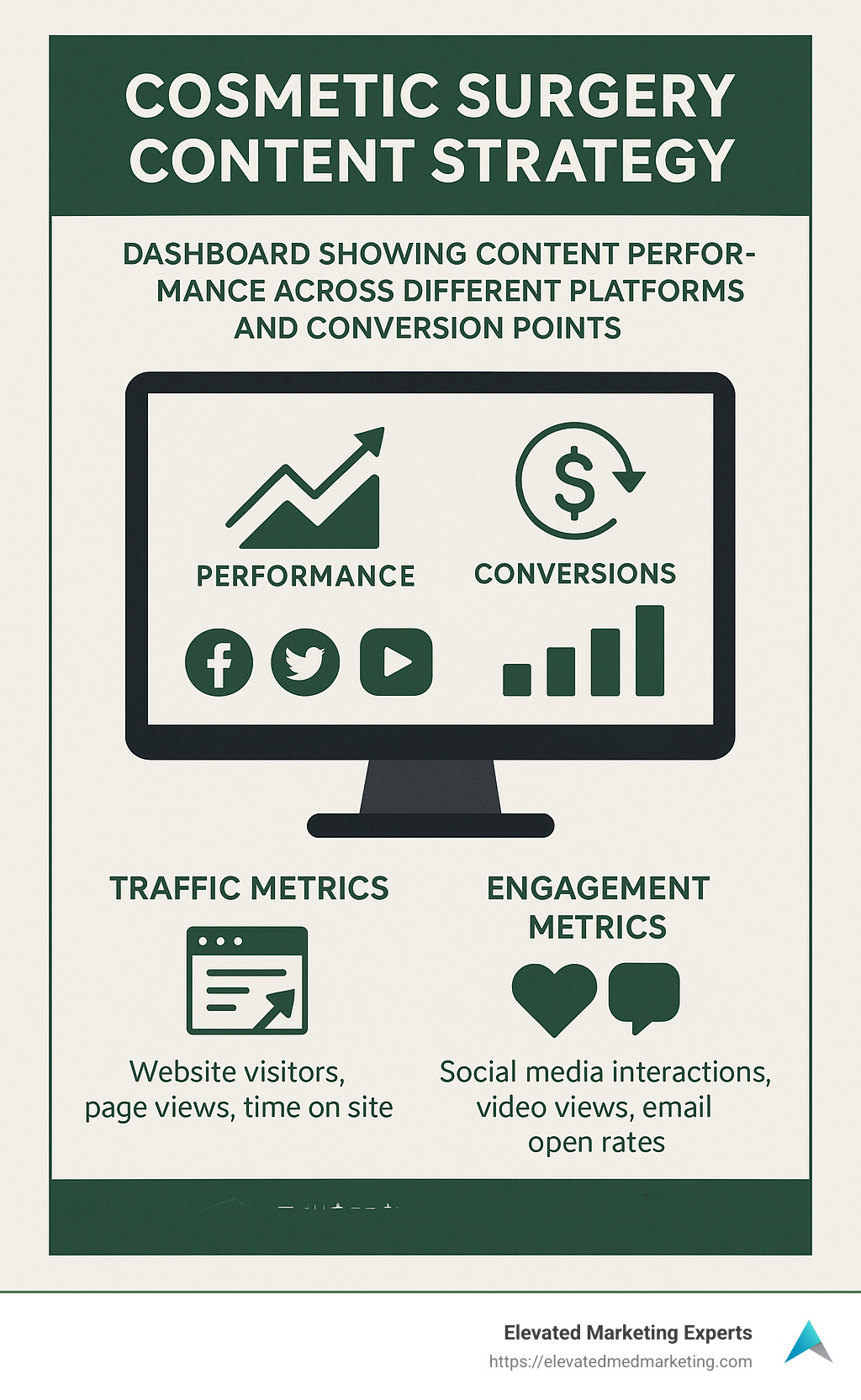
I’ve worked with dozens of cosmetic surgery practices, and I’ve noticed something interesting: the most successful ones obsess over their numbers. They track everything from website visitors to consultation bookings with the same precision they bring to the operating room.
The metrics that matter most fall into four main buckets. First, traffic metrics tell you who’s finding your content—think website visitors, page views, and how long they’re sticking around. Second, engagement metrics reveal if your content resonates—are people liking your Instagram posts or actually watching your videos all the way through? Third, lead generation metrics show you when interest turns into action through consultation bookings and form submissions. Finally, conversion metrics and ROI connect the dots between your content and actual procedures booked.
“I was spending thousands on ads but had no idea if my content was actually bringing in patients,” a facial plastic surgeon in Denver told me recently. “Once we started tracking properly, we finded our recovery guides were generating three times more consultations than our before-and-after galleries. That completely changed our content priorities.”
Tools like Google Analytics, Meta Business Suite, and Hootsuite make tracking these metrics much simpler than it used to be. The practices seeing six times higher website conversion rates aren’t necessarily creating better content—they’re just measuring results and adjusting accordingly.
For a deeper dive into measurement approaches, check out Content Marketing Best Practices.
Setting SMART Goals for Your Cosmetic Surgery Content Strategy
Vague goals like “get more patients” or “improve our social media” won’t get you far. Your cosmetic surgery content strategy needs SMART goals—Specific, Measurable, Achievable, Relevant, and Time-bound objectives that give your team clear targets.
Before setting goals, start with a baseline audit to understand where you currently stand. One practice I worked with was disappointed in their Instagram performance until we finded their 2% engagement rate was actually double the industry average! Without that context, they might have abandoned a channel that was performing exceptionally well.
Competitive benchmarking provides valuable reality checks. While a Beverly Hills practice might aim for 10,000 Instagram followers in six months, that same goal would be unrealistic for a new practice in a small town.
I’m a big fan of incremental objectives that build momentum. Rather than aiming to triple blog traffic immediately, try increasing it by 15% each quarter. These stepping-stone goals create a path to bigger achievements while providing regular wins to celebrate along the way.
Remember to develop specific goals for each platform while keeping sight of the big picture. Your Instagram strategy might focus on engagement while your blog aims for SEO dominance, but both should ultimately support patient acquisition.
“A social media strategy is a marathon, not a sprint,” as one of my clients wisely puts it. She schedules quarterly check-ins to evaluate progress and adjust goals based on what’s actually happening, not what she hoped would happen.
Reporting Cadence & Dashboards
Even the best measurement strategy falls apart without regular reporting. Think of your cosmetic surgery content strategy reports as regular health check-ups—they identify small issues before they become big problems.
Most practices benefit from monthly performance scorecards that track key metrics across all channels. These reports should be simple enough that anyone can understand them at a glance, but detailed enough to spot important trends.
A/B test insights deserve special attention in these reports. One medspa I work with tested two different headlines on their mommy makeover landing page and finded that the emotional appeal (“Refind Your Pre-Baby Body”) outperformed the clinical approach (“Comprehensive Post-Pregnancy Surgical Solutions”) by a staggering 43% in consultation bookings.
Don’t forget about content pruning analysis. Digital content isn’t “set it and forget it”—outdated or underperforming content can actually hurt your practice. One surgeon saw a 28% boost in overall website performance after updating or removing blog posts that were more than three years old.
The most sophisticated practices use attribution modeling to understand how different content pieces work together. For example, a potential patient might find your practice through an Instagram reel, read three blog posts, download a recovery guide, and finally book a consultation. Simple reporting might credit only the last touchpoint, but attribution modeling shows the full journey.
Reports should always include actionable recommendations. Numbers without insights are just data, not intelligence. Each report should answer the question: “Based on this information, what should we do differently next month?”
As one plastic surgeon told me after implementing a dashboard system: “For the first time, I can actually see which content investments are paying off. We’re working smarter now, not just harder.”
Latest Trends & Innovations Shaping 2024+
The landscape of cosmetic surgery content strategy continues to evolve rapidly. Staying ahead of trends ensures your practice remains competitive and relevant to potential patients.

As we move through 2024, exciting innovations are changing how cosmetic surgery practices connect with patients. AI-powered content creation tools like ChatGPT are now helping practices generate fresh topic ideas and content drafts—though the human touch remains essential for ensuring medical accuracy and maintaining your unique brand voice.
Have you noticed the rise of augmented reality try-ons? These sophisticated tools allow potential patients to visualize their results before ever stepping foot in your office. Imagine a patient using their smartphone to see how they might look after rhinoplasty or a facelift—this technology is creating more confident, pre-educated consultation candidates.
Virtual consultations have evolved from a pandemic necessity into a permanent, valuable offering. They’re expanding geographic reach for many practices while streamlining the patient journey. One surgeon told me they’ve doubled their consultation capacity by offering virtual options for initial assessments.
Financial messaging is evolving too. Buy Now, Pay Later (BNPL) services like Afterpay are becoming increasingly important in cosmetic surgery marketing. In fact, 57% of Afterpay customers say they would switch providers or abandon purchases altogether if this payment option wasn’t available. That’s a significant factor to consider in your messaging!
Don’t overlook voice search optimization in your content planning. As smart speakers and voice assistants become household staples, optimizing your content for conversational queries (“Hey Google, what’s the recovery time for a tummy tuck?”) is increasingly important.
According to research on platform engagement, our collective social media usage has jumped from 90 minutes daily in 2012 to 147 minutes in 2022. This dramatic increase highlights why engaging, platform-specific content is more crucial than ever for your cosmetic surgery content strategy.
Influencer Collaborations & User-Generated Content
Influencer marketing has matured into a sophisticated component of cosmetic surgery content strategy, with 83% of marketers confirming its effectiveness. But in aesthetic medicine, this approach requires special considerations.
I recently spoke with a practice that tripled their breast augmentation consultations after partnering with a local fitness influencer who shared her authentic journey. The key was authenticity verification—they used tools like HypeAuditor to confirm her engagement was genuine before investing in the partnership.
Many practices are finding greater success with micro and nano-influencers (those with 1,000-50,000 followers) rather than celebrities. These smaller accounts typically deliver higher engagement rates and create more authentic connections with potential patients. As one practice manager told me, “Our nano-influencer posts get 5x the engagement of our celebrity endorsement, and at a fraction of the cost.”
Rather than simply paying for promotional posts, forward-thinking practices are embracing a co-creation approach. They’re involving influencers in developing educational content that genuinely helps their audience understand procedures and recovery. This collaborative approach yields content that feels helpful rather than “salesy.”
Of course, clear disclosure compliance remains non-negotiable. All sponsored content must be properly labeled according to FTC guidelines—not just for legal reasons, but because transparency builds trust with your audience.
Have you considered developing a patient-influencer program? Converting satisfied patients into advocates through formalized ambassador programs creates a powerful stream of authentic content. As one plastic surgeon shared, “My patients tell my story better than I ever could.”
User-generated content, particularly genuine patient stories, continues to be among the most powerful assets in cosmetic surgery marketing. Patient testimonials provide an impressive 89% effectiveness rating when it comes to influencing potential patients—making them worth their weight in gold.
Automation & Personalization at Scale
Automation and personalization technologies are revolutionizing cosmetic surgery content strategy, allowing practices to deliver more relevant content while reducing manual workload.
AI-powered chatbots have come a long way from the clunky tools of the past. Today’s intelligent conversational assistants can answer common questions, qualify leads, and even schedule consultations 24/7. One practice I work with saw weekend consultation bookings increase by 35% after implementing a sophisticated chatbot—capturing interest when the office was closed.
Smart practices are leveraging CRM-driven email sequences that deliver personalized content based on procedure interest, consultation status, and patient history. These automated yet personalized touch points keep your practice top-of-mind throughout the decision journey. “Our nurture sequences have cut our sales cycle in half,” one practice manager told me, “because patients arrive at consultations already educated and confident.”
Predictive content recommendations are becoming more sophisticated too. These systems suggest relevant articles, videos, or before-after galleries based on browsing behavior, helping potential patients find exactly what they need to make decisions. Think of it as a digital concierge guiding visitors through your content.
Dynamic website personalization takes this a step further by adapting content based on visitor demographics, referral source, or previous interactions. Imagine a website that shows different testimonials to a 25-year-old interested in rhinoplasty versus a 45-year-old researching facelifts—personalization at this level significantly improves conversion rates.
To manage content across multiple platforms, practices are embracing automated social publishing tools that optimize posting times and content formats. These tools help maintain a consistent presence without requiring constant manual attention.
The results speak for themselves. One practice reported a 40% increase in consultation bookings after implementing a personalized email nurture sequence for website leads. Another saw a 25% reduction in no-shows through automated appointment reminders and pre-procedure education.
As you incorporate these technologies, remember what one wise surgeon told me: “Integrate AI tools strategically to improve workflow, but never lose the human touch that makes patients feel cared for.” In aesthetic medicine, technology should improve—not replace—the personal connections that build trust and loyalty.
Frequently Asked Questions about Cosmetic Surgery Content Strategy
How often should a practice publish new content?
When it comes to your Cosmetic Surgery Content Strategy, I’m often asked about posting frequency. The truth is, consistency trumps volume every time.
Think of content like a conversation with your potential patients—you want to be present regularly without overwhelming them. For social platforms like Instagram and TikTok where algorithms favor recency, aiming for 3-5 weekly posts keeps you visible without exhausting your team. Meanwhile, your blog can thrive with just 2-4 substantial, well-researched articles each month.
I’ve seen practices burn out trying to post daily across all channels, only to disappear for weeks afterward. As one of our clients put it after following our sustainable schedule, “Our engagement actually improved when we focused on quality over quantity.”
For email, most practices find success with 1-2 monthly newsletters, while adding at least two fresh videos monthly keeps your YouTube and social channels feeling current. It’s better to maintain a predictable rhythm your team can sustain than to create sporadic bursts of content that leave patients wondering where you went.
Which metrics prove my content is driving revenue?
Connecting content efforts to your bottom line requires tracking the complete patient journey—from that first Instagram post they liked to the moment they schedule their procedure.
The most revealing metrics go beyond simple page views. Attributed consultations show which specific content pieces led to booking requests. One of our facial plastic surgery clients finded their “Liquid Rhinoplasty FAQ” article generated three times more consultations than their general rhinoplasty page, despite lower traffic.
Conversion rates by content source often tell a fascinating story. We typically see patients who engage with educational content before consultation convert at significantly higher rates—one practice found these informed patients were 60% more likely to book procedures and spent 40% more on average.
To truly understand ROI, track procedure revenue by channel, calculate your customer acquisition cost, and compare your content investment against the revenue it generates. This approach helps identify which content types deserve more of your budget and attention.
The data doesn’t lie—patients who feel educated and confident before meeting you make better, faster decisions about their aesthetic journeys.
How do I keep up with search algorithm changes?
Search algorithms evolve constantly, but don’t let that keep you up at night. The core principles of an effective Cosmetic Surgery Content Strategy remain remarkably stable.
Instead of chasing every rumored update, focus on creating genuinely helpful content for your potential patients. Google’s ultimate goal has always been to connect searchers with the most valuable information—and that’s exactly what you should aim to provide.
Stay informed through reliable sources like Google’s official blog and reputable SEO publications. When you notice unexpected traffic changes, investigate whether an algorithm update might be affecting your content, but avoid knee-jerk reactions.
“The practices that panic with every algorithm update are the ones most likely to make costly mistakes,” notes our SEO director. “Those who consistently create authoritative, patient-centered content rarely see dramatic drops.”
Regular technical maintenance matters too—site speed, mobile responsiveness, and basic SEO elements contribute significantly to search performance. And diversify your traffic sources! Building strong email lists and social following creates resilience against search volatility.
The most algorithm-proof strategy? Create content so genuinely helpful that patients would miss it if it disappeared. This patient-first approach aligns perfectly with Google’s increasing emphasis on helpful, authoritative content—particularly for medical topics like cosmetic surgery.
Conclusion
Creating an effective cosmetic surgery content strategy isn’t just another marketing task—it’s the lifeblood of practice growth in today’s digital-first world. If there’s one thing I’ve learned working with countless aesthetic practices, it’s that random content posting without strategy is like performing surgery without a plan—the results are rarely what you hoped for.
The journey we’ve outlined isn’t complex, but it does require commitment. Start by truly understanding your ideal patients and building content pillars that speak directly to their concerns. Whether it’s a mother considering a mommy makeover or an executive exploring facial rejuvenation, your content should make them feel seen and understood.
Diversity in content formats keeps your strategy fresh and engaging. A comprehensive blog post can educate while a before-and-after gallery provides the visual proof patients crave. Short videos humanize your practice in ways static content simply cannot.
Platform selection matters tremendously. As we’ve seen, your 25-year-old rhinoplasty prospects are scrolling Instagram while your 65-year-old facelift candidates might be researching thoroughly on your website or Facebook. Meeting patients where they already spend time dramatically increases your chances of connecting meaningfully.
Compliance isn’t optional. Every piece of content must respect patient privacy and meet regulatory standards. This isn’t just about avoiding penalties—it’s about building the kind of trust that turns curious prospects into loyal patients who refer their friends.
The beauty of a well-executed cosmetic surgery content strategy is that it’s measurable. Track your performance, learn what resonates, and continuously refine your approach. The practices seeing the greatest growth aren’t necessarily those with the biggest budgets—they’re the ones most willing to analyze results and adapt accordingly.
Stay curious about emerging trends without chasing every shiny object. AI tools, virtual consultations, and augmented reality are reshaping patient expectations, but the fundamentals of helpful, authentic content remain unchanged.
At Liftd Marketing Experts, we understand the unique challenges aesthetic practices face in creating content that both educates and converts. Our industry-focused approach combines deep knowledge of cosmetic procedures with proven digital marketing expertise. We’ve helped practices of all sizes transform their online presence from basic to exceptional.
Ready to lift your practice’s content strategy? Learn more about our Cosmetic Surgery SEO services or reach out today for a personalized strategy consultation. Let’s create content that doesn’t just attract attention—it fills your consultation calendar with ideal patients.


