

Conversion rate optimization tips: 5 Powerful Ways to Stop Losing Sales 2025
The Science Behind Boosting Your Website Results
Conversion rate optimization tips are proven strategies that increase the percentage of website visitors who take desired actions, from signing up for consultations to making purchases. Here’s what you need to know:
- Define clear goals for what counts as a conversion on your site
- Calculate your current rate (conversions ÷ visitors × 100)
- Research user behavior through heatmaps and session recordings
- Simplify your pages with one clear call-to-action per page
- Build trust with testimonials and security badges
- Test variations of key elements through A/B testing
- Improve page speed to under 4 seconds to reduce bounce rates
- Add social proof where 95% of users look for validation
- Optimize forms by reducing fields to the essential minimum
- Implement mobile-first design for the majority of web traffic
The average conversion rate across industries is only 2-3%, meaning there’s substantial room for improvement on most websites. With visitors forming first impressions in just 50 milliseconds, implementing these optimization techniques isn’t just helpful—it’s essential.
Think of your website like a bucket collecting potential customers. Instead of simply pouring in more traffic (which costs money), conversion rate optimization fixes the leaks in your bucket, maximizing results from existing visitors.
I’m Joe Amaral, and I’ve helped numerous medical practices double their conversion rates through implementing conversion rate optimization tips that transform underperforming websites into patient-generating assets. Let me show you how these strategies can work for your practice too.

Why Every Click Counts
Imagine spending thousands on advertising to fill a bucket with water, only to find it’s riddled with holes. That’s exactly what happens when your website has conversion problems. For every 100 visitors you attract to your medical spa or plastic surgery practice website, only 2-3 typically convert into leads or patients.
This “leaky bucket” analogy perfectly illustrates why conversion rate optimization tips are so valuable. If you could double your conversion rate from 2% to 4%, you’d essentially double your results without spending an extra penny on advertising. For a medical practice generating 20 consultations monthly, that’s potentially 20 additional patients—without increasing your marketing budget.
The math is compelling: a higher conversion rate directly translates to more revenue and a better return on your marketing investment. In the competitive aesthetic medicine field, this efficiency can be the difference between a thriving practice and one that struggles to grow.
Tip 1: Diagnose the Funnel—Know Your Numbers
Ever wonder why visitors come to your website but leave without booking a consultation? Before you can fix what’s broken, you need to find the cracks in your patient journey. Think of your website as a pathway with several stopping points—and at each one, potential patients decide whether to continue or walk away.
For medical practices like yours, these pathways typically look something like this: a visitor lands on your homepage, browses to your services page, and hopefully completes a contact form. Or perhaps they find you through a blog post, check out your about page, and then book a consultation. Understanding exactly where people drop off is the foundation of all conversion rate optimization tips.
Let’s be honest about the numbers. The healthcare industry averages around a 2.8% conversion rate—meaning for every 100 website visitors, fewer than 3 typically take action. How does your practice compare?
| Industry | Average Conversion Rate |
|---|---|
| Medical & Healthcare | 2.8% |
| E-commerce | 2.3% |
| SaaS | 3.0% |
| Financial Services | 2.6% |
| Plastic Surgery/Med Spa | 2.5% |
Calculate Your Baseline Conversion Rate
Before making any changes, you need to know your starting point. The math is simple:
Conversion Rate = (Number of Conversions ÷ Total Number of Visitors) × 100
Let’s say your plastic surgery website welcomed 5,000 visitors last month and generated 100 consultation requests. That’s (100 ÷ 5,000) × 100 = 2%. Pretty average, but we can do better!
For practices tracking multiple conversion points (like phone calls, form submissions, and chat conversations), you might also want to calculate:
Number of Net New Patients = Website Visitors × Conversion Rate × Close Rate
This formula helps you see the full picture from website visit to actual patient.
When deciding which parts of your site to improve first, I recommend using what we call the PIE framework:
– Potential: How much room for improvement exists?
– Importance: How valuable is the traffic to this page?
– Ease: How complicated would changes be?
The pages scoring highest across these dimensions deserve your immediate attention.
Spot Your Leaks with Heatmaps & Session Replays
Want to know a secret? One of the most powerful conversion rate optimization tips is simply watching how real visitors interact with your website. It’s like being a fly on the wall as potential patients steer your digital practice.

Heatmaps show you exactly where visitors click, how far they scroll, and which elements they ignore completely. You might find “rage clicks”—where frustrated users repeatedly click on something that doesn’t respond. These are golden clues for improvement.
I remember working with a medical spa client whose heatmap revealed visitors were constantly clicking on before/after photos, expecting them to enlarge—but nothing happened. Simply making those images expandable increased time on site by 35%!
Session recordings take this even further by letting you watch actual visitor journeys from start to finish. Tools like Microsoft Clarity offer these features for free, making them accessible even for smaller practices.
Conversion Rate Optimization Tips for Quick Wins
Based on my experience with aesthetic practices, here are some immediate actions that often yield results:
First, focus on primary metrics that directly impact your bottom line. While it’s tempting to track everything, consultation bookings and contact form submissions should be your North Star.
Don’t ignore micro-conversions either. When someone downloads your procedure guide or watches a patient testimonial video, they’re showing growing interest—even if they’re not ready to book yet.
Always form data-driven hypotheses rather than making random changes. Instead of guessing, use actual user data to create testable theories like: “Adding before/after photos to procedure pages will increase consultation requests by 15%.”
Finally, pay special attention to high-exit pages where visitors frequently leave your site. These are usually the low-hanging fruit for optimization.
Successful conversion optimization isn’t about throwing spaghetti at the wall to see what sticks. It’s about methodical improvements based on real evidence from your actual website visitors.
Tip 2: Simplify UX & Design for Friction-Free Journeys
Let’s face it—medical websites can be intimidating. Your potential patients are already anxious about procedures and costs, and the last thing they need is a confusing website experience on top of that!
When I work with aesthetic practices, I find that implementing conversion rate optimization tips for user experience often creates dramatic improvements. It makes sense when you consider that 76% of consumers say their number one priority in website design is simply “the website makes it easy for me to find what I want.”

Speed Matters—Four-Second Rule
Think about the last time you waited for a slow website to load. Frustrating, right? That frustration translates directly into lost patients for your practice.
The data tells the story: a mere 1-second delay can reduce conversions by 7%, and a whopping 40% of visitors will abandon your site if it takes more than 3 seconds to load. Mobile users are even less patient!
I recently worked with a plastic surgeon whose website took 6.2 seconds to load. After we trimmed that down to 2.8 seconds, their conversion rate jumped by 23%. Here’s what made the difference:
Google Lighthouse helped us identify the issues, then we compressed images with ImageOptim, minimized HTTP requests, enabled browser caching, implemented a CDN, and upgraded their hosting. The results spoke for themselves—speed truly matters.
Craft One-Goal Pages & Clear CTAs
One of my favorite conversion rate optimization tips is simplifying each page to focus on a single goal. When visitors face too many choices, they often make none at all—this is Hick’s Law in action.
For your medical practice website, this means giving each page one clear purpose. Your homepage might focus on booking a consultation, while your procedure page highlights requesting more information. When we reduced a medical spa’s homepage CTAs from five to one, their click-through rate increased by 38%.
Make your CTAs stand out with contrasting colors and action-oriented text. “Book Your Consultation” works much better than “Submit.” And remember to keep critical information above the fold where visitors see it without scrolling.
Want to learn more about creating effective medical websites? Check out our guide on Website Design for Healthcare.
Checkout & Cart Abandonment Fixes
While you’re not selling products like an e-commerce site, you’re still “selling” consultations and appointments—and many of the same principles apply.
Guest booking options are essential—43% of users prefer not creating an account. Let prospects book consultations without registration hassles. The Baymard Institute found that promotional code fields overwhelm 66% of users, so hide these behind a discreet link instead of featuring them prominently.
Forms are where many practices lose potential patients. The average checkout displays 11.8 form fields, but most only need 8. For consultation requests, stick to the essentials: name, phone, email, and procedure of interest. Enable browser auto-fill functionality to make completion faster.
Here’s a tip that’s rescued countless consultations: for partial form completions where an email was provided, send a gentle follow-up. This simple practice typically recovers 10-15% of abandoned bookings that would otherwise be lost forever.
By creating a smooth, friction-free journey for your website visitors, you’re not just improving your conversion rates—you’re also creating a more positive first impression of your practice. And in the aesthetic medicine world, first impressions matter tremendously.
Tip 3: Build Trust, Credibility & Social Proof
Let’s face it—when someone’s considering a cosmetic procedure, they’re not just shopping for a service. They’re entrusting their appearance, health, and confidence to your care. That’s why building trust isn’t just a nice-to-have for aesthetic practices—it’s absolutely essential for converting visitors into patients.
Did you know that a whopping 95% of potential patients check reviews before making decisions about healthcare providers? It’s true! Implementing conversion rate optimization tips focused on trust can transform your website from a digital brochure into a patient-generating powerhouse.

Leverage User-Generated Content & Ratings
Nothing speaks louder than real patients sharing their genuine experiences. When I work with medical spas and plastic surgeons, I always emphasize that authentic patient stories create more impact than even the most polished marketing copy.
Want to showcase these powerful testimonials effectively? Place verified reviews prominently throughout your site—not just buried in a dedicated “Reviews” section where they might never be seen. Your homepage, procedure pages, and especially near call-to-action buttons are perfect spots for these trust signals.
Before-and-after galleries work wonders too. They serve as visual testimonials that instantly communicate your expertise. Tools like Yotpo can help you collect and display these assets beautifully while maintaining patient privacy where needed.
I’ve seen how highlighting procedure counts builds immediate confidence. A simple statement like “Over 5,000 successful rhinoplasties performed” tells potential patients they’re in experienced hands. One medical spa client of ours saw consultation bookings jump by 47% after we added a rotating testimonial carousel to their homepage featuring real patient stories and photos.
The psychology of loss aversion is fascinating too—people are more motivated to avoid missing out than they are to gain something new. Try framing your messaging as “Don’t miss our limited June consultation slots” rather than just “Book now” and watch your conversion rates climb.
Compliance Psychology & “Breadcrumb” Technique
One of my favorite conversion rate optimization tips for aesthetic practices is what we call the “breadcrumb technique.” It’s simple but incredibly effective: get visitors to say “yes” to small requests before asking for the bigger commitment of scheduling a consultation.
Think of it as building a relationship rather than asking for marriage on the first date. You might offer a free downloadable guide about a procedure they’re interested in before requesting contact information. Or perhaps a quick quiz to help determine which treatment would best address their concerns before showing booking options.
This approach, popularized by KlientBoost, works beautifully for aesthetic practices. Most patients need multiple touchpoints before they’re ready to commit to a procedure, so creating a gradual path to conversion feels natural and respectful of their decision-making process.
Trust-Boosting Conversion Rate Optimization Tips
Beyond testimonials and breadcrumbs, there are several powerful trust elements that consistently improve conversion rates for our clients.
First, display your cancellation policy clearly. This might seem counterintuitive—why remind people they can cancel?—but research shows that 11% of consumers abandon purchases because they can’t find policies about changing their minds. Transparency actually reduces anxiety about booking.
Live chat is another conversion game-changer. A remarkable 92% of consumers prefer live chat for real-time support. Even if you can only staff it during business hours, that immediate connection captures questions that might otherwise go unasked—and unanswered.
Don’t forget the power of credentials and affiliations. Board certifications, years of experience, and memberships in professional associations like ASPS or ASAPS signal credibility instantly. Display these trust badges prominently, especially on pages where you’re collecting sensitive patient information.
Security indicators matter too—they reassure visitors their data is safe when they’re sharing personal health information with you. These trust elements work by addressing the psychological barriers that might be preventing your website visitors from taking that final step to becoming patients.
For more scientific research on how loss aversion influences decision-making, check out this fascinating research on loss aversion.
Tip 4: Persuasive Content & Offers That Convert
Words matter—especially when you’re trying to convince someone to book a consultation or procedure. Great content doesn’t just attract visitors; it turns them into patients. And that’s exactly what effective conversion rate optimization tips should do.
Think about it: you’re not writing for a committee or a crowd. You’re writing for one person sitting behind their screen, maybe feeling self-conscious about their appearance, wondering if your practice can help them. How do you speak directly to them?
Conversion Rate Optimization Tips for Copy & CTAs
The magic happens when your words connect with what visitors truly want. Instead of just saying “We offer Botox injections,” try speaking to the benefit: “Reduce wrinkles and look years younger in just one 15-minute session.” See the difference? One describes what you do; the other describes what they’ll get.
Your headlines deserve special attention. David Ogilvy wasn’t wrong when he noted that 8 out of 10 people will read your headline, but only 2 will continue reading. Make those headlines count!
Button text might seem trivial, but it’s anything but. We helped a medical practice increase consultation bookings by nearly 15% just by changing their CTA from “Request Consultation” to “Get Your Personalized Treatment Plan.” Small change, big results.
Don’t overlook text-based CTAs within your content, either. HubSpot’s research shows these can generate up to 93% of a blog post’s leads, often outperforming those fancy button CTAs. Why? They feel more natural and less “salesy” when woven into helpful content.
The best copy anticipates and addresses objections before visitors even raise them. Will it hurt? How long is recovery? Is financing available? Answer these questions upfront, and you’ll remove barriers to conversion.
Personalize with Segmentation & Retargeting
Nobody wants to feel like just another number. Personalization can boost your conversion rates by 20% or more by making visitors feel understood and valued.
We’ve seen remarkable results with procedure-specific personalization. One plastic surgery practice we work with increased consultations by 32% after we implemented dedicated landing pages for different procedures in their Google Ads campaigns. Visitors searching for “rhinoplasty” saw content specifically about nose reshaping, not general plastic surgery information.
Geographic personalization works wonders too. When someone from Beverly Hills visits your site, showing them your Beverly Hills location details first (rather than your Pasadena office) creates an immediate connection.
And don’t give up on those who almost converted! Retargeting campaigns that show ads featuring the specific procedures someone was exploring can bring them back to complete their inquiry. Those “abandoned form” users are often just a gentle reminder away from becoming patients.
Use Video & Rich Media to Lift Intent
There’s something powerful about seeing a real person talk about their experience or watching a procedure being explained by the doctor who’ll perform it. Video content can increase purchase intent by a whopping 97%—making it one of our favorite conversion rate optimization tips.
You don’t need Hollywood production values. In fact, authenticity matters far more than polish. A dermatology practice we worked with saw consultation requests jump 28% after adding simple 60-second procedure videos to their service pages. These weren’t fancy productions—just the doctor explaining what patients could expect, shot on a good smartphone with decent lighting.
Patient testimonial videos work especially well because they feel genuine. Before/after reveal videos (with proper consent, of course) can demonstrate results in a way static images sometimes can’t. And virtual office tours help reduce the anxiety of visiting a new medical practice by showing exactly what to expect.
The beauty of these content strategies is that they work together. Your persuasive copy leads to personalized offers, supported by engaging videos, all building trust and moving visitors toward that crucial conversion point. And that’s what effective conversion rate optimization tips are all about—creating a seamless path from interest to action.
Tip 5: Test, Learn, Collaborate, Repeat
The most powerful conversion rate optimization tips come from your own website data. Testing different variations reveals what works specifically for your audience.
Tools Stack for Ongoing Experiments
Effective CRO requires the right tools:
- Testing platforms: Optimizely, VWO, or Google Optimize allow you to run A/B and multivariate tests
- Analytics: Google Analytics 4 provides conversion tracking and user flow visualization
- User behavior tools: Hotjar or Microsoft Clarity for heatmaps and session recordings
- Survey tools: SurveyMonkey or Typeform to collect visitor feedback
- Landing page builders: Unbounce or Instapage for rapid page testing
When selecting tools, consider your team’s technical capabilities and budget. Even free tools like Google Optimize can yield significant insights when used strategically.
Document Findings & Share Wins
CRO is a team sport. Create a knowledge base where you document:
– Test hypotheses and rationales
– Test results (both wins and losses)
– Implementation plans for successful variations
– Ideas for future testing
Regular sharing sessions keep stakeholders engaged and build a culture of optimization. We recommend monthly reviews of test results and quarterly planning for new experiments.
Conversion Rate Optimization Tips for Sustainable Growth
Sustainable CRO follows these principles:
Invest in research: Spend 80% of your time on research and 20% on testing. Understanding user behavior leads to better hypotheses.
Prioritize systematically: Use frameworks like ICE (Impact, Confidence, Ease) or PXL to score potential tests.
Test meaningful changes: Button color changes rarely move the needle significantly. Test substantive changes to offers, page structure, or messaging.
Maintain statistical significance: Ensure tests run long enough to reach 95% confidence levels.
Avoid simultaneous tests on the same page: This can confound results and lead to incorrect conclusions.
Learn from “failed” tests: Tests that don’t increase conversions still provide valuable insights about what doesn’t resonate with your audience.
The most successful medical practices view CRO not as a one-time project but as an ongoing process of refinement and improvement.
Frequently Asked Questions about Conversion Rate Optimization Tips
What is a “good” conversion rate?
I get this question all the time, and here’s the honest truth: while the industry average hovers around 2-3%, what’s “good” really depends on your starting point and specialty.
For aesthetic medicine practices like yours, seeing consultation request rates of 3-5% is something to celebrate, while targeted landing pages might achieve contact form submissions of 8-10% when done right.
But here’s what I tell all my clients: don’t get too caught up comparing yourself to industry benchmarks. What truly matters is improving your own baseline. If you’re currently converting at 1.5% and you boost that to 2.25%, that’s a 50% improvement—which means 50% more potential patients from the same traffic. That’s significant business growth regardless of what others are achieving!
How much traffic do I need to A/B test?
Statistical significance isn’t just a fancy term—it’s your insurance policy against making decisions based on random chance. For meaningful results, you generally need:
- 2,000-5,000 visitors per variation for major page redesigns
- 1,000-2,000 visitors per variation for headline tests
- 1,000-3,000 visitors per variation for CTA button tests
But don’t worry if your medical practice website doesn’t get thousands of visitors daily. You can still benefit from conversion rate optimization tips by adjusting your approach. Try testing your highest-traffic pages first, running tests for longer periods (think months, not weeks), or focusing on dramatic changes that will show clearer differences in performance.
When traffic is limited, qualitative research becomes your best friend. A few strategic user interviews or session recordings can reveal insights that numbers alone might miss.
Which pages should I optimize first?
Not all pages are created equal when it comes to optimization potential. I recommend prioritizing in this order:
First, look at your high-traffic entry points—typically your homepage and popular blog posts that bring in organic visitors. Next, focus on key conversion pages like your contact page and consultation request forms where small improvements can directly impact your bottom line.
Don’t forget to examine pages with suspiciously high exit rates (they’re trying to tell you something!) and pages that sit directly in conversion paths, such as service pages that should lead to consultation requests.
For most medical practices I work with, procedure pages present the greatest optimization opportunities. These pages directly influence booking decisions and often contain the exact information potential patients need before taking the next step. A small improvement here can make a significant difference in your practice growth.
Conclusion
Congratulations! You now have a powerful toolkit of conversion rate optimization tips that can truly transform your aesthetic practice’s online performance.
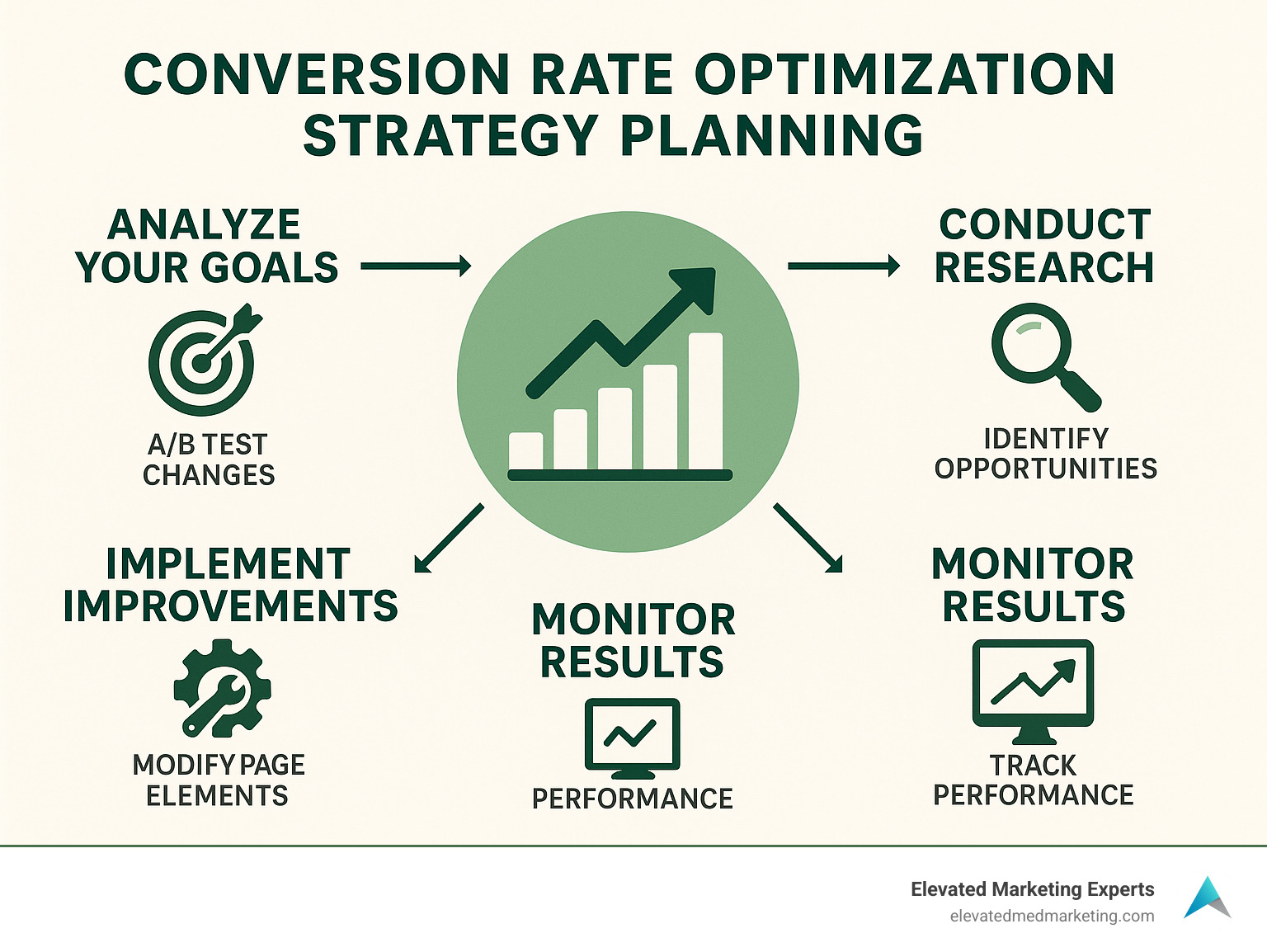
Think of what we’ve covered as five essential pillars that work together to create a patient-generating website:
- Diagnose your funnel with precision to spot exactly where potential patients are dropping off
- Simplify the user experience to create smooth, friction-free journeys that feel natural and easy
- Build trust and credibility through authentic testimonials, before/after galleries, and transparent communication
- Create persuasive content that speaks directly to what your patients are hoping to achieve
- Test and iterate continuously to refine your approach based on real data, not guesswork
At Liftd Marketing Experts, we’ve watched these strategies work wonders for plastic surgeons and medical spas just like yours. We’ve seen conversion rates double—sometimes even triple—which means more consultations, procedures, and practice revenue without spending an extra penny on advertising. It’s like getting more mileage from the traffic you already have.
I encourage you to take a fresh look at your own website with these principles in mind. Which pages seem to be losing visitors? Are your calls-to-action clear and compelling, or buried among distractions? Does your site build the kind of trust that’s absolutely essential for someone considering aesthetic procedures?
The beauty of these conversion rate optimization tips is that even small improvements can yield significant results. A form that’s easier to complete, a testimonial that resonates more deeply, or a page that loads just a second faster—these seemingly minor changes can dramatically impact your bottom line.
If you’d like expert help implementing these strategies for your practice, our team at Liftd Marketing Experts specializes in marketing for medical aesthetics. We understand the unique challenges and opportunities in your field because it’s all we do, day in and day out.
Ready to stop watching potential patients slip away and start converting more of your existing traffic into bookings? Contact us today for a free website conversion audit and personalized recommendations custom specifically for your practice.


