

Cardiology SEO: 7 Powerful Ways for Outstanding Success 2025
Why Cardiology SEO is Critical for Your Practice’s Growth
Cardiology SEO is the process of optimizing your cardiology practice’s website and online presence to rank higher in search engine results, attract more patients, and grow your practice revenue. Here’s what every cardiologist needs to know:
Key Cardiology SEO Strategies:
- Local SEO optimization – Rank for “cardiologist near me” searches
- Keyword targeting – Focus on heart conditions and procedures you treat
- Content marketing – Educate patients about cardiovascular health
- Online reputation management – Build trust through patient reviews
- Technical optimization – Ensure fast, mobile-friendly, HIPAA-compliant sites
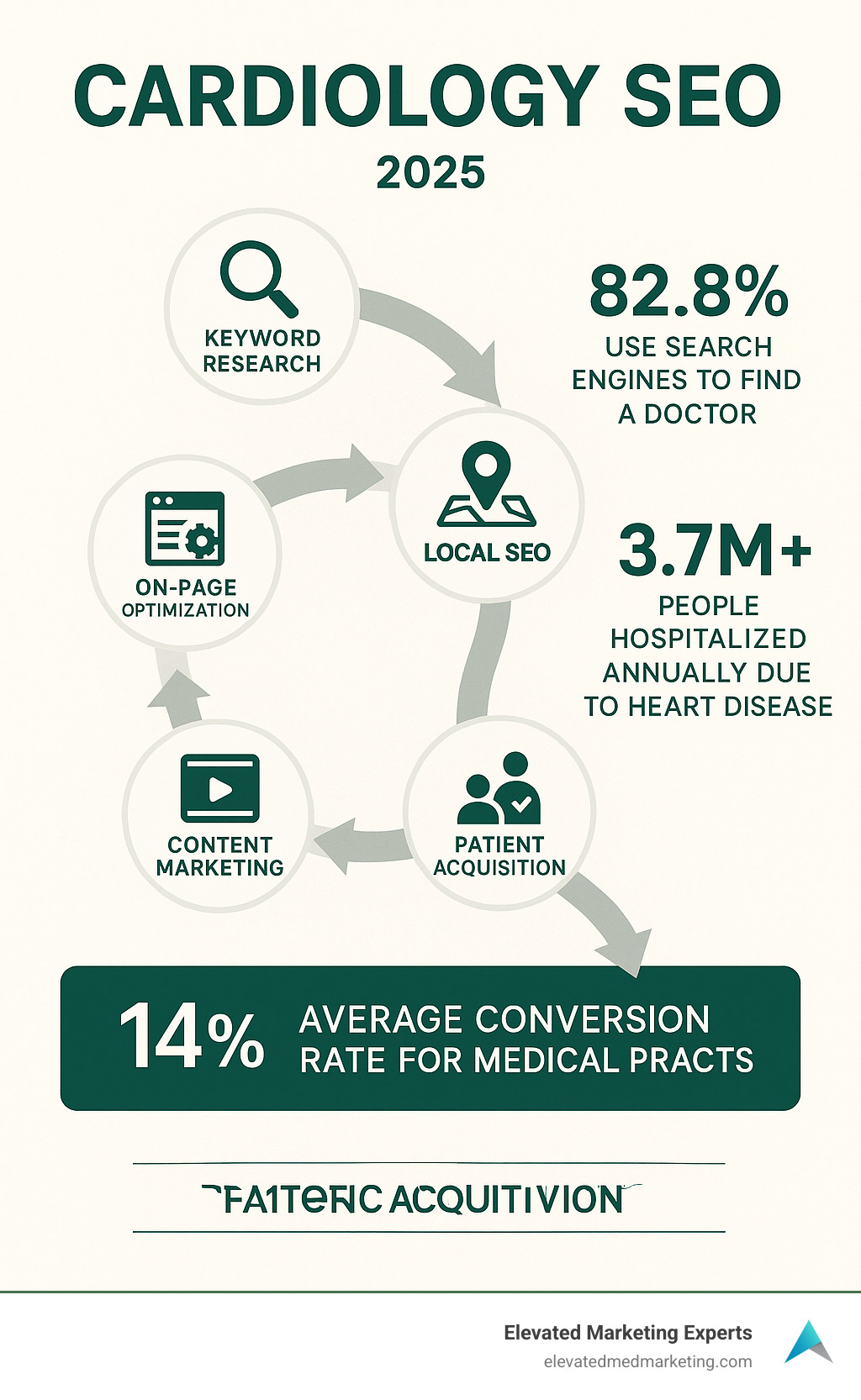
The numbers tell a compelling story. 82.8% of people use search engines to find a doctor before making an appointment, while 75% of Americans turn to the Internet first when searching for health information. With 3.7 million people going to the hospital every year due to heart disease, the demand for cardiology services is massive.
But here’s the challenge: if your practice isn’t visible online, you’re missing out on patients who need your expertise. Most cardiology practices struggle with digital marketing because they’re focused on patient care, not search rankings.
The reality is simple – patients search online first, then call practices that appear at the top of search results. Without proper SEO, even the best cardiologists remain invisible to potential patients.
I’m Joe Amaral, and I’ve spent over a decade helping medical practices grow through digital marketing strategies. My experience in Cardiology SEO has shown me that heart specialists who invest in proper search optimization see dramatic increases in patient inquiries and practice revenue.
Terms related to Cardiology SEO:
- Organic search engine marketing
- Organic SEO costs
- Organic SEO specialists
Cardiology SEO: Definition & Importance
Heart disease remains the leading cause of death in the United States, with scientific research showing that cardiovascular disease affects millions of Americans annually. This creates enormous demand for cardiology services, but it also means intense competition among practices.
Cardiology SEO is the specialized practice of optimizing your cardiology website and online presence to rank higher in search results when patients search for heart-related care. Unlike general medical SEO, cardiology SEO focuses specifically on cardiovascular conditions, procedures, and local patient acquisition.
The importance of Cardiology SEO extends beyond simple visibility. It’s about connecting with patients at the exact moment they’re searching for heart care. When someone searches “cardiologist near me” or “chest pain specialist,” they’re often experiencing anxiety about their heart health. Your practice needs to appear at the top of those search results to provide the care they need.
Private-pay patients represent a particularly valuable segment for cardiology practices. These patients aren’t restricted by insurance network limitations and often search online to find the best specialists. Effective Cardiology SEO helps you capture these high-value patients who bypass managed care directories and search directly on Google.
Why “Cardiology SEO” Matters for Growth
The statistics are overwhelming: 82.8% of people use search engines to find a doctor before making an appointment. This means that for every 10 potential patients in your area, more than 8 will search online before choosing a cardiologist.
We’ve seen this digital-first behavior accelerate dramatically. Patients no longer rely solely on physician referrals or insurance directories. They research symptoms, read reviews, and compare practices online. If your cardiology practice isn’t visible in search results, you’re essentially invisible to most potential patients.
The patient journey typically follows this pattern:
- Symptom awareness – Patient experiences chest pain, shortness of breath, or other cardiac symptoms
- Initial search – They search for information about their symptoms
- Provider search – They search for local cardiologists
- Practice evaluation – They review websites, read patient reviews, and compare options
- Contact decision – They call the practice that appears most credible and accessible
Cardiology SEO ensures your practice appears prominently throughout this journey, from initial symptom research to final contact decision.
Key Benefits of Cardiology SEO for Practices
The benefits of effective Cardiology SEO extend far beyond increased website traffic. Here’s what practices typically experience:
Increased Patient Visibility: When your practice ranks on the first page of Google for relevant cardiology searches, you become the go-to choice for patients in your area. This is particularly important for specialized procedures like interventional cardiology or electrophysiology.
Higher Quality Appointments: Patients who find you through organic search are often more engaged and committed to treatment. They’ve actively researched their condition and chosen your practice, leading to better patient compliance and outcomes.
Revenue Growth: Practices implementing comprehensive Cardiology SEO strategies typically see 20-50% increases in new patient inquiries within the first year. One practice we worked with saw a 320% increase in SEO traffic and corresponding revenue growth.
Competitive Advantage: Many cardiology practices still rely on traditional referral networks. By investing in SEO, you gain a significant advantage over competitors who aren’t visible online.
Brand Authority: Ranking highly for cardiology-related searches establishes your practice as a trusted authority in cardiovascular care. This builds patient confidence before they even contact your office.
Crafting a Winning Cardiology SEO Strategy & Local Dominance
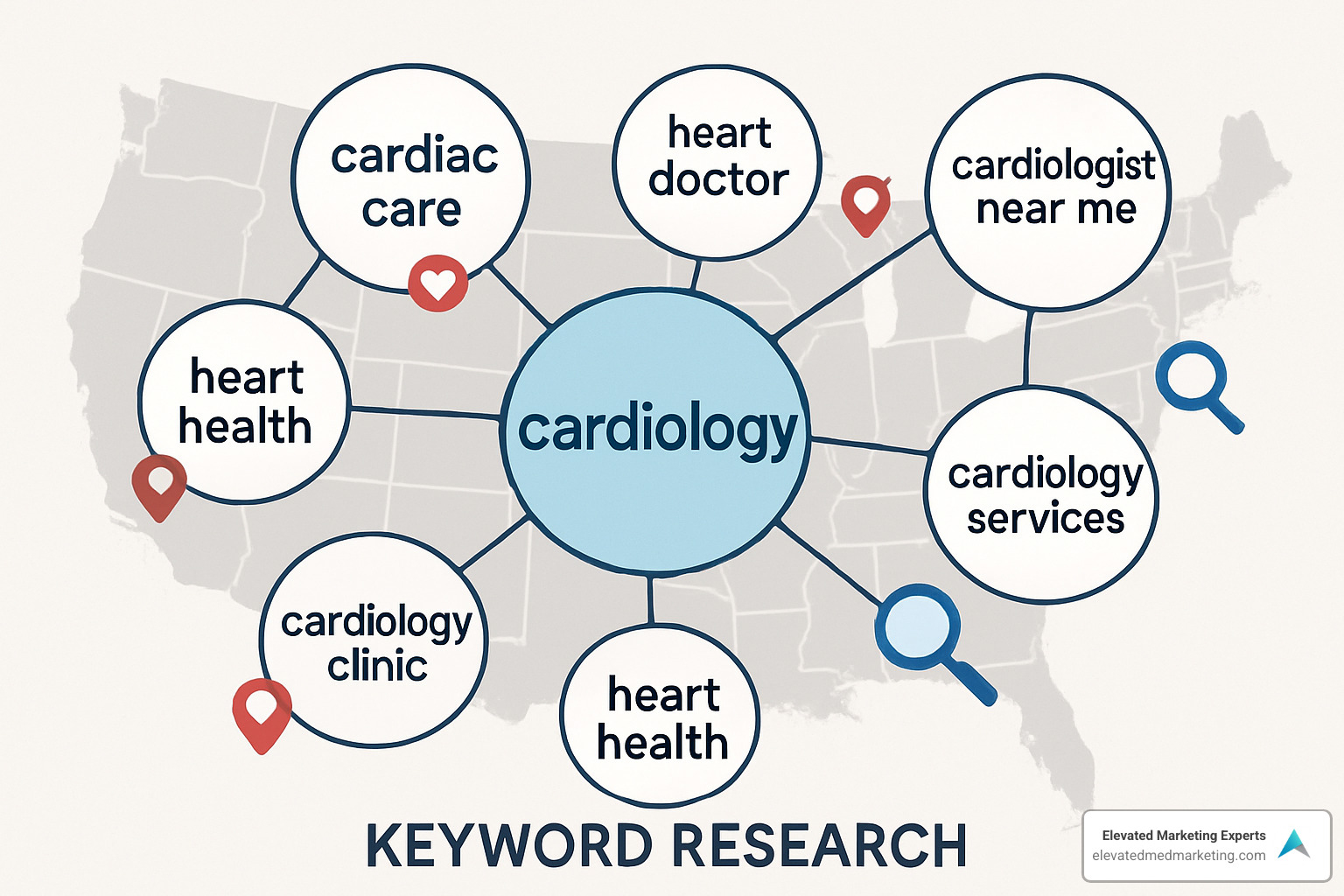
Developing an effective Cardiology SEO strategy requires a comprehensive approach that addresses multiple aspects of your online presence. Based on our research and experience, successful cardiology practices focus on five core areas: keyword research, technical optimization, content marketing, local SEO, and reputation management.
The foundation of any successful Cardiology SEO campaign starts with understanding patient search behavior. Research shows that 58% of U.S. adults use the Internet to look for health or medical information, and 70% read reviews when searching for healthcare providers.
Here’s how organic SEO compares to paid advertising for cardiology practices:
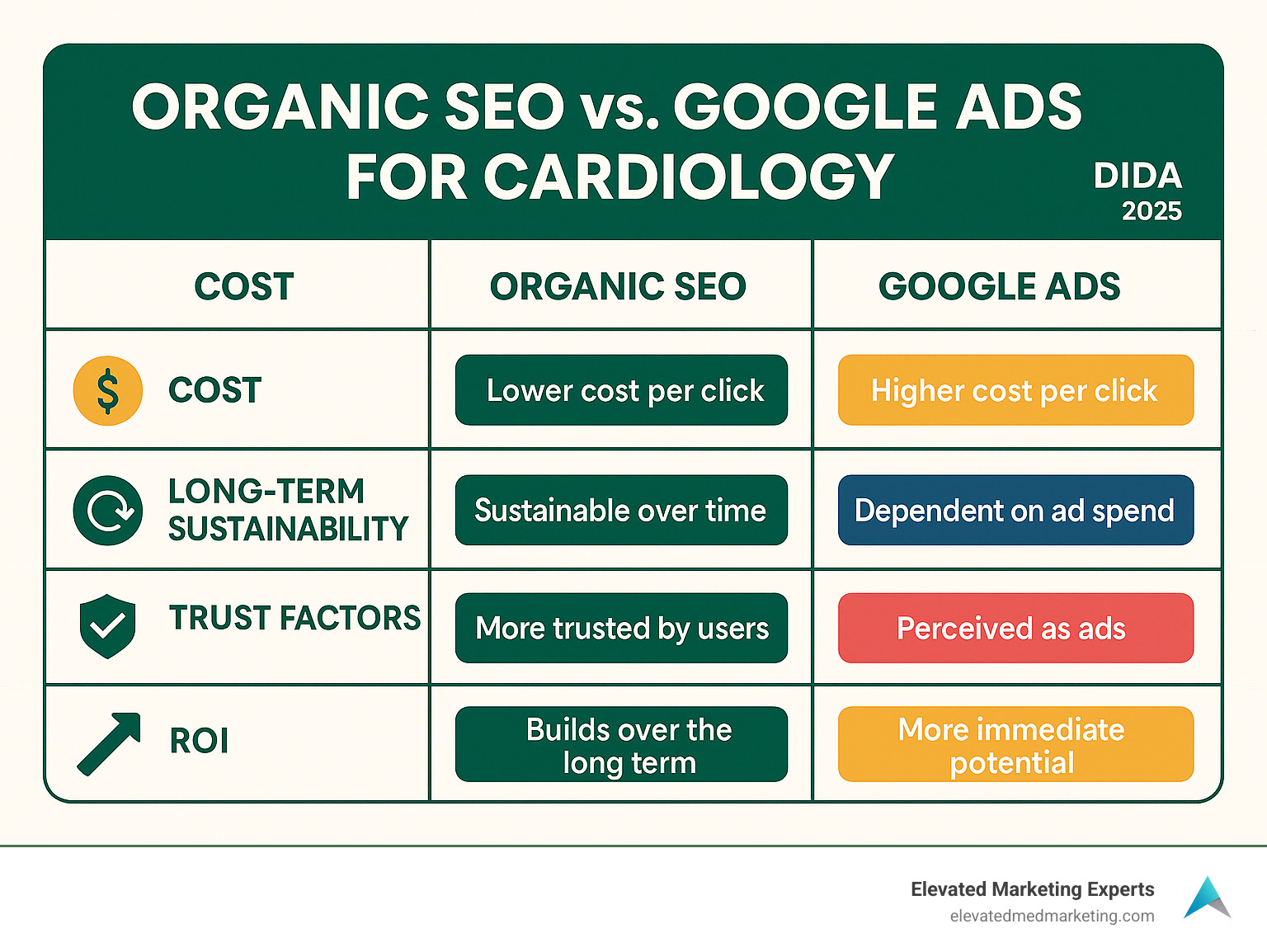
Organic SEO vs. Google Ads for Cardiology:
| Factor | Organic SEO | Google Ads |
|---|---|---|
| Cost | Lower long-term cost | Higher ongoing cost |
| Sustainability | Results last indefinitely | Results stop when ads stop |
| Trust | Higher patient trust | Lower trust (marked as ads) |
| Timeline | 3-6 months for results | Immediate results |
| ROI | Higher long-term ROI | Lower long-term ROI |
The most effective approach combines both strategies, using search engine optimization for long-term growth and targeted ads for immediate visibility.
Intent-Driven Keyword Research
Effective Cardiology SEO begins with understanding exactly what potential patients are searching for. Our research reveals that cardiology-related searches fall into several categories:
Service-Based Keywords: These target specific procedures and treatments:
- “Echocardiogram near me”
- “Stress test [city name]”
- “Cardiac catheterization”
- “Pacemaker implantation”
- “Heart valve repair”
Condition-Based Keywords: These target patients searching for specific heart conditions:
- “Chest pain specialist”
- “Heart failure treatment”
- “Arrhythmia doctor”
- “Coronary artery disease”
- “Atrial fibrillation treatment”
Geographic Modifiers: Always include location-based terms to capture local searches:
- “Cardiologist in [city]”
- “Heart doctor near me”
- “Best cardiologist [county]”
The key is selecting keywords that accurately describe your services while including geographic modifiers to limit competition. For example, targeting “cardiologist Miami” is more effective than competing for the broad term “cardiologist.”
Keyword Research Tools for Cardiology:
- Google Keyword Planner for search volume data
- SEMrush for competitor analysis
- Ahrefs for keyword difficulty assessment
- Answer the Public for patient question research
Technical & On-Page Optimization for Cardiology SEO
Technical SEO forms the foundation of your Cardiology SEO strategy. Search engines need to crawl, understand, and index your website effectively before they can rank it highly.
Schema Markup for Medical Practices: Implementing structured data helps search engines understand your practice information:
- Medical practice schema
- Physician schema with specialties
- Review schema for patient testimonials
- Local business schema with NAP data
Site Speed Optimization: Page load speed directly impacts both search rankings and patient experience. Aim for load times under 3 seconds:
- Optimize images (use WebP format when possible)
- Minimize HTTP requests
- Enable browser caching
- Use a content delivery network (CDN)
Mobile Optimization: With mobile searches accounting for over 50% of healthcare-related queries, your site must be mobile-friendly:
- Responsive design that adapts to all screen sizes
- Touch-friendly navigation and buttons
- Fast mobile load times
- Easy-to-read fonts and proper spacing
HIPAA Compliance: Maintaining patient privacy while optimizing for search:
- Secure SSL certificates (HTTPS)
- HIPAA-compliant contact forms
- Privacy policy updates
- Secure patient portal integration
Content Marketing that Heals & Converts
Content marketing is where Cardiology SEO truly shines. By creating valuable, educational content, you establish authority while capturing patients throughout their research journey.
Blog Content Strategy: Regular blogging signals freshness to search engines while providing value to patients:
- “Understanding Your EKG Results”
- “When to See a Cardiologist: Warning Signs”
- “Preparing for Your First Cardiac Catheterization”
- “Heart-Healthy Diet Tips from Our Cardiologists”
Video Content: Videos are particularly effective for explaining complex cardiac procedures:
- Procedure explanation videos
- Patient testimonial videos
- Virtual office tours
- Heart health education series
Patient Success Stories: With proper HIPAA compliance, patient stories build trust and demonstrate expertise:
- Before/after treatment outcomes
- Patient testimonials about their experience
- Recovery journey documentation
The key to effective SEO content strategy is addressing patient concerns at every stage of their journey, from initial symptom awareness to post-treatment care.
Local SEO & Reputation Amplification
Local SEO is crucial for cardiology practices since most patients prefer providers within a reasonable distance. Our research shows that practices ranking in Google’s local 3-pack receive significantly more calls than those appearing only in organic results.
Google Business Profile Optimization:
- Complete all profile sections with accurate information
- Add high-quality photos of your office and staff
- Post regular updates about services and health tips
- Respond to all patient reviews promptly
Citation Management: Consistent NAP (Name, Address, Phone) information across all directories:
- Major medical directories (Healthgrades, WebMD, Vitals)
- Local business directories (Yelp, Yellow Pages)
- Insurance provider directories
- Hospital affiliation listings
Review Response Strategy: Managing online reputation while maintaining HIPAA compliance:
- Thank patients for positive reviews
- Address negative reviews professionally
- Never discuss specific patient information
- Encourage satisfied patients to leave reviews
Star Ratings Impact: Practices with 4+ star ratings receive significantly more patient inquiries. Focus on providing exceptional patient experiences that naturally generate positive reviews.
Advanced Cardiology SEO, Measurement & Future Trends

The landscape of Cardiology SEO continues evolving rapidly. Voice search, artificial intelligence, and changing patient behaviors are reshaping how people find healthcare providers. Staying ahead of these trends is crucial for maintaining competitive advantage.
Voice Search Optimization: With smart speakers and voice assistants becoming commonplace, optimize for conversational queries:
- “Hey Google, find a cardiologist near me”
- “What are the symptoms of heart disease?”
- “Best heart doctor in [city]”
Core Web Vitals: Google’s focus on user experience metrics affects medical websites significantly:
- Largest Contentful Paint (LCP) – page loading speed
- First Input Delay (FID) – interactivity
- Cumulative Layout Shift (CLS) – visual stability
AI-Powered Search: As search engines become more sophisticated, focus on comprehensive, authoritative content that answers patient questions thoroughly.
Structured Data & EEAT for Cardiology SEO
Google’s emphasis on Experience, Expertise, Authoritativeness, and Trustworthiness (EEAT) is particularly important for medical websites. Cardiology SEO success depends heavily on demonstrating these qualities.
Medical Schema Implementation:
- Physician schema with board certifications
- Medical organization schema
- Review and rating schema
- FAQ schema for common patient questions
Author Authority: Establish physician credibility through:
- Detailed physician bios with credentials
- Medical school and residency information
- Board certifications and specializations
- Published research and speaking engagements
Trust Signals: Build patient confidence through:
- Hospital affiliation badges
- Medical association memberships
- Patient safety certifications
- Awards and recognitions
Multi-Location & Group Practice Optimization
Large cardiology groups face unique Cardiology SEO challenges. Each location needs individual optimization while maintaining brand consistency.
Location Page Strategy:
- Unique content for each location
- Local keyword targeting by city/region
- Individual Google Business Profiles
- Location-specific patient testimonials
Citation Management: Maintain consistent NAP data across all locations while building location-specific citations in local directories.
Zip Code Targeting: Focus on specific zip codes around each location to capture hyper-local searches.
Measuring Success & Overcoming Challenges
Effective Cardiology SEO requires continuous monitoring and optimization. Key metrics to track include:
Ranking Metrics:
- Keyword position tracking
- Local pack appearances
- Featured snippet captures
- Voice search rankings
Traffic Metrics:
- Organic search traffic growth
- Local search traffic
- Mobile traffic percentage
- Page engagement metrics
Conversion Metrics:
- Phone call tracking
- Appointment booking rates
- Contact form submissions
- Patient acquisition cost
Common Challenges and Solutions:
Challenge: HIPAA compliance while optimizing
Solution: Work with healthcare marketing specialists who understand medical privacy requirements
Challenge: Technical SEO complexity
Solution: Partner with agencies experienced in medical website optimization
Challenge: Content creation time constraints
Solution: Develop content calendars and consider professional content strategy services
Frequently Asked Questions about Cardiology SEO
How long before Cardiology SEO shows results?
Cardiology SEO typically shows initial results within 3-6 months, with significant improvements appearing after 6-12 months. The timeline depends on several factors:
- Competition level in your geographic area
- Current website condition and technical issues
- Content quality and frequency of updates
- Local SEO optimization completeness
- Consistency of optimization efforts
We’ve seen practices achieve first-page rankings for competitive cardiology terms within 3 months when implementing comprehensive strategies. However, sustainable, long-term results require ongoing optimization and content creation.
Is Cardiology SEO better than paid ads for doctors?
Both Cardiology SEO and paid advertising have their place in a comprehensive marketing strategy. Here’s when each works best:
Choose Organic SEO when:
- You want long-term, sustainable results
- Building trust and authority is important
- You have time to invest in content creation
- Your budget is limited for ongoing ad spend
Choose Paid Ads when:
- You need immediate visibility
- Launching a new practice or location
- Promoting specific services or procedures
- You have budget for ongoing advertising
The most successful cardiology practices use both strategies, with SEO providing the foundation and paid ads filling specific gaps or promoting particular services.
How do I keep my cardiology site HIPAA-compliant while optimizing?
Maintaining HIPAA compliance during Cardiology SEO optimization requires careful attention to patient privacy:
Safe SEO Practices:
- Use general patient testimonials without specific medical details
- Implement secure contact forms with encryption
- Avoid discussing specific patient cases in content
- Use stock photos instead of actual patient images
- Ensure all tracking codes comply with HIPAA requirements
Content Guidelines:
- Focus on educational content about conditions and treatments
- Share general success stories without identifying information
- Discuss treatment options and procedures in general terms
- Always include privacy disclaimers on forms and pages
Working with healthcare marketing specialists ensures your Cardiology SEO efforts remain compliant while maximizing results.
Conclusion
Cardiology SEO isn’t just about ranking higher in search results—it’s about connecting with patients who need your expertise at the exact moment they’re searching for cardiovascular care. With 82.8% of people using search engines to find doctors and 3.7 million Americans hospitalized annually for heart disease, the opportunity for growth is enormous.
The practices that succeed in today’s digital landscape are those that combine clinical excellence with strategic online visibility. By implementing comprehensive Cardiology SEO strategies—from technical optimization and content marketing to local SEO and reputation management—you position your practice as the trusted choice for heart care in your community.
At Liftd Digital Marketing, we specialize in helping medical practices grow through proven SEO strategies. Our experience with cardiology practices has shown us what works: a patient-focused approach that combines technical expertise with compelling content and local optimization.
Ready to improve your practice’s online presence? We offer comprehensive SEO audits that identify opportunities for growth and provide actionable recommendations. Our organic SEO packages are designed specifically for medical practices, ensuring HIPAA compliance while maximizing search visibility.
The heart of successful Cardiology SEO lies in understanding that behind every search query is a person seeking care for their cardiovascular health. By optimizing your online presence, you’re not just improving rankings—you’re improving lives by connecting patients with the cardiac care they need.
Don’t let your expertise remain hidden in search results. Contact us today to learn how our specialized Cardiology SEO services can help your practice achieve the online visibility it deserves.


