

Understanding SEO and the Importance of Organic SEO for Aesthetic Practices
Being visible online is not just an option for aesthetic practices; it’s a necessity. However, many plastic surgeons and medical spa owners find themselves struggling to climb the Google ranks and attract high-quality traffic to their websites. The key to overcoming these challenges lies in Organic SEO (Search Engine Optimization).
SEO is a powerful tool that can dramatically improve your online presence, helping your practice to appear on the first page of Google search results. This is crucial because most potential clients rarely scroll past the first few listings. Organic SEO focuses on improving your site’s visibility without the need for paid ads. It involves optimizing various elements of your website and content so that Google recognizes your site as a relevant and authoritative source for users searching for aesthetic services.
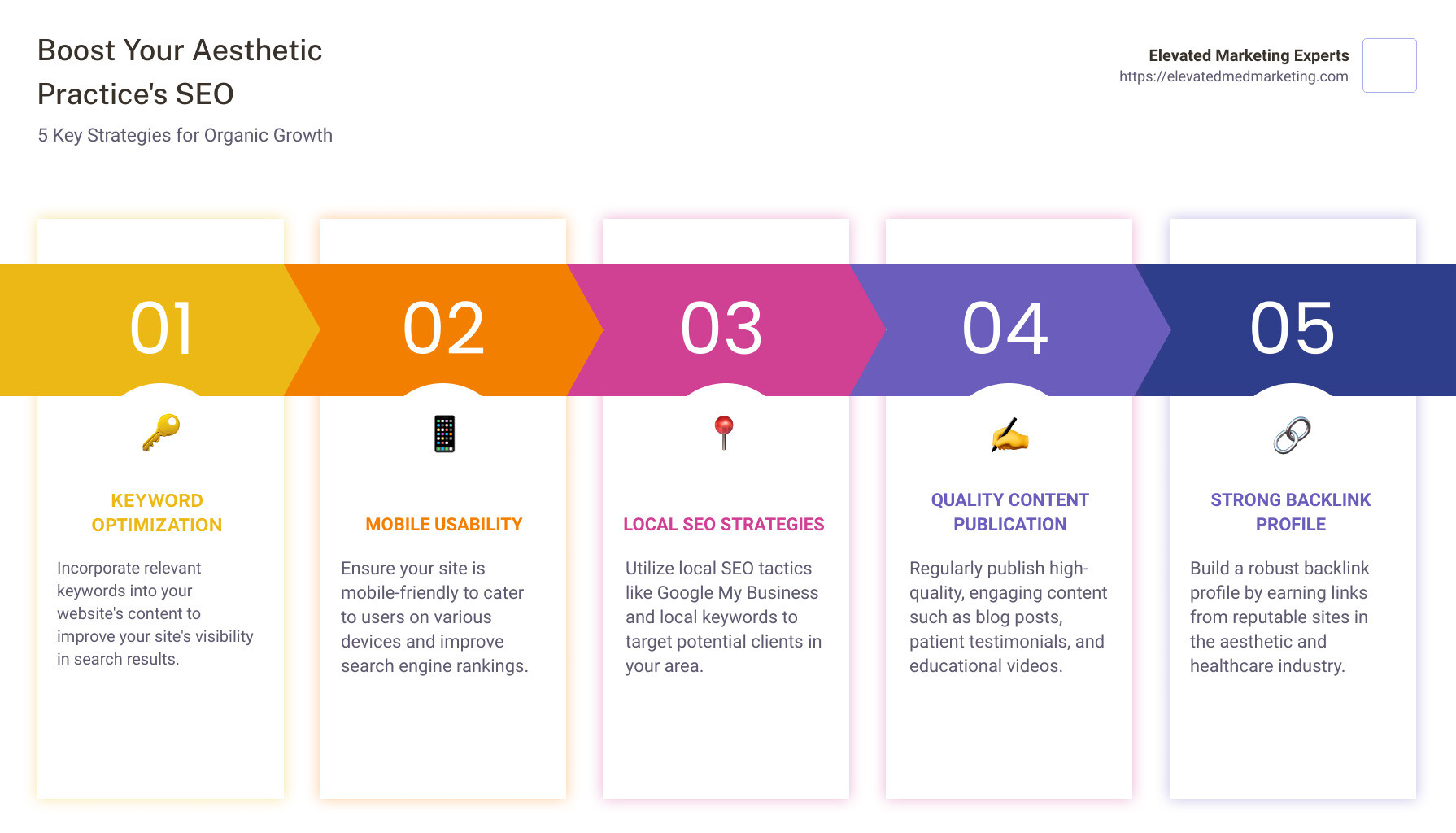
- Quick Tips for Improving Your Aesthetic Practice’s Organic SEO:
- Optimize your website’s content with relevant keywords.
- Ensure your site is mobile-friendly.
- Leverage local SEO tactics.
- Consistently publish high-quality, engaging content.
- Build a strong backlink profile.
These steps are just the beginning of enhancing your practice’s online visibility through SEO. By focusing on organic strategies, you’re investing in a sustainable and cost-effective way to attract more clients and grow your business.
The journey to SEO success is continuous and changing. Staying informed and adapting to changes in search engine algorithms is crucial. Dive deeper into each of these areas as we explore how to effectively boost your aesthetic practice’s organic SEO, setting your business up for long-term growth and success.
Understanding SEO in Aesthetic Marketing
SEO Basics
At its core, SEO (Search Engine Optimization) is about making your aesthetic practice easily discoverable by search engines like Google. It’s the art and science of matching your online content with what people are searching for. When someone types “best facial rejuvenation near me” or any of the ’35 aesthetic practice organic seo’ queries into a search engine, you want your practice to pop up on that first page of results.
Why? Because most people hardly ever scroll past the first few results, let alone the first page.
SEO involves a mix of strategies and techniques, including choosing the right keywords, creating valuable content, and ensuring your website is easy for search engines to understand.
Marketing Strategy
Your digital marketing strategy is like a map guiding potential clients to your door. SEO is a crucial part of this map. Without it, you could have the best aesthetic services in town, but if no one can find you online, your practice might as well be invisible.
A solid SEO strategy involves knowing what potential clients are searching for and tailoring your online presence to meet those queries head-on. This means creating content that answers their questions, showcases your services, and highlights the unique benefits of choosing your practice.
Digital Presence
Your online presence is your storefront. It’s often the first interaction potential clients have with your practice. A strong digital presence not only makes you visible but also builds credibility and trust.
Your website, social media profiles, and online reviews form the cornerstone of your digital presence. Each element should be optimized for SEO. This means:
- Website: Fast, mobile-friendly, and easy to navigate.
- Social Media: Active profiles that engage with your audience and share relevant, valuable content.
- Online Reviews: Encourage satisfied clients to leave positive reviews on Google and other review sites.
SEO isn’t a one-time task but a continuous effort. Google’s algorithms constantly change, and so do the ways people search for services. Keeping up with these changes and adjusting your strategy accordingly is key to staying ahead in the competitive aesthetic market.
In summary, understanding SEO in aesthetic marketing is about more than just keywords and links. It’s about creating a comprehensive digital strategy that puts your practice in front of the right people, at the right time. By focusing on the basics of SEO, developing a solid marketing strategy, and building a strong digital presence, you’re laying the groundwork for a successful, visible online future for your aesthetic practice.
Let’s move on to explore the key components of effective SEO for aesthetic practices and how you can implement them to boost your organic search rankings.
Key Components of Effective SEO for Aesthetic Practices
To make your aesthetic practice shine online, mastering the art of SEO is crucial. Here’s how you can implement effective SEO strategies to boost your organic search rankings.
Keyword Research
Start by understanding what potential clients are searching for. Tools like Google’s Keyword Planner or Semrush can help you discover keywords related to your services. For instance, “best Botox clinic in Chicago” might be a goldmine if you’re located in that area. The goal is to find keywords that are not only relevant but also have a high search volume with low competition.
Content Creation
Content is the heart of SEO. Your website needs to offer valuable, engaging content that answers the questions your potential clients are asking. Think blog posts about the benefits of certain procedures, before-and-after galleries, patient testimonials, and educational videos. According to research, practices that regularly update their blog see a significant increase in site traffic.
On-page SEO
This is all about making your website as search-engine-friendly as possible. Ensure your titles, headings, and meta descriptions are optimized with your target keywords. Images should have descriptive filenames and alt text. Also, make sure your website’s structure is easy to navigate – both for users and search engine crawlers.
Off-page SEO
Off-page SEO involves activities outside your website that improve your site’s visibility. Building quality backlinks from reputable sites in the aesthetic field can significantly boost your rankings. Engaging on social media and collaborating with influencers can also drive traffic to your site.
Local SEO
For aesthetic practices, local SEO is key. Make sure your practice is listed on Google My Business and other online directories. Include your practice’s name, address, and phone number consistently across the web. Encourage satisfied clients to leave positive reviews on these platforms. Local keywords, such as “dermatologist in [Your City],” should be sprinkled throughout your site’s content.

Implementing these components requires a blend of technical know-how, content creativity, and strategic thinking. But the rewards, including higher visibility in search results and more traffic to your site, are well worth the effort. SEO is not a one-time task but an ongoing process that needs to be refined and adjusted as search trends and algorithms evolve.
Let’s dive deeper into how you can optimize your website and content to make your aesthetic practice more visible online.
Building a Strong Foundation: Website Optimization
When we talk about making your aesthetic practice stand out in the digital world, think of your website as the foundation of a house. Just like a strong foundation supports a house, a well-optimized website supports your online presence. Let’s break this down into simpler parts: Website Design, Mobile Responsiveness, Page Speed, and User Experience.
Website Design
Your website is often the first impression potential clients get of your practice. It should reflect the quality and professionalism of your services. Make sure it’s clean, attractive, and easy to navigate. A cluttered or outdated website can turn people away fast. You don’t need to be a professional designer to have a great website. There are tools and platforms that can help you create a stunning website without needing to code.
Mobile Responsiveness
Nowadays, more people use their phones to browse the internet than ever before. If your website doesn’t look good or work well on a smartphone, you’re losing out. Mobile responsiveness means your site adjusts to fit the screen it’s being viewed on, whether it’s a phone, tablet, or desktop. This is crucial for keeping potential clients engaged.
Page Speed
Imagine clicking on a website and waiting forever for it to load. Frustrating, right? That’s how your visitors feel if your website takes too long to load. Page speed is a key factor in user satisfaction. It’s also important for SEO because search engines, like Google, prioritize websites that load quickly. You can use tools like Google’s PageSpeed Insights to check your site’s speed and get suggestions for improvement.
User Experience
Finally, think about the overall experience someone has when they visit your website. Is it easy to find information? Are your services and contact details clearly visible? A positive user experience keeps people on your site longer, increasing the chances they’ll contact you. Simple things like having a clear menu, a FAQ section, and a contact form can make a big difference.
Remember, optimizing your website isn’t just about adding the right keywords for ’35 aesthetic practice organic seo’. It’s about making sure that once potential clients find your site, they have a good experience. A well-designed, fast, mobile-friendly website is more likely to convert visitors into clients.
Next, we’ll explore how creating SEO-friendly content can not only attract visitors to your site but also engage and retain them.
Content is King: Creating SEO-Friendly Content
Creating SEO-friendly content is not just about stuffing pages with keywords. It’s about crafting valuable content that speaks directly to the needs and interests of your audience. Let’s dive into how you can create compelling content for your aesthetic practice.
Blog Posts
Start with blog posts. These are the bread and butter of your content strategy. Focus on topics that your potential clients are curious about. For example, “The Top 5 Benefits of Chemical Peels.” Use simple language and keep your sentences short. You’re talking to people curious about aesthetic services, not fellow experts. Each blog post should target specific keywords, but always prioritize readability and value over keyword density.
Before-and-After Galleries
Before-and-after galleries are incredibly powerful. They show, rather than tell, the potential results of your services. Make sure these galleries are easy to find and navigate on your website. Include a brief description for each photo, using relevant keywords naturally. This not only helps with SEO but also provides context for the viewer.
Patient Testimonials
Patient testimonials add a layer of trust and authenticity to your practice. They’re stories from real people who’ve experienced real results. Feature these prominently on your site. If possible, include a photo or video along with the testimonial to increase its impact. When it comes to SEO, these testimonials can be rich in natural language and keywords related to your services, helping your site rank for those terms.
Educational Videos
Finally, educational videos can be a game-changer. They’re engaging and can be shared across multiple platforms, from your website to social media. Topics can range from “How Laser Hair Removal Works” to “What to Expect During Your First Botox Appointment.” These videos should be informative, easy to understand, and short. Use clear titles and descriptions filled with keywords to help these videos get found.
Creating SEO-friendly content is a continuous process. It’s not about hitting a quota but consistently providing value to your audience. By focusing on these four content types – blog posts, before-and-after galleries, patient testimonials, and educational videos – you’re not just improving your SEO. You’re building a library of resources that establish your aesthetic practice as a trustworthy, knowledgeable authority in the field.
Next, we’ll look into how leveraging local SEO can further enhance your visibility and attract more clients to your practice.
Leveraging Local SEO for Your Aesthetic Practice
Local SEO is like a magnet. It draws potential clients from your area directly to your aesthetic practice. Let’s dive into how you can make this powerful tool work for you.
Google My Business: Your Digital Storefront
Think of Google My Business (GMB) as your practice’s digital storefront. It’s the first thing people see when they search for your services online. Here’s how to make it shine:
– Claim and verify your GMB listing. This step is crucial. It tells Google you’re a legitimate business, ready to serve clients.
– Fill out every detail. From your practice’s address and phone number to your operating hours and services offered, the more information, the better.
– Add photos. Before-and-after shots, your team in action, or your welcoming office space can make a big difference. They visually tell the story of your practice.
Local Citations: Spread the Word
Local citations are mentions of your practice across the web. They can be in local business directories, on websites, or in social media profiles. Here’s why they matter:
– Consistency is key. Ensure your practice’s name, address, and phone number (NAP) are the same across all platforms. This consistency boosts your credibility with Google.
– Quality over quantity. Focus on getting listed in reputable directories. Think Yelp, Healthgrades, or your local chamber of commerce.
Online Reviews: The Voice of Your Clients
Reviews are word-of-mouth marketing in the digital age. They can make or break your practice’s reputation. Here’s how to encourage positive reviews:
– Ask happy clients to leave a review. A simple request can go a long way.
– Respond to all reviews, good or bad. This shows you value feedback and are committed to client satisfaction.
– Highlight positive reviews on your website or social media. Let the good words of others sing your praises.
Local Keywords: Speak Your Clients’ Language
Using local keywords is like setting up a sign in your neighborhood. It helps locals find you. Here’s how to incorporate them:
– Research local terms. What would someone in your area type into Google when looking for your services? “Botox in [Your City]” or “Laser hair removal near me” are examples.
– Include these keywords in your website’s content, blog posts, and meta descriptions. But remember, don’t overdo it. Keep it natural.
By focusing on these four areas – Google My Business, local citations, online reviews, and local keywords – you’re laying down a solid foundation for your aesthetic practice’s local SEO. This strategy not only boosts your visibility but also establishes your practice as a trusted, go-to choice in your community.
We’ll explore how to enhance this visibility even further through off-page SEO. Stay tuned to learn about building a backlink strategy, engaging on social media, and collaborating with influencers to keep your practice at the top of everyone’s mind.
Enhancing Visibility Through Off-Page SEO
After setting a strong foundation with your website and local SEO, it’s time to boost your aesthetic practice’s visibility even further. Off-page SEO plays a crucial role in how your practice ranks in search results. Let’s dive into three key areas: backlink strategy, social media marketing, and influencer collaborations.
Backlink Strategy
Think of backlinks as digital “votes of confidence” from other websites. The more high-quality sites link to your practice’s website, the more search engines see your site as credible and authoritative. Here’s how to start:
- Create share-worthy content: High-quality, informative content naturally attracts backlinks. This includes detailed blog posts, infographics, and educational videos.
- Guest blogging: Offer to write articles for reputable sites in your industry. This not only gives you a platform to share your expertise but also earns you valuable backlinks.
- Monitor your backlinks: Use tools like Ahrefs or Moz to track who’s linking to you. This helps you understand which content performs well and where your backlinks are coming from.
Social Media Marketing
Your patients are on social media, and you should be too. Platforms like Instagram and Facebook are perfect for showcasing before-and-after photos, sharing patient testimonials, and providing educational content. Here’s how to make the most of it:
- Be consistent: Regular posting keeps your practice top of mind for your followers.
- Engage with your audience: Respond to comments, ask questions, and participate in community discussions. Engagement boosts your visibility.
- Use hashtags wisely: Hashtags can help people discover your content. Use relevant hashtags that potential patients might search for.
Influencer Collaborations
Partnering with influencers can put your practice in front of a larger, engaged audience. Look for influencers whose followers match your target demographic. Here’s how to approach this:
- Start local: Local influencers have followers in your area who could become your patients.
- Focus on authenticity: Choose influencers who align with your practice’s values and have a genuine interest in aesthetic medicine.
- Measure impact: Track the performance of your influencer campaigns to see what works best for your practice.
By implementing these off-page SEO strategies, you can significantly improve your aesthetic practice’s online visibility. Building a strong online presence takes time and consistent effort. Keep at it, and you’ll see your practice climb the ranks in search engine results.
Next, we’ll look into the tools and analytics you can use to measure your SEO success and adjust your strategies accordingly. Stay tuned for insights on leveraging Google Analytics, SEMrush, and more to keep your practice ahead of the competition.
Measuring Success: SEO Tools and Analytics
Understanding the impact of your SEO efforts is crucial to refining your strategy and ensuring that your aesthetic practice stands out online. To do this, you’ll need to familiarize yourself with several tools designed to track and analyze your website’s performance. Let’s dive into how you can use Google Analytics, SEMrush, PatientGain, and Outranking to measure your success.
Google Analytics: Your SEO Dashboard
Google Analytics is like a high-powered engine for your website’s analytics. It tracks virtually every action taken on your site, from page views and bounce rates to more complex events like conversion tracking. Here’s how to use it for your aesthetic practice:
- Track Visitor Behavior: See which pages your visitors spend the most time on and adjust your content accordingly.
- Monitor Traffic Sources: Understand where your visitors are coming from—be it search engines, social media, or direct visits.
- Set Goals: Use the Goals feature to track conversions, like appointment bookings or contact form submissions.
By regularly checking Google Analytics, you can get a clear picture of what’s working and what’s not, allowing you to make informed decisions about your SEO strategy.
SEMrush: Competitive Insights and More
SEMrush is a powerful tool for keyword research and competitive analysis. It gives you insights into the keywords your competitors are ranking for and shows you where you might have opportunities to outrank them. Here’s how SEMrush can benefit your practice:
- Keyword Research: Discover valuable keywords and phrases that potential patients are using to find services like yours.
- Competitive Analysis: Analyze your competitors’ SEO strategies and find gaps that you can exploit.
- Track Rankings: Keep an eye on how your keywords are performing over time and adjust your strategy as needed.
With SEMrush, you’re not just shooting in the dark; you’re making strategic moves based on data.
PatientGain: Tailored for Healthcare
PatientGain is a specialized tool designed with healthcare practices in mind. It offers a suite of applications focused on improving your online presence and patient acquisition efforts. Here’s why it’s a good fit for your aesthetic practice:
- Reputation Management: Easily monitor and manage your online reviews across different platforms.
- Website Performance: Track how well your website is doing in terms of attracting and converting visitors.
- Content Creation: Use their content apps to create SEO-friendly content that engages potential patients.
PatientGain provides a comprehensive solution that addresses the unique needs of healthcare providers, including those in the aesthetic field.
Outranking: Content Optimization Made Easy
Outranking is a tool that helps you optimize your content for search engines. It guides you on how to structure your articles, what keywords to include, and how to make your content more engaging for readers. Here’s how Outranking can boost your SEO:
- SEO Scoring: Get real-time feedback on your content’s SEO friendliness and make improvements on the fly.
- Keyword Suggestions: Find related keywords that can help your content rank for a broader range of search queries.
- Competitor Analysis: See how your content stacks up against the top-ranking pages for your target keywords.
Outranking simplifies the process of creating content that both search engines and your potential patients will love.
By leveraging these tools, you can gain valuable insights into your website’s performance, understand how you stack up against competitors, and uncover opportunities to improve your SEO strategy. SEO is not a set-it-and-forget-it task. It requires continuous effort and adjustment based on data-driven insights. With Google Analytics, SEMrush, PatientGain, and Outranking, you’re equipped to measure your success and keep your aesthetic practice ahead of the curve.
In our next section, we’ll tackle some Frequently Asked Questions about Organic SEO for Aesthetic Practices, providing you with clear answers to common queries. Stay tuned to demystify SEO and enhance your online presence.
Frequently Asked Questions about Organic SEO for Aesthetic Practices
Navigating SEO can be complex, especially for aesthetic practices aiming to enhance their online visibility. Let’s simplify some of the most common queries.
What is the difference between organic SEO and paid advertising?
Organic SEO and paid advertising are like two different paths leading to the same destination: increased visibility for your website. Here’s a simple way to understand them:
Organic SEO is all about naturally climbing the ranks in search results. It involves optimizing your website and content so search engines love you. Think of it as growing a garden. You plant the seeds (keywords), water them (create content), and pull out the weeds (optimize your site). Over time, your garden grows, attracting visitors (traffic).
Paid advertising, on the other hand, is like paying for a billboard. You spend money to get your site in front of people quickly. It’s faster, but once you stop paying, the visibility drops.
How long does it take to see results from organic SEO efforts?
Patience is key with organic SEO. It’s not instant like flipping a switch. Generally, you might start seeing small improvements in 3 to 6 months. But for significant changes, especially in competitive markets, it could take 6 months to a year or more. SEO is a marathon, not a sprint. It’s about building a solid foundation that keeps attracting visitors over time.
Can I do SEO on my own or should I hire a professional?
This is a big question. Here’s a straightforward answer:
Yes, you can start on your own, especially if you’re running a small practice with a tight budget. There’s a lot of free information and tools out there to help beginners. Focus on creating great content, optimizing your website, and learning as you go.
However, hiring a professional can accelerate your efforts. SEO experts have the experience and tools to analyze your website deeply, identify opportunities you might miss, and stay updated on the latest trends. If you’re serious about getting ahead and have the budget, professional help can be a wise investment.
In conclusion, whether you’re planting your SEO garden yourself or hiring a gardener, the goal is to make your aesthetic practice bloom online. Keep nurturing your website with quality content, smart optimization, and a dash of patience, and you’ll see growth over time. Every big journey begins with a single step.
Conclusion
In our journey through 35 aesthetic practice organic SEO, we’ve uncovered the layers that make SEO not just a strategy, but a continuous commitment to growth and excellence in the digital landscape. Let’s wrap up with some key takeaways:
Continuous Effort
SEO is not a one-off task; it’s an ongoing process. The digital world is always evolving, and so are the algorithms that dictate our online visibility. This means our efforts to stay relevant and visible to our potential patients must be persistent. Regularly updating your website with fresh, engaging content, staying on top of keyword trends, and continuously optimizing your site for user experience are all crucial steps in this never-ending journey.
Staying Updated
The realm of SEO is ever-changing. What worked yesterday might not work tomorrow. Thus, keeping oneself informed about the latest SEO practices, algorithm updates, and digital marketing trends is vital. Subscribing to SEO newsletters, following industry leaders on social media, and participating in webinars or workshops can keep you ahead of the curve. Knowledge is power, especially in the dynamic world of SEO.
Professional Help
While it’s possible to manage your SEO efforts in-house, there’s undeniable value in seeking professional help. SEO experts, like those at Elevated Marketing Experts, bring a wealth of knowledge, experience, and tools that can significantly boost your practice’s online visibility and patient acquisition. They can provide tailored strategies, conduct in-depth keyword research, and offer insights that you might not have considered. Investing in professional SEO services can be a game-changer for your aesthetic practice.

In conclusion, embarking on the 35 aesthetic practice organic SEO journey requires dedication, adaptability, and sometimes, a helping hand from the experts. By committing to continuous effort, staying informed, and considering professional assistance, your aesthetic practice can achieve and maintain a strong online presence. The digital landscape is a garden of opportunities—tend to it diligently, and it will flourish, bringing your practice to new heights of success and visibility.


